My friend Mark over at Marko Polo invited me to participate in his survey of Buddhist blogs. As I answered his questions, I realized that he'd given me the opportunity to take a quick snapshot of The Buddha Diaries and what it's all about. Here are Mark's questions, and my answers.
Buddhist Blog Questionnaire
1. How did you get acquainted with the teachings of the Buddha?
I grew up as the son of an Anglican (Church of England) minister, and my entire education was in Christian private schools. I was thoroughly indoctrinated in my youth, and abandoned all interest in the church—and in Christianity—by the time I was eighteen. I had no interest in religion of any kind until I was about fifty years old. At the time, my daughter was in the grip of a terrible disease (she has since recovered, thank you!) and I needed some more substantial anchor in my life. A friend recommended Soka Gakkai Buddhism—the branch that is based in chanting—and I was attracted to it because I was convinced that I could never simply sit in silent meditation, and chanting gave me something to “do”. A couple of years later, at an Esalen Institute workshop, I was turned on to Ram Dass, and soon discovered Pema Chrodron, whose book “When Things Fall Apart” spoke loudly to my situation. It was at this time that I first embarked on silent meditation, and soon joined a weekly sitting group to support my early practice.
2. What, if any, religion or philosophy do you associate yourself with currently? Could you describe your faith a bit?
I “associate myself” with Buddhism—but without calling myself a Buddhist. It’s more of a practice than a faith, because it doesn’t require me to believe in anything that I can’t actually put to the test through experience. My skeptical mind shies away from faith. I’m with Missouri: Show Me!
3. Which of the Buddhist teachings do you find most valuable in your everyday life? Why?
Breath meditation. Because it helps me train and stabilize the mind, and find some inner peace. Also the Eightfold Path (see Accesstoinsight.org.) It’s a practical guide on how to lead my life with integrity.
4. Describe your blog. What is your approach to writing? Who is your intended audience? What issues does your blog tend to focus on, be they Buddhist or otherwise?
The Buddha Diaries is a meditation on the events of my life seen through the lens of the Buddhist meditation practice. It covers everything from George the dog to George W. Bush, from books I read and movies that I see to travels and family. It’s a way of examining my life—and the life of the mind—as I continue on my journey through life, and its intended audience is anyone who shares my passion to lead an “examined life.” I’m not trying to convert anyone to Buddhist thought or practice, nor to preach the Buddhist gospel (if there were one.)
My writing, like my meditation, is a practice. I do it virtually every day as a means of remaining conscious and taking stock of where I am. The great adage that I learned years ago and have always followed is an old one: How do I know what I think ‘til I see what I say? Writing is an adventure of the mind, a means of self-discovery, a continuing journey. The fact that, through The Buddha Diaries, I have found many who want to share it with me is a source of endless pleasure and satisfaction.
Friday, November 30, 2007

Thursday, November 29, 2007
The Heart of the Matter
 I have been thinking a lot about the heart this week--prompted, in good part, by the review I have been writing of the new book by Ken McLeod, "An Arrow to the Heart: A Commentary on The Heart Sutra." (The review will be published here on The Buddha Diaries and probably elsewhere within the next few days.) For the better part of my life I was simply embarrassed by the heart. Specifically, my own. Brought up distrustful of every emotion, let alone its public display, I reached maturity--in years at least--obsessed with the brain (oh, and that other organ, down south.) The heart, when I noticed it, was only the source of trouble, discomfort, fear and pain--all things I would rather not have to contemplate. As for "love," that was too risky for me, involved too much giving of myself to others. Sex was a whole lot easier to deal with.
As I have said elsewhere--and perhaps, too, in these pages, though I don't remember--I didn't discover that I had a heart until I was more than half way to heaven. It happened at a men's training weekend, where I had gone at a period of great trouble in my life to find out what I might be able to do to make it better. For the first time in my life, I encountered men who were willing to admit that they had an emotional and spiritual life as well as an intellectual and physical one, and who almost coerced me, in a loving way but much against my will, to get in touch with the heart I didn't know I had.One of the requirements of the weekend was to come up with a mission, a sense of one's life purpose, of what one was given to do with one's time here on earth. The mission I chose has been modified several times in the years that have since elapsed, but I am happy with where it stands today: to mediate harmony in the world by getting to the heart of the matter.
That weekend started me, too, on the path that has led me to this day. One of the signal heart events along the way was a retreat with that same Ken McLeod who wrote the book under review. I forget the name he gave to the retreat, but it concerned the inner warrior, that fierce part we need as our ally to do battle with the inner demons as well as the outer ones. The exercise I remember in particular was a visualization in which we participants were invited to grasp the hilt of a sword with full intention and, for the first stroke, to turn it inward, cutting from throat to sternum to reveal the open, beating, vulnerable heart. Sometimes in meditation, as this morning, I rehearse that powerful movement, opening the chest in my mind's eye to expose my heart to the world.
These days, when I attend to the heart, I am aware of other feelings. I have put in substantial mileage on this miraculous little machine, without--so far--any maintenance at all; and while I have been pretty good about keeping it turned over and exercised, the gas and oil I have fed it with have not always been of the highest quality. Each time I'm in touch with it, I have to wonder how much more service it can be expected to provide, and when the poor old thing might simply decide that enough's enough and leave me stranded in the middle of the freeway. I contemplate that fear, even as I strive to keep the heart open and generous.
I'm grateful to Ken for his book, and for the reminder that the heart is something that I always need to pay attention to. As a final note, if any man feels the need to know about that men's weekend--or any woman who loves him--he is most welcome to be in touch with me and I will supply more detail.
Tuesday, November 27, 2007
Eating Art
Well, friends, my contribution to The Huffington Post this week is listed on the front (home) page as a "Recent Blog Post"--which, given the intricacy of the site, is a welcome boost. The entry, "Eating Art in an Age of Greed," is in the Living section, and it starts like this:
To read the whole article, and I hope you will, please click here--and comment if you feel so moved. I would much value your help in getting this new venture off the ground.
I have always recoiled from the word “consumer”—especially when it comes to art. I’m old enough to think of consumption as a disease that destroyed decrepit old aunties and sent starving artists in frigid Parisian garrets to the morgue after hacking their way through dreadful coughing spells to a miserable early death. And yet here we are, a nation of consumers. Our country counts on us to consume, it’s these days our patriotic duty...
To read the whole article, and I hope you will, please click here--and comment if you feel so moved. I would much value your help in getting this new venture off the ground.
The Art of Self-Destruction
Are the souls of certain creative people particularly raw, that they are given to fortify themselves with alcohol or drugs and destroy their lives? It's not a new phenomenon, of course. There's a certain obsessive quality about the devotion that it takes to pursue the life of an artist despite all the obstacles encountered along the way. Few of those who attempt it rise beyond the level of mediocrity--not in terms of their work, perhaps, but how it is received or remembered in the course of years, decades, centuries... And then there are those who, no matter how successful, can never bring themselves to accept the adulation of the world out there; something inside convinces them that they are failures.
These thoughts prompted by two events last week, one movie, one theatrical performance. It's not fair, I know, to judge a movie based on the DVD, but Ellie and I missed "La Vie en Rose" when it was in the theaters, and caught up with it in our living room down at the beach at the end of last week. It's the story of the French songstress, Edith Piaf, the "little sparrow," who used her rather coarse and reedy voice to belt out songs that scalded the listening ear with its exuberance and pain.

Given the story of her turbulent life--abandoned as a child, brought up in a brothel, plagued by the death of a child, the murder of her sponsor, the plane crash death of the love of her life, disease--it's not surprising that this tiny (4 foot 8 inches!) fragile woman used whatever she could lay her hands on to alleviate the pain. It's clearly a meaty story, too, for the big screen. But, sadly, I just hated the film. Attribute it in part to the small screen, but the director's obsession with chiaroscuro effects--the dramatic juxtaposition of dark and light--made it often impossible to make out what was happening on the screen. Worse, though, was the infuriatingly "clever" play with time, turning what would have been an irresistible story of a heart and soul in deep distress into a confusing, intellectually-driven cinematic nightmare. My judgment. But I loved the songs.
By strange coincidence, we heard from friends that "Hank Williams: Lost Highway" was playing at our local theater, the Laguna Playhouse, and bought tickets for Saturday night. I'm an old Hank Williams fan. I couldn't resist. And really enjoyed the show. It tracked Hank's rise to fame and his downward slide into oblivion as the demon alcohol sank its claws ever deeper into his flesh. Expelled from the Grand Old Opry and eventually abandoned by his band, the Drifting Cowboys, because of his uncontrolled drinking, he died of drug-induced heart failure at the age of twenty-nine in the back seat of a Cadillac on his way to a gig. Hank's songs about love and rejection, high living and remorse remain as enduring testament to genius gone tragically awry.
"Lost Highway" proved to be a good show, flawed at the end, I thought, by an unsuccessful effort to bring the audience back out of the despondency of its main character. It needed a different structure, one which allowed a little more retrospective distance--an end to which it could usefully have put the character of Tee-Tot, the black blues singer who was Hank's early inspiration and who "framed" the front end of the story. If I were to do the rewrite, I would end with the focus on this character, completing the frame and giving us a sane, Greek chorus perspective on the protagonist. Still, the actor-singer-performers did a great job in recreating the best of Hank Williams songs--enough of a treat in itself.
So, back to our initial question... Both Williams and Piaf suffered the wounds of a traumatic childhood (Hank was born with a mild case of spina bifida and was brought up in the Depression with an absent father,) and both clearly experienced great suffering in their lives. The art they practiced may have been to some extent a means of relieving the suffering by giving it back to the world in the form of songs. But evidently it was not enough. The path to self-destruction was filled in each case with as much pathos as tragedy--with as much self-pity, then, as necessity. The trail of death, in the twentieth century alone--from the poet Dylan Thomas to those rock stars, Jimi Hendrix, Janis Joplin, Jim Morrison, Kurt Cobain, along with too many others to name--is depressing evidence of the prevalence of the disease.
The Buddhist teaching is that pain is inevitable, but suffering is a choice. If suffering is what we add to pain by attaching to it, it may follow that these creative people clung to pain because it provided them with the source and medium for their art. There are many others, of course, who choose a different path, and it will likely always be one of those impenetrable human mysteries as to why each one of us opts for the path we do. Sad, though, that talents like Williams and Piaf are snatched away from us before they can fulfill the greatness of their promise.
NOTE: I have just added to the blogroll a newly-discovered blog called "About Suffering" by Robert Daoust. It's very much in keeping with today's theme, so I hope you'll check it out.
These thoughts prompted by two events last week, one movie, one theatrical performance. It's not fair, I know, to judge a movie based on the DVD, but Ellie and I missed "La Vie en Rose" when it was in the theaters, and caught up with it in our living room down at the beach at the end of last week. It's the story of the French songstress, Edith Piaf, the "little sparrow," who used her rather coarse and reedy voice to belt out songs that scalded the listening ear with its exuberance and pain.

Given the story of her turbulent life--abandoned as a child, brought up in a brothel, plagued by the death of a child, the murder of her sponsor, the plane crash death of the love of her life, disease--it's not surprising that this tiny (4 foot 8 inches!) fragile woman used whatever she could lay her hands on to alleviate the pain. It's clearly a meaty story, too, for the big screen. But, sadly, I just hated the film. Attribute it in part to the small screen, but the director's obsession with chiaroscuro effects--the dramatic juxtaposition of dark and light--made it often impossible to make out what was happening on the screen. Worse, though, was the infuriatingly "clever" play with time, turning what would have been an irresistible story of a heart and soul in deep distress into a confusing, intellectually-driven cinematic nightmare. My judgment. But I loved the songs.
By strange coincidence, we heard from friends that "Hank Williams: Lost Highway" was playing at our local theater, the Laguna Playhouse, and bought tickets for Saturday night. I'm an old Hank Williams fan. I couldn't resist.
 And really enjoyed the show. It tracked Hank's rise to fame and his downward slide into oblivion as the demon alcohol sank its claws ever deeper into his flesh. Expelled from the Grand Old Opry and eventually abandoned by his band, the Drifting Cowboys, because of his uncontrolled drinking, he died of drug-induced heart failure at the age of twenty-nine in the back seat of a Cadillac on his way to a gig. Hank's songs about love and rejection, high living and remorse remain as enduring testament to genius gone tragically awry.
 "Lost Highway" proved to be a good show, flawed at the end, I thought, by an unsuccessful effort to bring the audience back out of the despondency of its main character. It needed a different structure, one which allowed a little more retrospective distance--an end to which it could usefully have put the character of Tee-Tot, the black blues singer who was Hank's early inspiration and who "framed" the front end of the story. If I were to do the rewrite, I would end with the focus on this character, completing the frame and giving us a sane, Greek chorus perspective on the protagonist. Still, the actor-singer-performers did a great job in recreating the best of Hank Williams songs--enough of a treat in itself.
So, back to our initial question... Both Williams and Piaf suffered the wounds of a traumatic childhood (Hank was born with a mild case of spina bifida and was brought up in the Depression with an absent father,) and both clearly experienced great suffering in their lives. The art they practiced may have been to some extent a means of relieving the suffering by giving it back to the world in the form of songs. But evidently it was not enough. The path to self-destruction was filled in each case with as much pathos as tragedy--with as much self-pity, then, as necessity. The trail of death, in the twentieth century alone--from the poet Dylan Thomas to those rock stars, Jimi Hendrix, Janis Joplin, Jim Morrison, Kurt Cobain, along with too many others to name--is depressing evidence of the prevalence of the disease.
The Buddhist teaching is that pain is inevitable, but suffering is a choice. If suffering is what we add to pain by attaching to it, it may follow that these creative people clung to pain because it provided them with the source and medium for their art. There are many others, of course, who choose a different path, and it will likely always be one of those impenetrable human mysteries as to why each one of us opts for the path we do. Sad, though, that talents like Williams and Piaf are snatched away from us before they can fulfill the greatness of their promise.
NOTE: I have just added to the blogroll a newly-discovered blog called "About Suffering" by Robert Daoust. It's very much in keeping with today's theme, so I hope you'll check it out.
Monday, November 26, 2007
Obama
Just back in Los Angeles, and settling back into the office here. Before Monday goes the way of every other day, and with comparable speed, I have a quick word or two on politics for the blog. I have been sitting on the sidelines for quite some time about the Democratic candidates for president, and have been going along perhaps too easily with the "inexperienced" tag that has been tied onto Barack Obama. At the weekend, though, I read two pieces in the current Atlantic Monthly that shifted my thought a bit: the first, "Goodbye to All That" (nice title, by the way: Robert Graves used it first) by Andrew Sullivan made the simple but to me compelling point that Obama's face alone would speak volumes to the world at large about a new America. "Change" would be more than a word: it would be unmistakably, inarguably visible. And change, as I see it, is what we desperately need. I'm no Democrat-basher. It was Ronald Reagan's commandment, of course, that no Republican should speak badly of a fellow Republican--and it worked for them. The Democrats are not above criticism, but let's for God's sake get one of them elected.
The second article, "Teacher and Apprentice,"by Marc Ambinder, revealed a different side of Obama, one that is more ambitious for the job than I had somehow imagined--a good thing, perhaps, given the high office he seeks. I'm glad to learn that he's not above a little Machiavellian strategizing when the need arises, and that he can be ruthless. It's not a quality I myself aspire to, but I do believe it's needed by a man who seeks to represent this country to the world.
I plan to float a while longer in this fluid situation. I gaze sadly at the lonely Kucinich button that hangs on the bulletin board above my desk, and wish that it made sense not only to agree with what he says, but to support him with my vote. But I'm not that idealistic. And I remember with some anger what Ralph Nader did in 2000. In drawing the idealist vote, he assured election victory for the man who sits in the Oval Office today. I still can't bring myself to grace him with the title that he stole.
The second article, "Teacher and Apprentice,"by Marc Ambinder, revealed a different side of Obama, one that is more ambitious for the job than I had somehow imagined--a good thing, perhaps, given the high office he seeks. I'm glad to learn that he's not above a little Machiavellian strategizing when the need arises, and that he can be ruthless. It's not a quality I myself aspire to, but I do believe it's needed by a man who seeks to represent this country to the world.
I plan to float a while longer in this fluid situation. I gaze sadly at the lonely Kucinich button that hangs on the bulletin board above my desk, and wish that it made sense not only to agree with what he says, but to support him with my vote. But I'm not that idealistic. And I remember with some anger what Ralph Nader did in 2000. In drawing the idealist vote, he assured election victory for the man who sits in the Oval Office today. I still can't bring myself to grace him with the title that he stole.
Saturday, November 24, 2007
Peace of Mind
I have been noticing that my mind has been more than usually restless in the past couple of days, during meditation. It has been busy trying to write, while I have been busy trying to bring its attention to what I want it to attend to: the breath. I attribute this in good part to the recent conflict of opinions on The Buddha Diaries, in consequence of which I have been questioning my meditation practice, and what purpose it serves.
The simple conclusion that I reach, time and again, is that it works. I have a limited amount of time left to me in this life—and I’m still unable to jump that hurdle into belief in another, or other lives—and a limited amount of energy. Ahead of me lies the strong possibility of some form of illness or debility, and the certainty of continuing aging and death. I want to experience these parts of life with as much clarity and forbearance as I can muster, and that requires peace of mind. When I say that meditation works, I mean that it teaches me the path toward peace of mind.
I do need, still, to be engaged. I need to be engaged in books and movies, in the visual arts which have been the focus of much of my writing over the years, in politics and culture… My mind is still capable of learning, my heart still capable of growing when I immerse myself in such things.
What I don’t need, though, is a restless mind. I’m finding that I can engage just fine without it. For me, intellectual curiosity is not necessarily fed by battles over rights and wrongs or goods and bads. I believe that I have largely surrendered the need to be right, and that position feels comfortable to me. I am not averse to being in a place of comfort.
These quiet thoughts an observations, for a Saturday morning. Metta, then. I wish the world a peaceful weekend, filled with true happiness. And that would be enough, for me.
The simple conclusion that I reach, time and again, is that it works. I have a limited amount of time left to me in this life—and I’m still unable to jump that hurdle into belief in another, or other lives—and a limited amount of energy. Ahead of me lies the strong possibility of some form of illness or debility, and the certainty of continuing aging and death. I want to experience these parts of life with as much clarity and forbearance as I can muster, and that requires peace of mind. When I say that meditation works, I mean that it teaches me the path toward peace of mind.
I do need, still, to be engaged. I need to be engaged in books and movies, in the visual arts which have been the focus of much of my writing over the years, in politics and culture… My mind is still capable of learning, my heart still capable of growing when I immerse myself in such things.
What I don’t need, though, is a restless mind. I’m finding that I can engage just fine without it. For me, intellectual curiosity is not necessarily fed by battles over rights and wrongs or goods and bads. I believe that I have largely surrendered the need to be right, and that position feels comfortable to me. I am not averse to being in a place of comfort.
These quiet thoughts an observations, for a Saturday morning. Metta, then. I wish the world a peaceful weekend, filled with true happiness. And that would be enough, for me.
Friday, November 23, 2007
Cockroach
That’s it, I killed. Thanksgiving Day,
no less. In violation of the first,
most fundamental of the Buddhist precepts,
not to mention number six
of the Ten Commandments. Thou
shallt not. So yes, I killed
a bug. There it was, brazen,
on our kitchen counter top,
between two dishes brought home
from Thanksgiving dinner
with our friends. My intention
was no more sinister than removal;
my weapon, a paper towel, thrice folded
to protect my fingers from contact
with the creature. The cockroach, though,
is a fast and wily bug. First try
it darted as I struck; I was not sure
if it was in my grasp. “Did I get it?”
I checked with our house guest, watching.
”No,” he said, “I’m pretty sure
you missed.” And sure enough,
I’d come up empty. “There,” he said,
pointing, “there.” And there it was,
lurking maliciously, sheltered
by a nearby cooking pot. I struck again,
this time harder, faster, with less
hesitance, perhaps—a strike
that rapidly proved fatal, too hard
for the little creature’s body.
I disposed of it through the kitchen window,
where I had planned—I swear—to set him free.
Well, I thought—to justify my act—if only
he’d stayed sitting still, I could have
picked him up more gently
with my paper towel, and spared
his life. He brought it on himself.
Still, I woke thinking of this bug
this morning, and of how thoughtlessly
we do strike out against imagined enemies
and needlessly extinguish life. Too bad.
I only hope my accumulated merit
outweighs this act of wanton murder
on Thanksgiving night!
no less. In violation of the first,
most fundamental of the Buddhist precepts,
not to mention number six
of the Ten Commandments. Thou
shallt not. So yes, I killed
a bug. There it was, brazen,
on our kitchen counter top,
between two dishes brought home
from Thanksgiving dinner
with our friends. My intention
was no more sinister than removal;
my weapon, a paper towel, thrice folded
to protect my fingers from contact
with the creature. The cockroach, though,
is a fast and wily bug. First try
it darted as I struck; I was not sure
if it was in my grasp. “Did I get it?”
I checked with our house guest, watching.
”No,” he said, “I’m pretty sure
you missed.” And sure enough,
I’d come up empty. “There,” he said,
pointing, “there.” And there it was,
lurking maliciously, sheltered
by a nearby cooking pot. I struck again,
this time harder, faster, with less
hesitance, perhaps—a strike
that rapidly proved fatal, too hard
for the little creature’s body.
I disposed of it through the kitchen window,
where I had planned—I swear—to set him free.
Well, I thought—to justify my act—if only
he’d stayed sitting still, I could have
picked him up more gently
with my paper towel, and spared
his life. He brought it on himself.
Still, I woke thinking of this bug
this morning, and of how thoughtlessly
we do strike out against imagined enemies
and needlessly extinguish life. Too bad.
I only hope my accumulated merit
outweighs this act of wanton murder
on Thanksgiving night!
Thursday, November 22, 2007
A Happy Thanksgiving...
... to all Buddha Diaries Readers. I am truly grateful to have your thoughtful participation in these explorations into the mind and heart, as I am grateful for everything that is granted to me in this life I have been given. May we all find true happiness and the source of happiness!
Wednesday, November 21, 2007
Bumper Stickers (Part Deux)
Spotted in Laguna Beach, Wednesday, November 21... (feel free to click to enlarge!)


See what a piker I am?
Tuesday, November 20, 2007
On Privilege and Suffering
 Thanks to those who responded to my "mea culpa" yesterday. Thailandchani raised this troubling question: "Can someone from an obviously privileged background ever come to really understand suffering?" To which she added, "Buddha left privilege behind for enlightenment." Troubling to me, obviously, because I happen to enjoy enormous privileges: by birth, by education, by social situation--by virtually any standard you care to apply. When I look around the world and see the immense suffering everywhere--from hunger, disease, oppression, warfare, poverty--it's hard to resist those feelings of guilt that privilege brings with it.
I happened to pick up a copy of a book by the Dalai Lama yesterday, at our local Target store, of all places, where Ellie and I had gone to find some stocking stuffers and cute clothes for our grandchildren in England. The book is called "How to Practice: The Way to a Meaningful Life," and on the very first page His Holiness has this to say on the topic in question:
Material advancement alone sometimes solves one problem but creates another. For example, certain people may have acquired wealth, a good education, and high social standing, yet happiness eludes them. They take sleeping pills and drink too much alcohol. Something is missing, something still not satisfied, so these people take refuge in drugs or in a bottle. On the other hand, some people who have less money to worry about enjoy more peace. They sleep well at night. Despite being poor in a material sense, they are content and happy. This shows the impact of a good mental attitude. Material development alone will not fully resolve the problem of humanity's suffering.And even the Buddha, as I recall, discovered after years of exposing himself to poverty and hunger as a mendicant and ascetic that deprivation brought no more release from suffering than did the life of luxury he had led before.
To return to Chani's question, then, I have to say that the answer is No. To me, with all my privileges, the suffering of a great part of humanity is unimaginable. There's no way I can "understand" it. Even though it exists, certainly, in my own back yard, it's oceans away, so vast as to be incomprehensible. Should I, like the Buddha, turn my back on the life that has been granted me, for better or for worse? There's a nagging part of me--the conscience?--that keeps telling me I should, even while I recognize that it's neither reasonable nor realistic, nor that such a gesture would even do very much to help.
On the other hand, as the Dalai Lama suggests, none of us escape the inevitability of suffering. Are the wealthy in their mansions with their drugs and bottles suffering any less than those out on the street, with theirs? Certainly, they are suffering in circumstances of greater material comfort--but how much does that help, when suffering happens in the heart and soul?
And then that voice kicks in again to tell me that I'm rationalizing...
I come back to the need to remain conscious, to accept responsibility for everything that privilege has brought to me, and to practice proportionate generosity. I'd be interested in your views.
photo credit
Monday, November 19, 2007
Mea Culpa
What a joy to be back in our little Laguna Beach sangha yesterday, after what seemed like weeks of absence. I guess it was probably no more than two weeks, but the mind does play tricks with time, doesn't it? The hour's sit, for example, seemed yesterday like an unusually long hour. But that's all it was. An hour... Such a pleasure, though, to be back with those good friends and fellow meditators. The post-sit discussion started off with a reading from a book I had received just the day before, Ken McLeod's "An Arrow to the Heart," a commentary on the (to me!) ever enigmatic Heart Sutra. More of this when I've had the opportunity to spend some time with the book...
In the meantime, I have been stewing some over Carly's response to my "Bumper Sticker" entry. He disapproved: "It's so out of the mainstream and unanswerable," he wrote, "it invites people to think Prius owners are a bit kooky. Sorry." In a subsequent, unposted communication, he was more detailed. I'm sure he won't mind my sharing some of it with you.
To all of which my first response is to get defensive. (He's right: I am a Leo!) I recognize that instinctive tightening of the gut, that flash of anger. I responded to his email to the effect that he was taking me too seriously, that I had intended it as something of a joke. In a word, I tried to shrug it off.
But then of course the next realization is that there is a deeper truth in what he says--otherwise, why should I be defensive? I do not aspire to sagehood, nor would I wish to be held up to that standard. But in some real sense it is quite un-Buddhist to declare, however subtly, the superiority of one's beliefs and practices.
I do not plan to remove that sticker from my rear end just yet. I will tote it around with me for a while, to see what else it has to teach me. Meantime, thanks to Carly for not buying into my comfortable bullshit. What would Buddha do? What he wouldn't do, I think, is put a bumper sticker on his car. Even if it was a Prius. Well, Carly's right again: especially if it was a Prius.
In the meantime, I have been stewing some over Carly's response to my "Bumper Sticker" entry. He disapproved: "It's so out of the mainstream and unanswerable," he wrote, "it invites people to think Prius owners are a bit kooky. Sorry." In a subsequent, unposted communication, he was more detailed. I'm sure he won't mind my sharing some of it with you.
"As I said," he wrote, in part, "it is very far out of the mainstream of your intended audience, therefore unanswerable and has an obscure tone, which does not invite introspection, but rather rejection.
"It was not your intention, but says, 'I know something you don't.'
"Because a Prius is already a statement itself, it says, "I know, or care more than you do, driving a conventional car.
"Because it is a religious statement, it says, 'My god is better than what you believe.' Or, 'My god is better than your god.'
"Because it is an obscure religion, it bolsters any opinion of how snobby religious people are.
"It is a very Leo thing to do because Leos are well-known to be egocentric. And Buddha is a brand which is worn with pride. As is Prius. The pride of the Lion.
"And because it's divisive, it doesn't conform with Buddhist ideals. Nor is it worthy of a sage."
To all of which my first response is to get defensive. (He's right: I am a Leo!) I recognize that instinctive tightening of the gut, that flash of anger. I responded to his email to the effect that he was taking me too seriously, that I had intended it as something of a joke. In a word, I tried to shrug it off.
But then of course the next realization is that there is a deeper truth in what he says--otherwise, why should I be defensive? I do not aspire to sagehood, nor would I wish to be held up to that standard. But in some real sense it is quite un-Buddhist to declare, however subtly, the superiority of one's beliefs and practices.
I do not plan to remove that sticker from my rear end just yet. I will tote it around with me for a while, to see what else it has to teach me. Meantime, thanks to Carly for not buying into my comfortable bullshit. What would Buddha do? What he wouldn't do, I think, is put a bumper sticker on his car. Even if it was a Prius. Well, Carly's right again: especially if it was a Prius.
Friday, November 16, 2007
Bumper Stickers
I have never once put a bumper sticker on my car--until now. It's a bit like wearing your heart on your sleeve, something I was taught, as a young English male, was never proper to do. The polite thing is to keep your opinions to yourself in all circumstances. And besides, who wants to drive around these days with an ad for a Kerry/Edwards ticket on one's rear end? Too painful. Or worse, Bush/Cheney. You'd risk brickbats, rotten eggs and tomatoes, or at the very least rude gestures on the freeway. (Though I like the simple W with a diagonal line through it.)
I do sympathize with a good number of the messages I see. I'm not opposed to peace, and all messages that signal support for that noble end never fail to warm my heart. I just worry that as soon as an eternal verity morphs into a bumper sticker, it degenerates into a cliche. "Support Our Troops" suggests so much that's different--and to me unacceptable--than what it's message purports to say that it makes my skin creep. I get a good laugh out of some bumper stickers, most recently "Honk if you like thinking about conceptual art." But once you get the joke... do you really want to be sharing your laudable sense of humor with every other driver on the freeway until your car finally makes the journey to its just reward in the junk yard? For me, no thanks. For the same reason, I personally reject tattoos.
Nature conservancy is good. I want to save the planet. I want to save the whales. I worry about the bees, and I do hug trees, of course, whenever the opportunity presents itself. As for those random acts of kindness... they used to be a refreshing bagatelle, but they have long since had their charm eroded by over-familiarity. Or am I just being cynical again?
Having begun this entry earlier, I took more than usual interest in the rear ends of cars as Ellie and I took our morning walk around Silver Lake. A lot of traffic there, believe me, and a lot of parked cars on the streets. I was surpised to see that only a tiny fraction of them were adorned with stickers. Perhaps they're going the way of the ill-starred John Kerry. Out of the literally hundreds of free advertising spaces, I saw only five in use. "WAR IS NOT THE ANSWER." Certainly. One of those verities I was mentioning above. "USC MOM"--a higher education version of the "I'm a Proud Parent" syndrome. "Shirley Chisholm For President." No kidding! (She ran in 1972, and died on January 1, 2005--having lived long enough to witness the current assault on the U.S. constitution which she so nobly served.) One (very small) JOHN KERRY 04 sticker. And an advertisement for CATNAP, with a www address for easy contact.
Anyway, here's the point. I received from a friend the gift of the only bumper sticker I have ever actually attached to my car. Here it is, on my super energy-saving, self-righteously environment-conscious car. (It's name itself is a bumper sticker, no?)

Okay, accuse me of wearing my heart on my sleeve. I just feel comfortable with this one. First off, it asks a question, it doesn't come up with the answer. It invites contemplation. I like that. Second, it's modest both in scale and color. Third, it's playful--a parody of the whole WWJD thing. And fourth... well, I like it.
What do you think? Do you have a bumper sticker? Kucinich, anyone? (I thought he was great in the debate last night!)
I do sympathize with a good number of the messages I see. I'm not opposed to peace, and all messages that signal support for that noble end never fail to warm my heart. I just worry that as soon as an eternal verity morphs into a bumper sticker, it degenerates into a cliche. "Support Our Troops" suggests so much that's different--and to me unacceptable--than what it's message purports to say that it makes my skin creep. I get a good laugh out of some bumper stickers, most recently "Honk if you like thinking about conceptual art." But once you get the joke... do you really want to be sharing your laudable sense of humor with every other driver on the freeway until your car finally makes the journey to its just reward in the junk yard? For me, no thanks. For the same reason, I personally reject tattoos.
Nature conservancy is good. I want to save the planet. I want to save the whales. I worry about the bees, and I do hug trees, of course, whenever the opportunity presents itself. As for those random acts of kindness... they used to be a refreshing bagatelle, but they have long since had their charm eroded by over-familiarity. Or am I just being cynical again?
Having begun this entry earlier, I took more than usual interest in the rear ends of cars as Ellie and I took our morning walk around Silver Lake. A lot of traffic there, believe me, and a lot of parked cars on the streets. I was surpised to see that only a tiny fraction of them were adorned with stickers. Perhaps they're going the way of the ill-starred John Kerry.
 Out of the literally hundreds of free advertising spaces, I saw only five in use. "WAR IS NOT THE ANSWER." Certainly. One of those verities I was mentioning above. "USC MOM"--a higher education version of the "I'm a Proud Parent" syndrome. "Shirley Chisholm For President." No kidding! (She ran in 1972, and died on January 1, 2005--having lived long enough to witness the current assault on the U.S. constitution which she so nobly served.) One (very small) JOHN KERRY 04 sticker. And an advertisement for CATNAP, with a www address for easy contact.
Anyway, here's the point. I received from a friend the gift of the only bumper sticker I have ever actually attached to my car. Here it is, on my super energy-saving, self-righteously environment-conscious car. (It's name itself is a bumper sticker, no?)

Okay, accuse me of wearing my heart on my sleeve. I just feel comfortable with this one. First off, it asks a question, it doesn't come up with the answer. It invites contemplation. I like that. Second, it's modest both in scale and color. Third, it's playful--a parody of the whole WWJD thing. And fourth... well, I like it.
What do you think? Do you have a bumper sticker? Kucinich, anyone? (I thought he was great in the debate last night!)
Thursday, November 15, 2007
A New Venture
Just a note, this morning, to let you know that The Huffington Post published my first entry on that site yesterday. As we used to say in English English, I’m all chuffed about it. I hope that my blogging friends will check me out here, and that you’ll consider giving me a boost by commenting, or even by checking in as a “fan.” I could use the help.
It's my intention to contribute at least once a week on Huffington. My hope is that these entries will attract more readers to “The Buddha Diaires” and, in turn, to this circle of bloggers I now think of as my friends. If Huffington readers link from The Post to “The Buddha Diaries,” they will find links there to all my friends and neighbors in the bloggerhood.
Aside from which—and more importantly: May we all find true happiness and the source of happiness! Blessings all around.
It's my intention to contribute at least once a week on Huffington. My hope is that these entries will attract more readers to “The Buddha Diaires” and, in turn, to this circle of bloggers I now think of as my friends. If Huffington readers link from The Post to “The Buddha Diaries,” they will find links there to all my friends and neighbors in the bloggerhood.
Aside from which—and more importantly: May we all find true happiness and the source of happiness! Blessings all around.
Wednesday, November 14, 2007
New York City: the Last Day
I'm now two days behind and playing catch-up. Looking out over the Hollywood Hills from where I sit at my desk, with a small breeze rising and the first glow of the sunrise yet to touch the city with its glow, I find it hard to get back to the constant flow of restless energy and the chill in the air of New York City. Ah, here comes the sun this minute, catching the windows on the slopes of the hills with the glint of gold...
New York, then. Sunday. Sunshine... We were delighted, leaving our small apartment for a newspaper and coffee run, to walk out into a beautiful, crisp fall day, perfect for the celebration of our anniversary. The sunshine felt like a special blessing after two days of cloudy skies and rain. We had booked matinee theater tickets for the afternoon, and were rather glad to hear that the show had been canceled due to a stage hands' strike: we would be able to enjoy the day out in the fresh air instead.
A subway ride up to Columbus Circle, and a lovely walk through Central Park up to the Natural History Museum.

The park was glorious, at its best--though we were surprised at how green the trees had remained, this far into the fall. That's global warming for you, I guess. Great crowds of families with children, strolling, cyclists, roller bladers, joggers... waves of them flowing toward us and passing us constantly from behind. We left the park at 77th Street and made our way up to 79th, where we had been invited for Sunday brunch by our friend Victoria, whose family had been theater friends with Ellie's family since the 1930s, and whose mother had for many years welcomed us to stay in her apartment on our vistis to New York City. Also on hand, Ellie's nephew, Danny, of whom we see too little.
So, lox, sturgeon, cream cheese, bagels, coffee... and good conversation. A true pleasure.
After brunch, we summoned our remaining energy and strode across the park to the Met--one of the most amazing places on this planet for anyone interested in art, archeology, anthropology, the history of human culture and the products of the human imagination. We started off in ancient Greece and Rome--a whole new installation--and were once more stunned by what those forebears of our Western civilzation achieved in marble, clay, and other media.

Here's the new central atrium for that period...

and the four graces...

Count 'em! We wandered on through Africa and Mexico, pausing here and there to admire what was once called "primitve" art--that now seems so sophisticated in its breadth of understanding of the universe and man's place in it. And could not resist a tour of the modern and contemporary galleries. Here's a big David Hockney...

...with myself posed carefully to obscure your view of it. (I earned the right, I think. I wrote the Abbeville Modern Masters book on Hockney.) I often wonder, in a place like the Met, how our modern and contemporary art will stand comparison with that of ancient Greece and Rome or, say, the Renaissance. Or the Baroque...

Such marvelous things they made! How much of what has been made in the 20th and 21st centuries will look as good five hundred years from now?
Well, it's an imponderable question, really, but my mind seems to like to play with it--usually, I have to confess, in disfavor of our own time. We left the Met at closing time and walked back down Fifth Avenue in the gathering darkness--distracted momentarily by the work of the window dressers at Bergdorf Goodman, preparing far too early for the Christmas season.

I hate to get commercial here, but they were doing a beautiful job--very Baroque--if not Rococo.
We enjoyed an extravagant anniversary dinner at Estiatorio Milos Restaurant in midtown, with lofty ceilings, excellent service and cuisine, and a good wine. Here we are...

...barely the worse for wear, it seems, for all our New York exertions. We ended our day and our stay in New York, fittingly, amongst the elbowing crowds and the garish lights of Times Square, and took the subway south to our temporary digs.
And finally, Monday morning, breakfast, apartment cleaning, and a taxi ride out to JFK. A surprisingly easy passage through ticketing and security, an okay airport lunch, and a long flight back to Los Angeles--with an enormous neighbor who spilled over into a good half of my seat. Ah well. A good thing I have learned to live through these experiences with at least a small measure of equanimity.
New York, then. Sunday. Sunshine... We were delighted, leaving our small apartment for a newspaper and coffee run, to walk out into a beautiful, crisp fall day, perfect for the celebration of our anniversary. The sunshine felt like a special blessing after two days of cloudy skies and rain. We had booked matinee theater tickets for the afternoon, and were rather glad to hear that the show had been canceled due to a stage hands' strike: we would be able to enjoy the day out in the fresh air instead.
A subway ride up to Columbus Circle, and a lovely walk through Central Park up to the Natural History Museum.

The park was glorious, at its best--though we were surprised at how green the trees had remained, this far into the fall. That's global warming for you, I guess. Great crowds of families with children, strolling, cyclists, roller bladers, joggers... waves of them flowing toward us and passing us constantly from behind. We left the park at 77th Street and made our way up to 79th, where we had been invited for Sunday brunch by our friend Victoria, whose family had been theater friends with Ellie's family since the 1930s, and whose mother had for many years welcomed us to stay in her apartment on our vistis to New York City. Also on hand, Ellie's nephew, Danny, of whom we see too little.
So, lox, sturgeon, cream cheese, bagels, coffee... and good conversation. A true pleasure.
After brunch, we summoned our remaining energy and strode across the park to the Met--one of the most amazing places on this planet for anyone interested in art, archeology, anthropology, the history of human culture and the products of the human imagination. We started off in ancient Greece and Rome--a whole new installation--and were once more stunned by what those forebears of our Western civilzation achieved in marble, clay, and other media.

Here's the new central atrium for that period...

and the four graces...

Count 'em! We wandered on through Africa and Mexico, pausing here and there to admire what was once called "primitve" art--that now seems so sophisticated in its breadth of understanding of the universe and man's place in it. And could not resist a tour of the modern and contemporary galleries. Here's a big David Hockney...

...with myself posed carefully to obscure your view of it. (I earned the right, I think. I wrote the Abbeville Modern Masters book on Hockney.) I often wonder, in a place like the Met, how our modern and contemporary art will stand comparison with that of ancient Greece and Rome or, say, the Renaissance. Or the Baroque...

Such marvelous things they made! How much of what has been made in the 20th and 21st centuries will look as good five hundred years from now?
Well, it's an imponderable question, really, but my mind seems to like to play with it--usually, I have to confess, in disfavor of our own time. We left the Met at closing time and walked back down Fifth Avenue in the gathering darkness--distracted momentarily by the work of the window dressers at Bergdorf Goodman, preparing far too early for the Christmas season.

I hate to get commercial here, but they were doing a beautiful job--very Baroque--if not Rococo.
We enjoyed an extravagant anniversary dinner at Estiatorio Milos Restaurant in midtown, with lofty ceilings, excellent service and cuisine, and a good wine. Here we are...

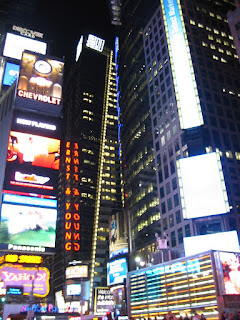
...barely the worse for wear, it seems, for all our New York exertions. We ended our day and our stay in New York, fittingly, amongst the elbowing crowds and the garish lights of Times Square, and took the subway south to our temporary digs.

And finally, Monday morning, breakfast, apartment cleaning, and a taxi ride out to JFK. A surprisingly easy passage through ticketing and security, an okay airport lunch, and a long flight back to Los Angeles--with an enormous neighbor who spilled over into a good half of my seat. Ah well. A good thing I have learned to live through these experiences with at least a small measure of equanimity.
Tuesday, November 13, 2007
Power Art vs. Powerful Art (cont.d)
To pick up where I left off yesterday. Big art is not necessarily powerful. Power spaces can diminish even the largest works. By the same token, big art is not necessarily empty. Nor is small art necessarily less powerful for being small.
This is all a bit convoluted, I admit, but at least I know what I mean. I hope you caught the gist of it too.
There were other things that caught my eye--and my imagination--as we made the gallery rounds. Take George Condo, at Nicholas Robinson Gallery:

Here's an artist who has deliberately eschewed the mainstream throughout his career, and whose work has been widely admired for its idiosyncracy and its refusal to be categorized. An odd mix of the surreal, the futuristic, the socially engaged and the satirical cartoon, Condo's work is confrontational in its unabashed grotesquerie, even as it allows itself to be wildly funny--a characteristic studiously avoided by all "serious" artists. It is at once fearless and derisive of "good art." I like it. A lot.
Which reminds me to say that you don't have to be in the vast spaces of a Mary Boone or a Gagosian to find the best and most interesting work. If you talk to him, you'll find that the Nicholas Robinson of the Nicholas Robinson Gallery is charming, perceptive, and informed. He clearly loves what he's doing, and is passionate about the art he represents. (He's also a fellow Brit. But does that prejudice me? Nah!) And if you leave the main gallery and venture down the back stairs, you'll find the work of several other artists he represents, including that of another I personally responded to, Steven Gregory. Gregory constructs things out of human bones--or artifacts in the shape of bones:

This big wheel is a powerful memento mori, very Buddhist, I thought, in its circular form and its demand that we look at death head on. No blinking.
I can't end my report on Saturday without at least a mention of our visit with an old friend, Judith Miller, an artist whom Ellie used to showcase, back in the early 1970s when the Ellie Blankfort Gallery was in full bloom, back in the early 1970s. Judith is living in New York these days, and fortuitously had a show at the Cheryl Pelavin Gallery down in Tribecca. Lovely paintings, featuring mostly what we tend not to look at, down below our feet, the potholes and puddles with all their glorious reflections. Those made from photographs taken in Times Square, after rain, are spectacularly rich in shimmering, quasi-liquid color:

What a delight to see Judith again, and to find her still engaged in her art.
It's no good. I can't write about everything we saw in the New York galleries. I have to stop somewhere, so let it be here, on an encouraging note. There are many galleries like Nicholas Robinson in Chelsea and Cheryl Pelavin in Tribecca, some of them seeded in amongst the powerhouses, and they provide ample evidence that the creative spirit is alive and well--even in New York, where, as we West-Coasters see it, the Establishment reigns supreme. We like to think that all the best, most creative stuff happens here. Well, much of it does. We can be grateful for the energy of our own art community. And even so, as we shall see when I finally get around to recounting our Sunday adventures, New York is, well... There's the Met, the Modern, the Whitney. And the Met... Incredible! More later!
This is all a bit convoluted, I admit, but at least I know what I mean. I hope you caught the gist of it too.
There were other things that caught my eye--and my imagination--as we made the gallery rounds. Take George Condo, at Nicholas Robinson Gallery:

Here's an artist who has deliberately eschewed the mainstream throughout his career, and whose work has been widely admired for its idiosyncracy and its refusal to be categorized. An odd mix of the surreal, the futuristic, the socially engaged and the satirical cartoon, Condo's work is confrontational in its unabashed grotesquerie, even as it allows itself to be wildly funny--a characteristic studiously avoided by all "serious" artists. It is at once fearless and derisive of "good art." I like it. A lot.
Which reminds me to say that you don't have to be in the vast spaces of a Mary Boone or a Gagosian to find the best and most interesting work. If you talk to him, you'll find that the Nicholas Robinson of the Nicholas Robinson Gallery is charming, perceptive, and informed. He clearly loves what he's doing, and is passionate about the art he represents. (He's also a fellow Brit. But does that prejudice me? Nah!) And if you leave the main gallery and venture down the back stairs, you'll find the work of several other artists he represents, including that of another I personally responded to, Steven Gregory. Gregory constructs things out of human bones--or artifacts in the shape of bones:

This big wheel is a powerful memento mori, very Buddhist, I thought, in its circular form and its demand that we look at death head on. No blinking.
I can't end my report on Saturday without at least a mention of our visit with an old friend, Judith Miller, an artist whom Ellie used to showcase, back in the early 1970s when the Ellie Blankfort Gallery was in full bloom, back in the early 1970s. Judith is living in New York these days, and fortuitously had a show at the Cheryl Pelavin Gallery down in Tribecca. Lovely paintings, featuring mostly what we tend not to look at, down below our feet, the potholes and puddles with all their glorious reflections. Those made from photographs taken in Times Square, after rain, are spectacularly rich in shimmering, quasi-liquid color:

What a delight to see Judith again, and to find her still engaged in her art.
It's no good. I can't write about everything we saw in the New York galleries. I have to stop somewhere, so let it be here, on an encouraging note. There are many galleries like Nicholas Robinson in Chelsea and Cheryl Pelavin in Tribecca, some of them seeded in amongst the powerhouses, and they provide ample evidence that the creative spirit is alive and well--even in New York, where, as we West-Coasters see it, the Establishment reigns supreme. We like to think that all the best, most creative stuff happens here. Well, much of it does. We can be grateful for the energy of our own art community. And even so, as we shall see when I finally get around to recounting our Sunday adventures, New York is, well... There's the Met, the Modern, the Whitney. And the Met... Incredible! More later!
Monday, November 12, 2007
Those Galleries...
Power Art vs. Powerful Art
First, warm thanks to those who sent anniversary greetings! It was a joy to hear from you: we carried your thoughts around with us all day. Here's our greetings card to you from Central Park.

A perfect day to celebrate!
Well, I did promise an account of out tour of the Chelsea galleries on Saturday. Almost all the major New York galleries have either moved to this area, or at least have spaces in the few blocks roughly between Ninth and Tenth Avenues and 19th Street to the south and 27th Street to the north--the epicenter (at least in the minds of the New York art world) of the contemporary art universe. We spent about five hours there, and tried to catch the highlights, starting at the south end with David Zwirner, where our main purpose was to get a preview of the Jason Rhoads installation due to open after our departure. Thanks in part to our daughter, Sarah, who worked in Jason's studio, we managed to persuade the gallery to allow us in while the work was still in progress.
Jason Rhoads, who died at the sadly young age of forty-one--I think of heart failure, but more broadly of an excessive appetite for the temptations life has to offer--was considered one of the rising stars of the global art world. The installations and performances that made him famous were certainly over-the-top, scatalogical, obscene, offensive, outrageous, out-of-control... The series of performances on which he was engaged at the time of his death--"Black Pussy"--attracted the creme de la creme of L.A.'s social and cultural elite to his studio, where he regaled them with an orgy of of every kind of excess. Not being of the creme de la creme, I did not make it to one of these performances, but heard first-hand descriptions from Saragm whose band (she's a drummer) actually participated in the general chaos.
The Zwirner exhibit is a piece-for-piece reconstruction of what had been the Rhoads studio in Los Angeles. I don't, regrettably, have a very good picture, but this will give you some idea of what it looked like.

Rhoads was a pack-rat, and his work was in part about the sheer plethora of STUFF the surrounds us in our lives--mostly the cheap, disposable stuff that seems to characterize who we are as a culture. His studio was, as you see, a chaos of the stuff that he collected, often in large quantities, to be included, eventually, in his work. During his life, his galleries would sell whole display shelves of stuff--for increasingly larger sums of money. Now it's the whole studio, as here exhibited, that is for sale as a single art piece, hopefully to some museum that would set it up as a permanent exhibit.
Make what you will of this. There is bound to be a great deal of revulsion. There is a part of me that shares in that response. But there's also the part of me that sees this work, in all its dis-order and purposeful disorientation, as an uncomfortably true reflection of the society we have created and its dreadfully degraded values. Rhoads delighted in shoving our noses in the often less-than-pleasant aspects of who we are.
That's a long prelude to what I had planned to write about the Chelsea galleries, where power art is often indistinguishable from powerful art, and where the whiff of big money is evident in huge spaces that seem to invite ambitious excess on the part of big-name artists whose work commands astronomical prices. Take Cy Twombley, for example, or Georg Baselitz (he of the upside-down, expressionistic figures,) each at a separate Gagosian space. Our friend, Keith, an artist of somewhat cynical bent, remarked of the vast Twombley canvases that the gallery space "sucked the air out of them." An astute comment. People were wandering around the cavernous space looking at the highly polished cement floor--presumably for some kind of anchor. Or take the immense Pat Steir abstractions at Cheim & Read. Or Ross Bleckner at Mary Boone:

The word "imposing" seems inadequate. The poor viewer doesn't stand a chance against these things: they overpower. And the spaces in which they are displayed seem calculated to intimidate. They are the cathedrals of the modern era, designed with the intention of bringing the faithful in line with the dogma of the high priests and their acolytes.
This is what I mean by "power art." There's plenty of it on view, and the strategy has the unfortunate effect of having artists work for exhibition in such spaces: their work expands beyond all reasonable boundaries--of intention as well as of scale. They cater, I would guess, to the egos of those wealthy enough to invest in them and, in today's "market," investment is an apt term to describe the activity of many of the buyers. The rest of us are required, perhaps, to stand in awe...
But there is also powerful art, and it's sometimes hard to make the disctinction. Powerful, for example, is the work of Do Ho Suh, a Korean artist at Lehmann Maupin, whose huge yellow and orange tornado at the center of the gallery...

...turns out to be constructed of thousands of small, cast-resin human figures, a vast engine of energy spiralling out from that one, single, tiny figure at the base. The power of humanity, we understand, has its source in a single human being, and each one of us stands inseparably on the shoulders of others. The one is many, the many one. Another work, an elegant, curving spine created, aslo, out of squatting figures acting as separate vertebrae, forms a tiny monument to the backbone of humanity. I found this work to be powerful.
As, too, the video work of Isaac Julien at Metro Pictures, installed on several giant screens, the beautifully filmed, episodic "story" of African immigrants and the dangers they face in making the trek to Europe and the jobs it offers. There is, in fact, no coherent, sequential story, only a flow of compelling images that evoke the spirit of human beings involved in a kind of tragic necessity, caught in an historical moment between empire and undertain future, between the old symbols and institutions of power and their own vulnerable humanity. "Western Union: Small Boats" engages us in the desires and perils of all those in the world today who are trapped in the same place between an ancient heritage and the often coldly indifferent flux of a contemporary world whose values have to do with commerce and success.
Big pieces, both of these, but powerful and engaging beyond the level of pure asthetics. They are powerful in that they appeal to our humanity rather than our pocket-books, to our heart as well as to our intellect.
But enough for today. I have more to say, but it will need to wait until tomorrow. And then there's Sunday... It's going to take me weeks to catch up with this brief stay in New York. Be patient, please!
First, warm thanks to those who sent anniversary greetings! It was a joy to hear from you: we carried your thoughts around with us all day. Here's our greetings card to you from Central Park.

A perfect day to celebrate!
Well, I did promise an account of out tour of the Chelsea galleries on Saturday. Almost all the major New York galleries have either moved to this area, or at least have spaces in the few blocks roughly between Ninth and Tenth Avenues and 19th Street to the south and 27th Street to the north--the epicenter (at least in the minds of the New York art world) of the contemporary art universe. We spent about five hours there, and tried to catch the highlights, starting at the south end with David Zwirner, where our main purpose was to get a preview of the Jason Rhoads installation due to open after our departure. Thanks in part to our daughter, Sarah, who worked in Jason's studio, we managed to persuade the gallery to allow us in while the work was still in progress.
Jason Rhoads, who died at the sadly young age of forty-one--I think of heart failure, but more broadly of an excessive appetite for the temptations life has to offer--was considered one of the rising stars of the global art world. The installations and performances that made him famous were certainly over-the-top, scatalogical, obscene, offensive, outrageous, out-of-control... The series of performances on which he was engaged at the time of his death--"Black Pussy"--attracted the creme de la creme of L.A.'s social and cultural elite to his studio, where he regaled them with an orgy of of every kind of excess. Not being of the creme de la creme, I did not make it to one of these performances, but heard first-hand descriptions from Saragm whose band (she's a drummer) actually participated in the general chaos.
The Zwirner exhibit is a piece-for-piece reconstruction of what had been the Rhoads studio in Los Angeles. I don't, regrettably, have a very good picture, but this will give you some idea of what it looked like.

Rhoads was a pack-rat, and his work was in part about the sheer plethora of STUFF the surrounds us in our lives--mostly the cheap, disposable stuff that seems to characterize who we are as a culture. His studio was, as you see, a chaos of the stuff that he collected, often in large quantities, to be included, eventually, in his work. During his life, his galleries would sell whole display shelves of stuff--for increasingly larger sums of money. Now it's the whole studio, as here exhibited, that is for sale as a single art piece, hopefully to some museum that would set it up as a permanent exhibit.
Make what you will of this. There is bound to be a great deal of revulsion. There is a part of me that shares in that response. But there's also the part of me that sees this work, in all its dis-order and purposeful disorientation, as an uncomfortably true reflection of the society we have created and its dreadfully degraded values. Rhoads delighted in shoving our noses in the often less-than-pleasant aspects of who we are.
That's a long prelude to what I had planned to write about the Chelsea galleries, where power art is often indistinguishable from powerful art, and where the whiff of big money is evident in huge spaces that seem to invite ambitious excess on the part of big-name artists whose work commands astronomical prices. Take Cy Twombley, for example, or Georg Baselitz (he of the upside-down, expressionistic figures,) each at a separate Gagosian space. Our friend, Keith, an artist of somewhat cynical bent, remarked of the vast Twombley canvases that the gallery space "sucked the air out of them." An astute comment. People were wandering around the cavernous space looking at the highly polished cement floor--presumably for some kind of anchor. Or take the immense Pat Steir abstractions at Cheim & Read. Or Ross Bleckner at Mary Boone:

The word "imposing" seems inadequate. The poor viewer doesn't stand a chance against these things: they overpower. And the spaces in which they are displayed seem calculated to intimidate. They are the cathedrals of the modern era, designed with the intention of bringing the faithful in line with the dogma of the high priests and their acolytes.
This is what I mean by "power art." There's plenty of it on view, and the strategy has the unfortunate effect of having artists work for exhibition in such spaces: their work expands beyond all reasonable boundaries--of intention as well as of scale. They cater, I would guess, to the egos of those wealthy enough to invest in them and, in today's "market," investment is an apt term to describe the activity of many of the buyers. The rest of us are required, perhaps, to stand in awe...
But there is also powerful art, and it's sometimes hard to make the disctinction. Powerful, for example, is the work of Do Ho Suh, a Korean artist at Lehmann Maupin, whose huge yellow and orange tornado at the center of the gallery...

...turns out to be constructed of thousands of small, cast-resin human figures, a vast engine of energy spiralling out from that one, single, tiny figure at the base. The power of humanity, we understand, has its source in a single human being, and each one of us stands inseparably on the shoulders of others. The one is many, the many one. Another work, an elegant, curving spine created, aslo, out of squatting figures acting as separate vertebrae, forms a tiny monument to the backbone of humanity. I found this work to be powerful.
As, too, the video work of Isaac Julien at Metro Pictures, installed on several giant screens, the beautifully filmed, episodic "story" of African immigrants and the dangers they face in making the trek to Europe and the jobs it offers. There is, in fact, no coherent, sequential story, only a flow of compelling images that evoke the spirit of human beings involved in a kind of tragic necessity, caught in an historical moment between empire and undertain future, between the old symbols and institutions of power and their own vulnerable humanity. "Western Union: Small Boats" engages us in the desires and perils of all those in the world today who are trapped in the same place between an ancient heritage and the often coldly indifferent flux of a contemporary world whose values have to do with commerce and success.
Big pieces, both of these, but powerful and engaging beyond the level of pure asthetics. They are powerful in that they appeal to our humanity rather than our pocket-books, to our heart as well as to our intellect.
But enough for today. I have more to say, but it will need to wait until tomorrow. And then there's Sunday... It's going to take me weeks to catch up with this brief stay in New York. Be patient, please!
Sunday, November 11, 2007
Eleven Eleven
 So here it is, 11/11. Our anniversary. A truly beautiful day in New York City, crisp, clear, sunny. It’s good to be here. And good to have spent these years together. We are grateful for all the good things life has brought our way…
Sorry, the order of things gets a bit confusing here: I'm trying to play catchup. I did not manage to get finished yesterday, looking back over our first day in New York, Friday—a day of the kind your could only dream of spending in this city. We got as far as dinner at Michael’s. So here’s the sequel:
Friday: The Fifth Act, Theater
After dinner, we walked down—actually, we kind of rushed down: time was short—to 45th Street and west across 8th Avenue to find the theater where we had booked seats for Tom Stoppard’s new play, “Rock and Roll.” Set in intellectual Cambridge University (the backdrop is a huge photograph of King’s College chapel,) and in Soviet-dominated Prague, it’s a wry look at the decline of socialism and the accompanying rise of the music that has come to define the culture of our time.

The central character is an old Cambridge lefty—well, a Communist, really—who remains an unrepentant believer even after the repression of Czech dissent by Soviet tanks in the late 1950s. At a time when even the most diehard communist idealists outside the USSR gave up on the failing system, those who remained defiant in spite of every evidence to the contrary were derisively known as “tankies,” and this cantankerous professor was one of them. Rock and Roll—represented throughout the play by bursts of familiar socially-engaged artists like Pink Floyd and John Lennon, along with the underground Czech “Plastic People of the Universe”—proves more durable, and infinitely more humane, as a promoter of the notion of social justice for all. Though hardly more successful. The play was so talk-heavy and heady in the first half that Ellie and I were close to pleading fatigue and leaving at intermission. We were glad we didn’t. The second half was great theater—rich in content, emotional, fully human, combining the tragedy of aging and disillusionment with the joy of discovering a deeper level of humanity.
We arrived back at our little apartment close to midnight. But only, we consoled ourselves, nine o’clock Los Angeles time.
Saturday: Power Art vs. Powerful Art
As "everybody knows," the New York contemporary art scene moved a good long while ago from SoHo to the Chelsea area, just around the corner from our little pied-a-terre. We spent the better part of Saturday "doing the galleries" there. Once again, we were amazed by the crowds, jamming whole blocks of streets and every gallery we visited. I'll devote tomorrow's entry to an overview. I have pictures to show you. For now, I realize that I'm a day behind, but it IS my anniversary and I don't want to spend the entire morning on the keyboard. Enough.
Saturday, November 10, 2007
From New York
While Cardozo was busy raising the issue of tattoos yesterday from the West Coast, Ellie and I spent the day in New York City. The energy here is famously incredible. You feel it the moment you arrive--and it simply never stops. Even at night, you feel the beat of it, the constant flow. And the depth of cultural strata! We felt it first with a simple walk to the local market to buy breakfast makings: at the cheese counter, there must have been at least three hundred different varieties. You'd put on ten pounds just looking at them--if you didn't know you'd be spending the rest of the day on your feet, elbowing your way through the endless crowds of people.
Breakfast at home, then, in the perfectly comfortable little apartment we discovered (thanks, Bobbie) down in Chelsea, saving ourselves a good $1500 in hotel bills over the long weekend. Then an easy subway ride up to Columbus Circle and a stroll from there back down to 57th Street and the midtown galleries--passing Carnegie Hall and thinking, really, what a thrill to be back in this hub of every cultural activity.
Of the midtown galleries, if you're headed toward NYC or live here, I'd say don't miss the show at Marion Goodman--a group show celebrating her 30th anniversary with some of the outstanding artists she has shown over the years, artists of the caliber of Marcel Broodthaers and Kiki Smith, Richard Artschwager and Juan Munoz. A stunning show, from which I'll mention only the marvelous installation by the South African artist William Kentridge (follow the "Artists" tab on the bottom of the page), "Preparing the Flute," which I took to be the maquette for a stage production of Mozart's "Die Zaubertfloete." Working with the music from this (literally!) enchanting opera, Kentridge built the model of a stage and played his images against a screen at the rear--a wonderful moving collage of black and white drawings, flashing lines and bursting fireworks, the artist's trademark birds with opening wings, and the artist hmself, his hand creating this unending series of eye-seizing images, magical and dark at once, as is the opera.
Stopping at a couple of the upscale galleries in this area, and pausing for a light lunch at a French restaurant on Madison Avenue, we made our way up to the Whitney, where there was a small show of very large paintings by the Los Angeles-based artist Mark Bradford in the project room (follow this link to see Bradford discussing his work on YouTube):

--and an absolute knock-out of an exhibition upstairs, a huge, comprehensive retrospective of the work of the African-American artist Kara Walker.

Walker takes on issues of racism and sexism in America with uncompromising, directly confrontational candor, using her extraordinary drawing skills and her familiar cut-out, silhouette images to demand that we take a hard look not only at the history of the "peculiar institution" of slavery but also its unhealed wound in the contemporary world. Images of oppression are countered with exuberant, finger-in-your-eye acts of personal liberation as texts and filmed puppetry, drawings and objects clash together in Walker's angry, outraged, defiant, and wildly human imagination. Very happy not to have missed the opportunity to see the full range of this artist, whose work has engaged me for quite a number of years.
A respite from art as we walked down Fifth Avenue, in light rain, from 77th Street to 53rd, rather than take a taxi to the Museum of Modern Art. Once we got there, we were astounded to find a line that stretched--well, it must have been at least a half mile, snaking through endless rows of barriers in an adjacent parking lot as though for an E-ride at Disneyland. It was, we discovered, Free Friday, and it seemed that half of New York had turned out for the occasion. The line moved fast, though, and we were soon inside the museum, concealing our carry-bag under our coats in order to avoid the lines at the cloakroom counters. Wonderful, really, to see people turn out in such crowds for art...
The Seurat drawing show... amazing!

I'm running out of superlatives, and I know that the exclamation marks are beginning to pile up. Forgive me. There were hundreds of drawings in this show, all of them made in a few short years (Seurat died at the age of 31,) and many of them studies for the great paintings, like the Grande Jatte, that earned him posthumous fame. Imagine, though, drawings without lines--or lines used not to define the images so much as to texture the ground on which they are created. Made in Conte crayon on a highly-textured, hand-made paper, these drawings are masterworks of evocation. No faces, please. The figures and landscapes seem to emerge from some dark inner necessity of the artist's, some inner compulsion to find their essence rather than their individuality, and to find it through the physical action of rehearsing it in drawing. The sheer numbers of what I thought of as Seurat's "essays" brought to mind my own fascination with the idea of practice, the idea that if you keep at it long enough and with enough attention you will eventually get it right. My sitting practice, over the past ten years, has brought me to a deeper understanding of the physical practice of paying attention that informs the best of art--as well as the best of writing. (Oh, Carnegie Hall again: "Practice, practice, practice...")
There was more at MoMA, the magnificent Martin Puryear show. (I find it somehow heartening to find so much New York museum space, once almost the exclusive province of white guys--and I mean guys!--now occupied by African-American artists: Walker, Bradford, and now Puryear.)

Puryear's strange, monumental objects seem constantly to evoke figural referents, but never quite become anything other than themselves. Constructed for the most part, in beautifully crafted wood, they use simple, even primitive forms to speak to the archetypal memory. I find that these objects of extraordinary elegance and serenity have the effect of elevating the spirit: the viewer feels somehow ennobled by their presence and proximity, embued with a kind of inner joy. It's an odd effect, but a very pleasant one. You just keep wanting to smile, and be with them. Little children, I noticed, seem driven to interact with them--contrary to the ubiquitously posted museum rules--as though they were some unusually exotic playground structures.
A great art day, then. Early evening, we found our way around the block from MoMA to the penthouse apartment of our friends Michael and Kim McCarty--she a wonderful artist whose work we had seen earlier at a group show in a gallery off Madison, he the proprietor of the celebrated Michael's restaurants in Santa Monica and New York. We admired their Fred Fisher designed remodel and were regaled with a fine champagne and tasty smoked salmon canapes before being escorted down for dinner in the restaurant that attracts the elite of the literary and media worlds, where we delighted in the distinctive Michael's cuisine.

A spectacular treat. (Thanks Kim, thanks Michael!)
Well, listen, I'm out of time and I risk boring everyone with the sheer length of this entry, so I'll pause now, even though I have not yet reached the end of this super-rich day. More tomorrow! And pictures! Come back and visit this one again!
Breakfast at home, then, in the perfectly comfortable little apartment we discovered (thanks, Bobbie) down in Chelsea, saving ourselves a good $1500 in hotel bills over the long weekend. Then an easy subway ride up to Columbus Circle and a stroll from there back down to 57th Street and the midtown galleries--passing Carnegie Hall and thinking, really, what a thrill to be back in this hub of every cultural activity.
Of the midtown galleries, if you're headed toward NYC or live here, I'd say don't miss the show at Marion Goodman--a group show celebrating her 30th anniversary with some of the outstanding artists she has shown over the years, artists of the caliber of Marcel Broodthaers and Kiki Smith, Richard Artschwager and Juan Munoz. A stunning show, from which I'll mention only the marvelous installation by the South African artist William Kentridge (follow the "Artists" tab on the bottom of the page), "Preparing the Flute," which I took to be the maquette for a stage production of Mozart's "Die Zaubertfloete." Working with the music from this (literally!) enchanting opera, Kentridge built the model of a stage and played his images against a screen at the rear--a wonderful moving collage of black and white drawings, flashing lines and bursting fireworks, the artist's trademark birds with opening wings, and the artist hmself, his hand creating this unending series of eye-seizing images, magical and dark at once, as is the opera.
Stopping at a couple of the upscale galleries in this area, and pausing for a light lunch at a French restaurant on Madison Avenue, we made our way up to the Whitney, where there was a small show of very large paintings by the Los Angeles-based artist Mark Bradford in the project room (follow this link to see Bradford discussing his work on YouTube):

--and an absolute knock-out of an exhibition upstairs, a huge, comprehensive retrospective of the work of the African-American artist Kara Walker.

Walker takes on issues of racism and sexism in America with uncompromising, directly confrontational candor, using her extraordinary drawing skills and her familiar cut-out, silhouette images to demand that we take a hard look not only at the history of the "peculiar institution" of slavery but also its unhealed wound in the contemporary world. Images of oppression are countered with exuberant, finger-in-your-eye acts of personal liberation as texts and filmed puppetry, drawings and objects clash together in Walker's angry, outraged, defiant, and wildly human imagination. Very happy not to have missed the opportunity to see the full range of this artist, whose work has engaged me for quite a number of years.
A respite from art as we walked down Fifth Avenue, in light rain, from 77th Street to 53rd, rather than take a taxi to the Museum of Modern Art. Once we got there, we were astounded to find a line that stretched--well, it must have been at least a half mile, snaking through endless rows of barriers in an adjacent parking lot as though for an E-ride at Disneyland. It was, we discovered, Free Friday, and it seemed that half of New York had turned out for the occasion. The line moved fast, though, and we were soon inside the museum, concealing our carry-bag under our coats in order to avoid the lines at the cloakroom counters. Wonderful, really, to see people turn out in such crowds for art...
The Seurat drawing show... amazing!
I'm running out of superlatives, and I know that the exclamation marks are beginning to pile up. Forgive me. There were hundreds of drawings in this show, all of them made in a few short years (Seurat died at the age of 31,) and many of them studies for the great paintings, like the Grande Jatte, that earned him posthumous fame. Imagine, though, drawings without lines--or lines used not to define the images so much as to texture the ground on which they are created. Made in Conte crayon on a highly-textured, hand-made paper, these drawings are masterworks of evocation. No faces, please. The figures and landscapes seem to emerge from some dark inner necessity of the artist's, some inner compulsion to find their essence rather than their individuality, and to find it through the physical action of rehearsing it in drawing. The sheer numbers of what I thought of as Seurat's "essays" brought to mind my own fascination with the idea of practice, the idea that if you keep at it long enough and with enough attention you will eventually get it right. My sitting practice, over the past ten years, has brought me to a deeper understanding of the physical practice of paying attention that informs the best of art--as well as the best of writing. (Oh, Carnegie Hall again: "Practice, practice, practice...")
There was more at MoMA, the magnificent Martin Puryear show. (I find it somehow heartening to find so much New York museum space, once almost the exclusive province of white guys--and I mean guys!--now occupied by African-American artists: Walker, Bradford, and now Puryear.)

Puryear's strange, monumental objects seem constantly to evoke figural referents, but never quite become anything other than themselves. Constructed for the most part, in beautifully crafted wood, they use simple, even primitive forms to speak to the archetypal memory. I find that these objects of extraordinary elegance and serenity have the effect of elevating the spirit: the viewer feels somehow ennobled by their presence and proximity, embued with a kind of inner joy. It's an odd effect, but a very pleasant one. You just keep wanting to smile, and be with them. Little children, I noticed, seem driven to interact with them--contrary to the ubiquitously posted museum rules--as though they were some unusually exotic playground structures.
A great art day, then. Early evening, we found our way around the block from MoMA to the penthouse apartment of our friends Michael and Kim McCarty--she a wonderful artist whose work we had seen earlier at a group show in a gallery off Madison, he the proprietor of the celebrated Michael's restaurants in Santa Monica and New York. We admired their Fred Fisher designed remodel and were regaled with a fine champagne and tasty smoked salmon canapes before being escorted down for dinner in the restaurant that attracts the elite of the literary and media worlds, where we delighted in the distinctive Michael's cuisine.

A spectacular treat. (Thanks Kim, thanks Michael!)
Well, listen, I'm out of time and I risk boring everyone with the sheer length of this entry, so I'll pause now, even though I have not yet reached the end of this super-rich day. More tomorrow! And pictures! Come back and visit this one again!
Friday, November 9, 2007
The Tattooed Buddhist: A Buddha Tattoo Anyone?

Are Buddhism and tattoos compatible? Well, that all depends on who you ask. For some, using the body as a canvas is an appropriate way of demonstrating one's commitment to Buddhist practice. For others, tattoos are contrary to the fundamental Buddhist precept of non-attachment.
We at The Buddha Diaries - always interested in matters pertaining to both art and Buddhism - find this debate rather fascinating. Being incorrigible art snobs, however, we are even more interested in the question of whether or not Buddhist tattoos have any artistic merit.
Here's a sampling of what our exploration of the internet turned up:
Sak Yant Tattoos

Yoso Tattoo Studio

Kat's Window
Buddhist Symbols

Asian Wave Tattoo

The Buddhist Blog
Angelina Jolie!

People Magazine
Any thoughts, out there?
Thursday, November 8, 2007
Fear of Flying
Did I mention--I'm getting so forgetful these days!--that we're leaving for New York this morning? I hadn't forgotten that we were leaving, just whether or not I'd mentioned it. 11/11 is our anniversary. That's right, we got married on Armistice Day, the eleventh hour of the eleventh day of the eleventh month, just when the treaty was signed to end the First World War. Which led, I regret to remind you, directly to the Second.
We have been more fortunate. We are still together after thirty-five years--of married life: there were three more before that, "living in sin," as the quaint old phrase had it. Ellie was eight months pregnant on our wedding day, and I had to virtually push her up the steps to the Los Angeles County Courthouse, where a judge did the deed. We decided to celebrate the occasion with a long weekend in New York, where we are long overdue to catch up with the museums and the art scene. We're also booked for a couple of Broadway shows, so it should be fun.
This morning, though, during meditation, I noticed how much anxiety I'm harboring, below the surface, about the travel part. My mind was the fecund source of a dozen desperate scenarios, and the emotions were roiling. A part of it is that I'm a bit sedentary by nature: I just feel comfortable at home, surrounded by all my STUFF--including, of course, my trusty computer--and knowing where I am. The other part is fear of flying. The airport hassle is one thing--the lines, the inspections, the unhelpful officials... And then there are those other dreads, irrational but no less real for that: the terrorists, the plane falling out of the sky... And most recently, the knowledge of what jet aircraft do to the environment, every mile they fly.
Irrational, yes. But real. I watched my mind play all its tricks this morning, and managed to remain relatively calm as I watched. Or at least, as the minutes passed, to use that wonderful power of meditation to bring it back to its senses.
I may be writing from New York. Or not. Depending on access, time, and so on. Be well, friends. And make it a good day.
We have been more fortunate. We are still together after thirty-five years--of married life: there were three more before that, "living in sin," as the quaint old phrase had it. Ellie was eight months pregnant on our wedding day, and I had to virtually push her up the steps to the Los Angeles County Courthouse, where a judge did the deed. We decided to celebrate the occasion with a long weekend in New York, where we are long overdue to catch up with the museums and the art scene. We're also booked for a couple of Broadway shows, so it should be fun.
This morning, though, during meditation, I noticed how much anxiety I'm harboring, below the surface, about the travel part. My mind was the fecund source of a dozen desperate scenarios, and the emotions were roiling. A part of it is that I'm a bit sedentary by nature: I just feel comfortable at home, surrounded by all my STUFF--including, of course, my trusty computer--and knowing where I am. The other part is fear of flying. The airport hassle is one thing--the lines, the inspections, the unhelpful officials... And then there are those other dreads, irrational but no less real for that: the terrorists, the plane falling out of the sky... And most recently, the knowledge of what jet aircraft do to the environment, every mile they fly.
Irrational, yes. But real. I watched my mind play all its tricks this morning, and managed to remain relatively calm as I watched. Or at least, as the minutes passed, to use that wonderful power of meditation to bring it back to its senses.
I may be writing from New York. Or not. Depending on access, time, and so on. Be well, friends. And make it a good day.
Wednesday, November 7, 2007
Torture
There's no other word for it, is there? The Mukasey appointment, approved yesterday despite the man's refusal to acknowledge the simple truth and with the connivance of a pair of Democrats I had previously admired, is but one more instance of our craven capitulation to the venal abuse of power on the part of Bush and his administration.
How did we get to this point, in America, where we allow ourselves to be led around by the nose by a man who apparently lacks the honesty to acknowledge what is plain to the world? "The United States does not torture," he repeats like some crazed mantra, as though by their repetition the words might somehow be believed. A man of this kind would surely in previous generations have been hounded out of office. Instead, our elected officials seem mesmerized into letting him have his way at every turn, and we are condemned to stand by and watch this cynical dishonoring of the most basic of human standards, the most basic of principles on which this country was founded. We have surrendered ourselves into the hands of men without conscience or consciousness, men who lie and abuse the power with which they were entrusted, men who ignore our will and spit in our eye with impunity.
How did this happen? How does it continue to happen that this man and his crew of bullies and liars work their will in a world that increasingly despises them? I am disgusted. I am disgusted with myself, who continue to sit here and blog, as though that were some significant action in the face of a government--my government--that ignores the plight of the poor, the sick, and the needy not only in our own country but around the world, and instead makes needless war and squanders the country's wealth on those very "weapons of mass destruction" it deplores in the hands of others. How does it happen that the voices of reason and conscience are belittled and ignored?
Enough for now. This morning, I woke with more than my usual share of outrage. What's a Buddhist to do, in such a dire circumstance? Breathe? Await the forces of karma to set things aright? Smile the smile of the Buddha?
You see what I mean?
How did we get to this point, in America, where we allow ourselves to be led around by the nose by a man who apparently lacks the honesty to acknowledge what is plain to the world? "The United States does not torture," he repeats like some crazed mantra, as though by their repetition the words might somehow be believed. A man of this kind would surely in previous generations have been hounded out of office. Instead, our elected officials seem mesmerized into letting him have his way at every turn, and we are condemned to stand by and watch this cynical dishonoring of the most basic of human standards, the most basic of principles on which this country was founded. We have surrendered ourselves into the hands of men without conscience or consciousness, men who lie and abuse the power with which they were entrusted, men who ignore our will and spit in our eye with impunity.
How did this happen? How does it continue to happen that this man and his crew of bullies and liars work their will in a world that increasingly despises them? I am disgusted. I am disgusted with myself, who continue to sit here and blog, as though that were some significant action in the face of a government--my government--that ignores the plight of the poor, the sick, and the needy not only in our own country but around the world, and instead makes needless war and squanders the country's wealth on those very "weapons of mass destruction" it deplores in the hands of others. How does it happen that the voices of reason and conscience are belittled and ignored?
Enough for now. This morning, I woke with more than my usual share of outrage. What's a Buddhist to do, in such a dire circumstance? Breathe? Await the forces of karma to set things aright? Smile the smile of the Buddha?
You see what I mean?
Tuesday, November 6, 2007
George's Monday
Well, I'm sure that everyone is anxious to hear about George's day at the vet--my having mentioned, yesterday, that he was going in for some minor surgery and a tooth-cleaning. Here's the skinny.
I left him off at the vet's in the early morning, to be sure he'd be first in line. George was puzzled, to say the least, to have gone without his breakfast. He is, as they say, a creature of habit, and is displeased when his habits get interrupted--particularly, I have to say, when those habits have anything to do with food. George is a dog who takes his eating seriously. It was clear to him even as I put him in the car that this was not to be a day like any other day.
He was not especially relieved, I have to add, when he realized where he was when we arrived at the vet's office, but he managed to maintain his dignity (his dognity?) as I led him in and left him with the receptionist. Truth to tell, I was probably a lot more upset than George was, and simply projecting my anxieties onto him. He gave me one last reproachful look as they led him away and I tried to reassure him with familiar words: "Back soon." "Back soon," in fact, can mean anything from an hour at the gym to a couple of weeks in Europe, but I'm assured that dogs have no sense of time, so I trust that I'm forgiven for this small effort to reassure myself, as much as George, that everything will be okay.
We stopped by to pick him up around noon, as we were leaving the beach to return to Los Angeles. The receptionist offered me a bag whose contents were small and bloody. Two of George's teeth, which the vet had had to remove--in case I wanted to put them under his pillow, I suppose, for the tooth fairy. I declined. It appeared, however, from our conversation with Dr. G, that all had gone well. The tooth-cleaning proved to be a challenge: George has the habit of chewing at himself, and his teeth get jammed with little hairs. There was some infection, the doctor had ascertained from blood tests, but the problem was not uncommon for the breed. George, he told us, has a "typical Cavalier's mouth."
There was also that small growth on his hind leg which the doctor had successfully removed, and George now sports a bright orange bandage around the affected area. It can come off, the doctor says, in a couple of days. Otherwise, aside from the jaw-dropping, bank-breaking cost to us, we all came off relatively unscathed. George's body was still coping with a dose of morphine, administered to spare him pain, and he remained a little dopey for the rest of the day. A little distrustful, too, of people who had abandoned him to the tender mercies of that doctor. And a little careful with that leg. He has been jumping up with a little less enthusiasm than is his wont.
His appetite, however, seems to be unaffected. Here he is this morning, bandaged, but still regal. And ready for his breakfast.

I left him off at the vet's in the early morning, to be sure he'd be first in line. George was puzzled, to say the least, to have gone without his breakfast. He is, as they say, a creature of habit, and is displeased when his habits get interrupted--particularly, I have to say, when those habits have anything to do with food. George is a dog who takes his eating seriously. It was clear to him even as I put him in the car that this was not to be a day like any other day.
He was not especially relieved, I have to add, when he realized where he was when we arrived at the vet's office, but he managed to maintain his dignity (his dognity?) as I led him in and left him with the receptionist. Truth to tell, I was probably a lot more upset than George was, and simply projecting my anxieties onto him. He gave me one last reproachful look as they led him away and I tried to reassure him with familiar words: "Back soon." "Back soon," in fact, can mean anything from an hour at the gym to a couple of weeks in Europe, but I'm assured that dogs have no sense of time, so I trust that I'm forgiven for this small effort to reassure myself, as much as George, that everything will be okay.
We stopped by to pick him up around noon, as we were leaving the beach to return to Los Angeles. The receptionist offered me a bag whose contents were small and bloody. Two of George's teeth, which the vet had had to remove--in case I wanted to put them under his pillow, I suppose, for the tooth fairy. I declined. It appeared, however, from our conversation with Dr. G, that all had gone well. The tooth-cleaning proved to be a challenge: George has the habit of chewing at himself, and his teeth get jammed with little hairs. There was some infection, the doctor had ascertained from blood tests, but the problem was not uncommon for the breed. George, he told us, has a "typical Cavalier's mouth."
There was also that small growth on his hind leg which the doctor had successfully removed, and George now sports a bright orange bandage around the affected area. It can come off, the doctor says, in a couple of days. Otherwise, aside from the jaw-dropping, bank-breaking cost to us, we all came off relatively unscathed. George's body was still coping with a dose of morphine, administered to spare him pain, and he remained a little dopey for the rest of the day. A little distrustful, too, of people who had abandoned him to the tender mercies of that doctor. And a little careful with that leg. He has been jumping up with a little less enthusiasm than is his wont.
His appetite, however, seems to be unaffected. Here he is this morning, bandaged, but still regal. And ready for his breakfast.

Monday, November 5, 2007
A Buddhist Sunday
What a lovely surprise! The old Art Deco nursery clock from the rectory in Aspley Guise, where I spent my earliest days on earth, suddenly awoke after years of refusing stubbornly to work and started ticking away yesterday afternoon on the mantleshelf of our little Laguna Beach cottage, thousands of miles from its original home. Perhaps it was the fire we lit beneath it on the first cool afternoon of the fall--though we have lit fires under it many times before. Perhaps it was the good vibes we brought back with us from our visit to the Metta Forest monastery, whose monks had found refuge from the fires here at the cottage the week before... No matter, it started ticking away madly without its pendulum, which we soon unearthed and replaced, and it has been keeping good time ever since. The sound of its strike, on the half hour and the hour, takes me right back to the nursery. This morning, it timed my meditation sit for me very nicely.
That visit to Metta, then. (Note: I'll be posting photographs of the event later, when I get back to my office. Forgot to bring the connecting cord with me to hook the digital camera up to the laptop.) We made the trip down to the monastery yesterday morning, Sunday, for the annual "Kathina" ceremony--the day on which, traditionally, the lay community gathers at the end of the rainy season (in Thailand, that season ends October/November) to mark the occasion with the gift of material to the monks to make new robes. More broadly--and here in Southern California, where the rains don't usually start before January--it has become a festival to honor the spirit of generosity.
Hundreds of people swarmed to the Metta Forest monastery in Valley Center, where our teacher Thanissaro Bhikkhu serves as the abbot of his band of Thai Forest monks. Ellie and I, along with several members of our sangha, made the long trip down I-5 to Oceanside, then inland through the myriad new suburban communities and into the increasingly remote and lovely hills, and finally through the rich valleys of fruit orchards and up the hillside to where the monastery sits in serene isolation from the world below. From the dusty parking lot, we made the steep climb up through avocado orchards and past the simple huts where the monks live to the splendid little Buddhist temple at the top.

This paradise was already crowded with visitors--mostly Thai. Such friendly, generous people! (Thailandchani--wish you could have been there: you'd have felt right at home!) They brought not only the traditional gift of material for robes, laid out at the temple doors, but other supplies, everything the monks might need from boxes of flashlight batteries to enormous packages of paper towels and toilet paper.

And money. It seemed a little odd to one brought up in the tradition of the discreet passing of a collection box in church to see the money trees in front of the temple, where the faithful came, often with their children, to attach their gifts of cash and stop for a moment of meditation with hands pressed together in respect. The trees were soon blossoming with dozens of fluttering greenbacks, dollar bills, fives, tens, twenties...
Down the road a ways, when we arrived, the monks were already making their alms walk past a long line of food stalls set up by visitors as yet another expression of generosity.


There was Thai food, of course--but also Indian, Korean, Chinese... Our own sangha had brought fruit, all neatly cut and speared on kebob sticks. Than Geoff spotted me in the crowd on the way back up to the temple, where the monks ate, and told me with a big smile how much they had enjoyed our house last week.
After the monks had enjoyed their meal--they are allowed a single meal only, in the morning--there was a half-hour of chanting, with the visitors seated under awnings outside the temple whilst Than Geoff led via PA system from within. Most of the chants were unfamilar, but we were able to join in with the "Sublime Attitudes," familiar from Than Geoff's monthly visits to the Laguna Beach sangha, and it was a delight to sit amongst a crowd of the Thai Buddhist faithful from the communities of Southern California and sense the powerful energy of that wider expatriate community.
Following the chanting, Ellie and I had the opportunity to spend a few minutes with Than Geoff, who told us the story of the fire and their evacuation from the monastery.

Here's Ellie with Than Geoff and behind them, the mountain that burned... Then it was time for us lay people to enjoy the enormous variety of delicious foods at the stalls down the hill from the temple. The lane was crammed with people, but no one seemed deprived: there was more than enough to feed the proverbial army--some of it too hot for Ellie, who likes the spice but not so much the heat. We ate standing, walking--and far too much. I ended up my meal with an Indian pancake smothered with sweetened condensed milk from cans, something I don't remember eating since World War II! All in all, a toothsome indulgence.

Hummers, dozens and dozens of them, outside the temple. A treat to watch them feed. My little digital would only catch a few... But click on the image, anyway, you'll get the idea.
Finally, at noon, there was the ceremony of the presentation of the cloth. The monks gathered again in the temple to decide amongst themselves which one of them had that year earned the privilege of accepting it on behalf of the community--either because his robe was worn out or because of some special merit earned for other reasons. The custom, then, is for the sewing of the robe to begin and, with the help of the community of monks, to be completed before the end of the day. Ellie and I did not wait that long, and headed back down between the avocado groves to the car. A very special occasion.
George the dog was happy to see us on our return, having been left to fend for himself for several hours. This morning, a few minutes from now, I have to take him down to the vet for his tooth-cleaning operation and for the removal of a small growth on one of his hind legs. Poor George! Still, he'll be out of there in time to return with us to Los Angeles this early afternoon.
That visit to Metta, then. (Note: I'll be posting photographs of the event later, when I get back to my office. Forgot to bring the connecting cord with me to hook the digital camera up to the laptop.) We made the trip down to the monastery yesterday morning, Sunday, for the annual "Kathina" ceremony--the day on which, traditionally, the lay community gathers at the end of the rainy season (in Thailand, that season ends October/November) to mark the occasion with the gift of material to the monks to make new robes. More broadly--and here in Southern California, where the rains don't usually start before January--it has become a festival to honor the spirit of generosity.
Hundreds of people swarmed to the Metta Forest monastery in Valley Center, where our teacher Thanissaro Bhikkhu serves as the abbot of his band of Thai Forest monks. Ellie and I, along with several members of our sangha, made the long trip down I-5 to Oceanside, then inland through the myriad new suburban communities and into the increasingly remote and lovely hills, and finally through the rich valleys of fruit orchards and up the hillside to where the monastery sits in serene isolation from the world below. From the dusty parking lot, we made the steep climb up through avocado orchards and past the simple huts where the monks live to the splendid little Buddhist temple at the top.

This paradise was already crowded with visitors--mostly Thai. Such friendly, generous people! (Thailandchani--wish you could have been there: you'd have felt right at home!) They brought not only the traditional gift of material for robes, laid out at the temple doors, but other supplies, everything the monks might need from boxes of flashlight batteries to enormous packages of paper towels and toilet paper.

And money. It seemed a little odd to one brought up in the tradition of the discreet passing of a collection box in church to see the money trees in front of the temple, where the faithful came, often with their children, to attach their gifts of cash and stop for a moment of meditation with hands pressed together in respect. The trees were soon blossoming with dozens of fluttering greenbacks, dollar bills, fives, tens, twenties...
Down the road a ways, when we arrived, the monks were already making their alms walk past a long line of food stalls set up by visitors as yet another expression of generosity.


There was Thai food, of course--but also Indian, Korean, Chinese... Our own sangha had brought fruit, all neatly cut and speared on kebob sticks. Than Geoff spotted me in the crowd on the way back up to the temple, where the monks ate, and told me with a big smile how much they had enjoyed our house last week.
After the monks had enjoyed their meal--they are allowed a single meal only, in the morning--there was a half-hour of chanting, with the visitors seated under awnings outside the temple whilst Than Geoff led via PA system from within. Most of the chants were unfamilar, but we were able to join in with the "Sublime Attitudes," familiar from Than Geoff's monthly visits to the Laguna Beach sangha, and it was a delight to sit amongst a crowd of the Thai Buddhist faithful from the communities of Southern California and sense the powerful energy of that wider expatriate community.
Following the chanting, Ellie and I had the opportunity to spend a few minutes with Than Geoff, who told us the story of the fire and their evacuation from the monastery.

Here's Ellie with Than Geoff and behind them, the mountain that burned... Then it was time for us lay people to enjoy the enormous variety of delicious foods at the stalls down the hill from the temple. The lane was crammed with people, but no one seemed deprived: there was more than enough to feed the proverbial army--some of it too hot for Ellie, who likes the spice but not so much the heat. We ate standing, walking--and far too much. I ended up my meal with an Indian pancake smothered with sweetened condensed milk from cans, something I don't remember eating since World War II! All in all, a toothsome indulgence.

Hummers, dozens and dozens of them, outside the temple. A treat to watch them feed. My little digital would only catch a few... But click on the image, anyway, you'll get the idea.
Finally, at noon, there was the ceremony of the presentation of the cloth. The monks gathered again in the temple to decide amongst themselves which one of them had that year earned the privilege of accepting it on behalf of the community--either because his robe was worn out or because of some special merit earned for other reasons. The custom, then, is for the sewing of the robe to begin and, with the help of the community of monks, to be completed before the end of the day. Ellie and I did not wait that long, and headed back down between the avocado groves to the car. A very special occasion.
George the dog was happy to see us on our return, having been left to fend for himself for several hours. This morning, a few minutes from now, I have to take him down to the vet for his tooth-cleaning operation and for the removal of a small growth on one of his hind legs. Poor George! Still, he'll be out of there in time to return with us to Los Angeles this early afternoon.
Subscribe to:
Posts (Atom)




 Posts
Posts


