Could it be for being gone so long? First in Europe, now nearly two weeks in Laguna? I find myself in a strange place, almost entirely lacking in motivation. I have plenty to read--too much, really--but find it hard to get myself together enough to pick up a book. This afternoon, I slept for an hour after lunch, did yesterday's NY Times crossword puzzle, and sat and wondered what to do next. Checked in on the Huffington Post, and checked out again...
Funny thing, Ellie was in this same kind of place until recently. Now she's down in her new studio, working away for hours on end. And I sit here wondering what to do with myself.
Next week, starting Monday, I'll be back in the office. Maybe something will grab me then. Maybe not.
Is it too early to switch on the TV?
Thursday, April 30, 2009

100, and Still Counting...
I was distracted by other things during the President's 100-day press conference last night, when it was running live, so I missed it altogether. I did find a way to record it on a later re-run, and am watching it as I write this morning. What impresses me most is that he does actually listen to the questions and answer them. Unlike most politicians, who manage to twist a question in such a way that they can provide a neatly potted answer; they listen to the question that they want to hear, rather than the one that's asked. It seems to me that Obama listens to the question carefully, takes it in, and thinks it through aloud, on his feet, as he comes up with his answer. And when he speaks, he seems to be fully in command of a vast range of information, and draws on it with confidence and ease. You can see a finely tuned intelligence at work.
Clearly, there are issues on which he speaks with extreme care--more care than some of his listeners out here in the public sphere would wish. I myself could wish he had been more forthright on the topic of torture, and had appeared less compromising about the prosecution of those who permitted or practiced it in our name. On this subject, the measured quality that seemed admirable in addressing other issues seemed unfortunately evasive. On the other hand, I understand that complex legal and political implications make such circumspection inevitable. It is impossible for a United States president to blurt out things that I, as a private citizen, can pronounce as if they were self-evident truths.
All in all, it was an impressive performance. Compared to what we were subjected to in the last administration during Bush's few press conferences, this event was a triumph of both language and content. The derisive, dismissive attitude of the last occupant of the White House in response to the media was an embarrassment to us all. His resort to simplistic ideology as sufficient reason for every action and intention was, if not laughable, exasperating. Last night's event left me feeling, still, that we are in good hands. The man is not infallible--but at least he knows this himself.
Clearly, there are issues on which he speaks with extreme care--more care than some of his listeners out here in the public sphere would wish. I myself could wish he had been more forthright on the topic of torture, and had appeared less compromising about the prosecution of those who permitted or practiced it in our name. On this subject, the measured quality that seemed admirable in addressing other issues seemed unfortunately evasive. On the other hand, I understand that complex legal and political implications make such circumspection inevitable. It is impossible for a United States president to blurt out things that I, as a private citizen, can pronounce as if they were self-evident truths.
All in all, it was an impressive performance. Compared to what we were subjected to in the last administration during Bush's few press conferences, this event was a triumph of both language and content. The derisive, dismissive attitude of the last occupant of the White House in response to the media was an embarrassment to us all. His resort to simplistic ideology as sufficient reason for every action and intention was, if not laughable, exasperating. Last night's event left me feeling, still, that we are in good hands. The man is not infallible--but at least he knows this himself.
Wednesday, April 29, 2009
Build Your Own Podcast
This morning, I permit myself a boast. Well, more accurately a boast on behalf of my daughter, who has put together this excellent website as a part of her work for an advanced degree in librarianship and archives (the latter being her own particular interest.) One part of her contribution to this attractive, user-friendly site--for which she deservedly received high praise from her professor--is a set of easy-to-follow, step-by-step instructions for setting up your own podcast. So, if you've been thinking about that possibility... may I introduce you to my daughter?
My own podcast, The Art of Outrage continues to come out at Artscene Visual Radio after more than two years--though not quite so regularly as before. Having written about the contemporary art scene in Los Angeles for national art magazines for many years, I have found the podcast an interesting new way to keep my hand in. Well, my voice. The programs I put together consist largely of interviews with artists, curators, art dealers and writers, looking at art that is either outraged (mostly political and/or social, then, in orientation and content); or outrageous--flaunting the mainstream orthodoxy, whatever it might be at any given moment in art's currently fast-moving history.
All in all, I'm still a writer, and this form of communication comes more comfortably to me than the audio and visual media. Still, it's fun to experiment, and I always learn from trying something new and challenging. So, as Charles Osgood says at the end of his excellent CBS Sunday Morning show, "See you on the radio..." If you have the time, that is, and the inclination!
My own podcast, The Art of Outrage continues to come out at Artscene Visual Radio after more than two years--though not quite so regularly as before. Having written about the contemporary art scene in Los Angeles for national art magazines for many years, I have found the podcast an interesting new way to keep my hand in. Well, my voice. The programs I put together consist largely of interviews with artists, curators, art dealers and writers, looking at art that is either outraged (mostly political and/or social, then, in orientation and content); or outrageous--flaunting the mainstream orthodoxy, whatever it might be at any given moment in art's currently fast-moving history.
All in all, I'm still a writer, and this form of communication comes more comfortably to me than the audio and visual media. Still, it's fun to experiment, and I always learn from trying something new and challenging. So, as Charles Osgood says at the end of his excellent CBS Sunday Morning show, "See you on the radio..." If you have the time, that is, and the inclination!
Tuesday, April 28, 2009
Build Your Own Spaceship...
Readers of my travelog, England/France, might recall that I had the good fortune to have dinner one evening with the science writer Piers Bizony and his family. After dinner, in his recently-built study behind the house, I was awed by some of the books Bizony has produced about space exploration and the universe beyond our earth, with their spectacularly beautiful and mind-bending illustrations (like this one...

... but not actually this one. You'll have to check out his books to see what I mean.) Anyway, he was kind enough to let me have a copy of a (by Bizony's standards) tiny--and affordable!--new paperback, How to Build Your Own Spaceship: The Science of Personal Space Travel, and I have just finished reading it.
“Tiny” is a wild misnomer. The book may be small in size and length, but it covers a truly amazing amount of material—much of which was surprising and fresh even to one who has followed the adventures of human beings in space since the first Sputnik dazzled us with its little, insistent beep and its infinitesimal point of light across the night sky. In part, the book is a potted history of these events, put together by one whose evidently vast knowledge is shared easily and without pretension with the lay reader. The progress from Sputnik through man’s landing on the Moon to today’s exploration of the planet Mars and the possibility of future visits there—a matter of little more than half a century—is hard for the intellect to grasp. Bizony walks us through these monumental achievements with casual grace and an engaging sense of humor and perspective.
In part, too, the book is true to its title: it’s a companionable reference guide to the technology involved in building a spacecraft, getting it off the ground, and navigating it beyond the confines of Earth’s gravity. For one who, like myself, finds the technology of your average automobile hard to fathom, Bizony manages to make the reader comfortable even when he’s way out of his depth. Thanks to readable prose and the obvious passion of my guide, I found myself enjoying even those paragraphs where I hardly understood a thing about, say, the construction materiel or the propulsion fuels he was writing about. I trusted him enough to just go along for the ride.
The reason for this, I think, is the nice conceit implied in Bizony’s title: that he’s actually talking, with clear-sighted pragmatism, to someone who might take him up on his challenge. In fact it's not really a conceit. He assumes a reader as passionate as himself to participate in the grand vision. And indeed, as he makes clear, there are those people out there—not simply the outlandishly wealthy who are already funding non-governmental space projects that are within an ace of actualization, like Sir Richard Branson’s Virgin project, already advance-selling seats to (not quite so wealthy, but still very well-heeled) thrill-seekers for brief sorties into sub-orbital flight starting possibly as early as 2012. Many of these people, like Branson, are in it for the fun—not to mention the business opportunity. But also, as Bizony is at pains to remind his readers, there’s all kinds of room in the space game for amateurs who can afford to venture no further than their own front door. He is skilled in engaging us in the possibilities.
The nay-sayers about space exploration, of course, are legion. My own sympathies lie most with those who insist that we need the money more urgently for schools and health care than for interplanetary travel. That rightful—if pedestrian—wisdom is outweighed for me, eventually, by the belief that the need to feed our imagination and to create a vision for the future is just as great as the need to find solutions to our terrestrial problems, many though they be. Bizony’s delightful book opens the door—and the eyes—to realistic possibilities that do not involve the expense of taxpayer dollars but rather those of enterprising individuals who are in it for the sheer joy of adventure and the excitement of ever-new discovery.

... but not actually this one. You'll have to check out his books to see what I mean.) Anyway, he was kind enough to let me have a copy of a (by Bizony's standards) tiny--and affordable!--new paperback, How to Build Your Own Spaceship: The Science of Personal Space Travel, and I have just finished reading it.
“Tiny” is a wild misnomer. The book may be small in size and length, but it covers a truly amazing amount of material—much of which was surprising and fresh even to one who has followed the adventures of human beings in space since the first Sputnik dazzled us with its little, insistent beep and its infinitesimal point of light across the night sky. In part, the book is a potted history of these events, put together by one whose evidently vast knowledge is shared easily and without pretension with the lay reader. The progress from Sputnik through man’s landing on the Moon to today’s exploration of the planet Mars and the possibility of future visits there—a matter of little more than half a century—is hard for the intellect to grasp. Bizony walks us through these monumental achievements with casual grace and an engaging sense of humor and perspective.
In part, too, the book is true to its title: it’s a companionable reference guide to the technology involved in building a spacecraft, getting it off the ground, and navigating it beyond the confines of Earth’s gravity. For one who, like myself, finds the technology of your average automobile hard to fathom, Bizony manages to make the reader comfortable even when he’s way out of his depth. Thanks to readable prose and the obvious passion of my guide, I found myself enjoying even those paragraphs where I hardly understood a thing about, say, the construction materiel or the propulsion fuels he was writing about. I trusted him enough to just go along for the ride.
The reason for this, I think, is the nice conceit implied in Bizony’s title: that he’s actually talking, with clear-sighted pragmatism, to someone who might take him up on his challenge. In fact it's not really a conceit. He assumes a reader as passionate as himself to participate in the grand vision. And indeed, as he makes clear, there are those people out there—not simply the outlandishly wealthy who are already funding non-governmental space projects that are within an ace of actualization, like Sir Richard Branson’s Virgin project, already advance-selling seats to (not quite so wealthy, but still very well-heeled) thrill-seekers for brief sorties into sub-orbital flight starting possibly as early as 2012. Many of these people, like Branson, are in it for the fun—not to mention the business opportunity. But also, as Bizony is at pains to remind his readers, there’s all kinds of room in the space game for amateurs who can afford to venture no further than their own front door. He is skilled in engaging us in the possibilities.
The nay-sayers about space exploration, of course, are legion. My own sympathies lie most with those who insist that we need the money more urgently for schools and health care than for interplanetary travel. That rightful—if pedestrian—wisdom is outweighed for me, eventually, by the belief that the need to feed our imagination and to create a vision for the future is just as great as the need to find solutions to our terrestrial problems, many though they be. Bizony’s delightful book opens the door—and the eyes—to realistic possibilities that do not involve the expense of taxpayer dollars but rather those of enterprising individuals who are in it for the sheer joy of adventure and the excitement of ever-new discovery.
Monday, April 27, 2009
A Wasps' Nest
A night of uncomfortable dreams, only one of which I remember in any detail, and one other only in broad outline. The latter had to do with discovering, to my huge sadness and pain, that what I had imagined to be the love of my young life turned out to have been an illusion. Where I had thought to play an important role in the life of the object of my passion, I discovered in some way that I had meant nothing to her--that she scarcely even remembered me. I woke in the middle of the night in great despair...
I do recall some detail from later dream, closer to morning time. It found me clearing out a big storage tank of old stuff--things that had been thrown there higgledy-piggledy over the years and left neglected. The huge metal container, incidentally, was also filled with icy water: to reach the objects at the bottom would require climbing down into the water and bringing them out.
I had two assistants for the unenviable task. One of them I recognized as Daniel, my real-life assistant, who however played no major role in the dream. The other was a bright young woman whose identity was unknown to me.
We retrieved as much as we could without actually climbing down into the tank, and I realized that I could not ask my helpers to do the really awful part, climbing into the cold water. I was not even sure what was down there at the bottom, trash or treasure, but I prepared myself for the shock of the cold and stepped down into the tank--which mysteriously, but thankfully, was suddenly empty of the water I had feared. Instead, though, I began to notice something worse...
Wasps. (They're called yellowjackets by most people over here, but I have always called them wasps.) At first just a few of them, buzzing loudly. But then more and more. "Oh my God!" I yelled. "Oh my God!" And Daniel was asking me what was the matters. "Wasps," I said. I realized I had climbed down into a wasps' nest.
I needed help. The wasps were now swarming over me. I felt a thousand of them, glommed on to my lower back like a brace. More and more of them. At my request, the girl assistant swung open the top to the adjacent tank--these things were like dumpsters--to let the wasps escape, but they started swarming over her, gathering her mouth. She was panicked. "I can't speak," she started to say--but soon the wasps had covered her entire mouth, sealing it closed...
At which point I woke. I usually have some sense of what a dream could mean, but this one has me totally bewildered. Could it be connected to the earlier dream, when I had felt so rejected? What was Daniel doing there? And who was this young girl? I know that I have recently been rummaging among old memories, which may well be represented by all that stuff at the bottom of the tank. Intriguing, though...
Saturday, April 25, 2009
More on Torture... and More
Roger's comment after yesterday's entry about the torture issue left me wondering, uncomfortably, if I had abandoned some of the ideals and principles of my younger years. Would I have felt differently about the matter, say, twenty years ago? Thirty? Fifty?
Sadly, in some ways, I think the answer is Yes. Re-reading my entry, I found evidence of compromises I would have been unwilling to make back then. And I have sympathy--no, admiration--for those who reject such compromise. I think of another friend, whose work and dedication I much admire, who has also given up on "democracy" as we know it here, and on the promise for change. He is one of those stand-out independent thinkers who strives, constantly, for the fulfillment of a vision of a way of life that is free from the toxic influence of politics and greed; and who distrusts all politicians equally.
I wonder to what extent age has tainted my ideals. People do tend to become more conservative as they age, and it saddens me to contemplate the possibility that the socialist ideals I embraced in my young years may have been sacrificed along the way. But then I remind myself that my ideals have always been tempered by a measure of that British pragmatism I learned from an early age.
Having started this entry and put it on hold to allow for a walk down to the Saturday market, I ran in to a friend down in the village and struck up a conversation about the state of the world. I knew him to be an old lefty peacenik type, and before long we found ourselves talking about the conflicts taking place in the Middle East. I was not surprised to hear him insist that we should be out of there immediately, out of Iraq and Afghanistan, and that we should keep our noses out of the events in Pakistan. And of course this followed naturally on what I'd been thinking earlier, about ideals and pragmatism. I felt once again that inner struggle between the heart and its revulsion against every form of violence and warfare, and the head that reminds me of the Taliban's encroachments in Pakistan, the militant Islamic vision of international conquest by a medieval, fundamentalist world view and the barbaric means by which they seek to impose it, their ruthless dedication to terror and suppression to achieve their ends...
My friend reminded me of the catastrophe in Iraq. I'm sorry, I don't see all this to be anything like Iraq. To begin with, there's not just the suspicion of nuclear weapons, there's the fact of Pakistan's possession of them. If there's anything approaching the appeasement of the 1930s, it's the current situation in that country, where a weak government seems unable to control the advance of the growing ranks of an angry minority and could all too easily succumb to their fanatical power. What then? Is the world to stand by and wring its hands, hoping for the best? When, if ever, will enough be enough to satisfy the appetite for power and control, when the militants have made it clear that they intend to extend their vision of the Caliphate to the entire human race? It's abundantly clear that these are not people you can talk to. At what point, then, will it become a matter of resorting to violence?
The idealist in me rebels against war. The Buddhist in me reminds me that violence breeds only violence. The pragmatist insists that we can't simply abandon the Middle East to those who have made unambiguous their intent to rid the world of any vision other than their own. I would not want to place my trust in the hope that they do not have the power to do so. At the very least, it seems not improbable that they could seize power enough to create a catastrophic global conflict--starting with with India and Israel.
Perhaps the best I can do, as Voltaire suggested at the end of his satirical rant in the story of Candide, is to tend my own garden, peacefully. I can, after all, achieve nothing particularly useful by compromising my ideals. Than Geoff (Thanissaro Bhikkhu) has offered much the same advice: Is there anything you can do? he asks. Of course not. Then quit worrying about events over which you have no control and attend to your own integrity.
I get that. And yet... I agonize.
Friday, April 24, 2009
(A Note...
... to followers of The Buddha Diaries: the latest travel log of our recent trip to England and France can now be more easily read in chronological order by clicking on the link in the right hand sidebar.)
Thursday, April 23, 2009
The Torture Issue
We are witness to the unseemly spectacle of former senior officials of this country twisting language and thought processes--as they once twisted the law--to justify their condoning of the use of torture. The question, sadly, is no longer whether our interrogators were authorized by these men to torture captured or suspected terrorists, but how to bring those responsible to account--and to do so without the appearance of a partisan vendetta.
The often asserted boast that we are "a nation of laws" has the hollow ring of a cliche these days. At the national level, we had thought to re-establish the principle with the disgrace and resignation of former President Nixon. Then came Reagan and Iran-Contra--a scandal that sadly pales in comparison to the activities of the Bush Administration.
But mockery of the law reaches deeper in our culture than merely in our national politics. Who can doubt but that our current economic fiasco was caused by people who casually stretched and twisted and broke the law in order to enrich themselves? Who can trust the fairness of our legal system when our jails are filled with minor drug offenders--some victim to the atrocious three strikes law--whilst white collar criminals go scott free? When some of our states continue to practice the barbarity of capital punishment despite ample evidence of its discriminatory application? And, to get right down to the level of individual responsibility, who among us can claim to faithfully observe the traffic laws or the tax code? We have become, it seems to me, a nation of scofflaws rather than of laws. Laws, it seems, are made to be observed by others, not ourselves.
My primary hope for Barack Obama is not that he find a fix to our economic woes--a symptom, surely, rather than a cause; nor that he simply lead us out of war and back to peace; nor even that he find solutions to problems caused by our neglect of basic education and health care for our people. My primary hope is that he lead us into a new and more honest understanding of who we are, so that we can "move forward"--as he likes to say--with a greater clarity of purpose, a real sense of justice, and a clear conscience.
It's all very well, at this point, to throw up our hands and say we didn't know. Blame the bad guys who misled us and committed these dreadful acts without our knowing it. We refused to buy that argument when we heard it from the average German citizen after World War II, but now, it seems, we have no problem selling it to ourselves.
I have found myself wishing, with many other liberals like myself, that Barack Obama would do the "right thing" and initiate prosecutions against the miscreants at the top. I myself have been dismayed that the only people to suffer consequences have been those low-ranking "bad apples" from Abu Ghraib. They have unfairly taken the rap for their superiors, including Rumsfeld and his gang of memorandum-writing sycophants. I do share the belief that this national disgrace should not be swept under the rug.
I believe that we should have at the very least a truth commission to investigate the entire mess, with as much transparency as possible, and that we should leave the question of prosecutions open until we have explored every avenue of responsibility. We should do it, not as an act of retribution but as an act of self-examination, in order that we not repeat nor tolerate such barbarity ever again. And when, and if, we have managed to carry the investigation beyond politics, then, and only then, should we consider the need for punishment.
Saltwater Buddha: A Surfer's Quest to Find Zen on the Sea
I'm flattered that people want to send their books to The Buddha Diaries, for the kind of brief, informal comment/response I give to those I like, or those that interest me particularly. I'm especially thrilled when I hear back from an author I have written about. I have been doing this for many years now, professionally, in the world of contemporary art; for a period back in the 1970s I was the go-to man for poetry reviews for the Los Angeles Times; and later, in the late 1990s, for books related to spiritual inquiry, for the same newspaper. Once in a while I have heard back from an artist or a writer and it's always a special pleasure.
So it was good to hear once more from Jennifer Cody Epstein a couple of days ago, to let me know that her novel, The Painter From Shanghai is now coming out in paperback. (If you're interested to read what I first wrote about the book, you can click here.) Delighted for Jenn... May she find many new readers...
Now comes Saltwater Buddha: A Surfer's Quest to Find Zen on the Sea, by Jaimal Yogis, former surf bum and now a journalist surf bum, writing mostly for San Francisco magazine. In part, the book is an engaging romp through some of the country's great surfing sites, from Hawaii to (yes!) Brooklyn in the dead of winter. In part it's a kind of Bildungsroman--the lit crit word for a novel of education. We follow Jaimal through childhood and teenage years to an early adulthood spent in search of self and some other purpose in life than riding the waves. The narrative is a bit hip and slangy, its tone appropriate to the age, and it catches the culture to perfection; it conjures what landlubbers like myself--even those of us who frequent the surfer city of Laguna Beach--imagine the surfer's life to be. It also, pleasingly, rides over easily at times into truly lyrical descriptions of the meeting points between land, and sky, and ocean.
That's all enough to appeal to the surfer audience. If you're like me and get sucked in by the title, you may at first find the Buddhist angle to be a bit too offhand and glib. Stick with the story, though, and the inner growth of its narrator, and you'll find a lot of Buddhist wisdom sloughed off as easily as water off... well, a wet-suited surfer's back. Little nuggets that threaten at first sight to look like casual cliches turn out to glisten appealingly because the metaphors are precise and fitting, and because they reflect something of the quintessential simplicity of the Buddha's teachings. Not least, too, because Yogis comes to keenly understand the continuity between the physical and the spiritual, the particularity of a life lived in the world and the lessons of the Buddha.
Along the way, be it said, Yogis takes us through some vividly hair-raising experiences, from vertiginous waves to a stomach-churning episode on a fishing boat caught in an Atlantic storm. His story is also, in part, an adventure story in which the sea is a powerful antagonist, at once the siren and the ogre, irresistible and terrifying in its sheer, monstrous power. For this author, it's a voracious and demanding lover, and he is skilled at summoning its ever-changing presence.
Others may disagree, but I like best the Jaimal of the end of the book--the one who has faced a number of his demons and has learned to to be honest with himself. The one who begins to see a way to grow beyond his ego's consuming need to find and conquer the waves, to compete, and to prove himself--to "paddle," his metaphor for that ninety-nine percent of drudge work and effort that accompanies, in all creative work, the one percent of inspired production. At the end of the book, surfing in a white fog, it's this Jaimal who writes: "It's a bit unsettling. Looking back toward the beach, I might as well be lost at sea: nothing but white in front, nothing but white behind, to the sides--white... [and] when I accept the fact that I can't mark my place, can't predict where I'm floating to, it becomes fun in a different way: completely intuitive." There's "Nowhere to paddle to," he concludes. "Nowhere for the currents to drag me from." And realizes that "finally I'm doing it: Zen surfing."
Okay, I'll admit the surfer dude gets on my nerves a bit, but that may just be the old geezer in me, impatient of youth and its laid-back excesses. Or maybe just envious. But it turns out that this dude, through the practice of his art, the special skill that he hones with passionate dedication, does learn to jettison along the way those delusions of "self" that get in the way of actual experience, as they do with all of us; and affords us glimpses of the perfect union that can exist between mind and body, thought and being. "Here's the thing I learned through all of this," he writes. "I am not what I think I am. I just am."
Wednesday, April 22, 2009
Jet Lag
It's a not very funny business, this jet lag. I'm wondering if it gets harder--like everything else!--with age. I certainly can't remember ever having it this bad. It's not just a matter of feeling dead tired virtually all day and sleeping poorly at night--a time when the body persists in thinking that it's daytime. There's that, yes. But for me, this time, I'm experiencing various other symptoms. Balance, for example. I feel like I'm about to fall over half the time, and keep bumping into things. I'm ill-tempered and easily upset--ask Ellie! And along with the anger, there's a sense of overwhelming sadness and uncertainty. I'm trying to be Buddhist about the whole thing, watching the feelings rise and fall, breathing away the physical discomfort, reminding myself of impermanence... All good stuff. But it's getting on for three days now, and I wish it would go away. I've heard it said that it takes a day for every time-zone crossed. That's nine, from Paris. Eight from England...
I've also often heard it said that this is an evolutionary effect: that the human body was simply not designed to cross nine time zones in as many hours. Our technological advances have far outpaced the slow progress of evolutionary change. But then I watch a child playing a computer game, completing with amazing speed and dexterity the kind of tasks that my old fingers navigate with ponderous clumsiness, and I wonder if the evolution argument holds true. I wonder if those who travel long distances as a regular part of their lives--a Hillary Clinton, say--have learned to adapt more successfully than I?
So, any home remedies out there? Curiously, there was an article in one of the newspapers--the International Herald Tribune, perhaps?--the day we left. It said that there was no remedy that had been proved effective... Ah, well.
Monday, April 20, 2009
Thanks, Everyone
I just want to take a quick moment today to thank everyone who followed our European travels, and especially those who wrote in to comment. I did not, as you know, respond to comments while I was on the road, but I did read them, and was heart-warmed by words from old friends and new. Some I will be unable to respond to, except by a return comment, because I lack email addresses. So please, if you'd like to get in touch, use the email contact information that you'll find on the site rather than the comments column, which does not permit personal response. So good to hear from you all. Warm thanks...
Sunday, April 19, 2009
Arriving Home...
... and driving to our house through downtown Los Angeles, we noted that the temperature stood at 99 degrees. Our home in the hills was slightly cooler, at 95. Having left England only a few hours earlier with temperatures in the fifties, it was something of a shock.
From home, then, a few last words about our last day in England. The morning was devoted to a bit of grocery shopping--we always bring home a good stack of tea bags, and had also decided to make sandwiches for the plane. And a good cup of coffee on the main street in Harpenden. The off to lunch with the family at another pub, The Wicked Lady, where we all posed for a picture by our waiter...
 ... and I for one with each of my granddaughters...


I seem to have missed the chance for one with Joe. Too bad.
A good lunch, then, and a drive into St. Albans, where Ellie and Diane had chosen to indulge in a different kind of shopping whilst Matthew and I took the children down to the lovely park below the cathedral. We fed the ducks and swans...


... and found a moorhen's nest, with mother-to-be sitting on it in the middle of the lake...

... and a grassy slope that proved to be great for rolling down...

... somewhat to Matthew's distress, since it produced results like this...

... with the children's clothes. "I'll be dead meat," I think his comment was, anticpating Diane's reaction. We managed to assuage our guilt, however, with a stop at the ice cream van...

By one of those no-coincidence coincidences, we ran into my friend Ben and his son-in-law at the park, and accepted their invitation to stop by for a cup of tea. A great opportunity for Ben and I to sit in the rather chilly sunlight behind the house and engage in further conversation about the strange directions and indirections of our lives.
Back to Harpenden for an excellent chicken dinner, family pictures on the wide-screen television, after a few technical hitches. And then bed. Up early this morning to catch the flight to Los Angeles and the return home.
From home, then, a few last words about our last day in England. The morning was devoted to a bit of grocery shopping--we always bring home a good stack of tea bags, and had also decided to make sandwiches for the plane. And a good cup of coffee on the main street in Harpenden. The off to lunch with the family at another pub, The Wicked Lady, where we all posed for a picture by our waiter...
 ... and I for one with each of my granddaughters...

I seem to have missed the chance for one with Joe. Too bad.
A good lunch, then, and a drive into St. Albans, where Ellie and Diane had chosen to indulge in a different kind of shopping whilst Matthew and I took the children down to the lovely park below the cathedral. We fed the ducks and swans...


... and found a moorhen's nest, with mother-to-be sitting on it in the middle of the lake...

... and a grassy slope that proved to be great for rolling down...

... somewhat to Matthew's distress, since it produced results like this...

... with the children's clothes. "I'll be dead meat," I think his comment was, anticpating Diane's reaction. We managed to assuage our guilt, however, with a stop at the ice cream van...

By one of those no-coincidence coincidences, we ran into my friend Ben and his son-in-law at the park, and accepted their invitation to stop by for a cup of tea. A great opportunity for Ben and I to sit in the rather chilly sunlight behind the house and engage in further conversation about the strange directions and indirections of our lives.
Back to Harpenden for an excellent chicken dinner, family pictures on the wide-screen television, after a few technical hitches. And then bed. Up early this morning to catch the flight to Los Angeles and the return home.
Friday, April 17, 2009
A (Not Quite) Last Hurrah!
What a day--one that started out with breakfast at a sidewalk cafe in Paris and ended with a memorable dinner at a pub in the English countryside!
No pictures from the early part of the day. We simply got up at seven, showered, packed, and went out for a cafe au lait and tartine at our usual haunt, stopping at a local boulangerie to buy a sandwich for the train. Made our way to the Gare du Nord via taxi, with a driver who waxed passionate about Obama and heatedly excoriated Bush and the Bush years. Like every French person we have spoken to about the global political situation, he was excited by the prospect of America rejoining the community of nations.
The Eurostar proved a very fast and easy ride between Paris and London--after the usual ritual of getting through customs and immigration, completed by both countries, France and England, at the train station of origin. I caught up with American-style news with the Herald Tribune, did the crossword, and before I knew it found the train pulling in to St. Pancras station in London. Some small problems finding our way across St. Pancras to the appropriate train for Harpenden, but it all proved quite manageable, and we found Matthew and Alice waiting for us at their local train station.
Great to be back with the family! The children seemed delighted to see their grandparents again, and Diane had prepared an excellent chicken Caesar salad for our lunch, along with a good plate of cheeses. After lunch, a special treat in the form of a car trip north to visit Bletchley Park...

... a beautiful mansion set in a lovely park--and the site, not incidentally, of the great code-breaking work without which the Allied victory over Hitler in World War II would have been far from certain. I have a special attachment to the place, because the big old rectory where I lived, not far from Bletchley, as a child, was the temporary wartime home for several of the people who worked here. A long view of the utilitarian blocks...

.... that housed the enormously complex (and secret) equipment...

... that was developed to decode German military command messages sent out on their "Engima" machine in codes that the Nazis believed, right up to the end, to be unbreakable. It was the icnredible courage of some British servive men that led to the capture of code books--the first, I believe, from a captured U-Boat--that made the effort just a little bit easier.

Bletchley Park is now a fascinating museum, which involved a great deal of study for which we had no time. So most of the story remained, well, a complete enigma to my distinctly non-technical mind. But I do understand that the computer on which I write this morning originates in the work that was done by this relative handful of pioneers. Here's a shot of the telephone operating room with, in the foreground, Diane's tiny cell phone--likely more powerful than the entire early system!

Here's a snapshot of Ellie and the grandchildren on our way to visit the main house...

.... where I was thrilled to find, in the register, at least two familiar names. At first I remembered only the a couple of first names, Vivian and Fiona, then suddenly put Fiona together with Baker and found the name of one of our wartime guests. And then remembered that my aunt Gay was also living with us and working at Bletchley, and looked up "Williams"--my mother's maiden name. And there she was...

... Helen Gabrielle Willams. My aunt died a few years ago, but it was definitely a big thrill to find her wartime work memorialized here!
I couldn't leave without a few shots of the beautiful interior of the house, which Ellie and I decided must be of the Arts and Crafts era of the early twentieth century. Here we go, the great dining hall...

.... a grand stairway...

Here's Hut 6, where both Gay and Fiona worked, now somewhat decrepit, as you can see...

... though several of the buildings are being restored.
And in the evening, another very special moment, one that I have been looking forward to for the entire trip. I must have mentioned somewhere along the line in The Buddha Diaries that I had been contacted, thanks to the marvels of the Internet, by a very old friend who was at boarding school with me more than sixty years ago. I cannot remember seeing him since, though he recalls one brief meeting a few years later. No matter, here we are, reunited after all these years...

Whilst the families got acquainted around a big table in the pub where we had agreed to meet for dinner, Ben and I took a long walk together through the soggy English twilight, and were delighted to find how much we had, back then, and still have, in common. We have led lives very different--and very distant--from each other, but have arrived in many ways at the same place. There's no rom, here, to recall our conversation, but we promised each other to pursue our common interests in further dialogue. I'm looking forward to that, and I'm sure you'll be hearing more about it on The Buddha Diaries. In the meantime, here is a part of the younger generation--my Matthew and Diane and Ben's Sue and her husband Roger--with a beaming Ben.

The picture reflects, I think, some of the sheer joy of the evening. We all got along, as they say, famously--despite having to shout a great deal over the noise of an incredibly busy pub. My only regret is not to have found, on my camera this morning, a good picture of Ben's wife, Rosemary. Another time, perhaps, at the Alford arms...

Matthew's Tom-Tom GPS guided us back home along what it must have thought was the shortest route, along some alarmingly narrow but eerily beautiful country roads...

And so to bed, very tired, but after a truly exhilerating day. I'm writing this n Saturday morning, the last day before we hop aboard a plane for the long flight back to Los Angeles. As Ellie said last night at bedtime, it does seem weird to be headed back home. It feels so very distant from England, the English people, the English countryside...
No pictures from the early part of the day. We simply got up at seven, showered, packed, and went out for a cafe au lait and tartine at our usual haunt, stopping at a local boulangerie to buy a sandwich for the train. Made our way to the Gare du Nord via taxi, with a driver who waxed passionate about Obama and heatedly excoriated Bush and the Bush years. Like every French person we have spoken to about the global political situation, he was excited by the prospect of America rejoining the community of nations.
The Eurostar proved a very fast and easy ride between Paris and London--after the usual ritual of getting through customs and immigration, completed by both countries, France and England, at the train station of origin. I caught up with American-style news with the Herald Tribune, did the crossword, and before I knew it found the train pulling in to St. Pancras station in London. Some small problems finding our way across St. Pancras to the appropriate train for Harpenden, but it all proved quite manageable, and we found Matthew and Alice waiting for us at their local train station.
Great to be back with the family! The children seemed delighted to see their grandparents again, and Diane had prepared an excellent chicken Caesar salad for our lunch, along with a good plate of cheeses. After lunch, a special treat in the form of a car trip north to visit Bletchley Park...

... a beautiful mansion set in a lovely park--and the site, not incidentally, of the great code-breaking work without which the Allied victory over Hitler in World War II would have been far from certain. I have a special attachment to the place, because the big old rectory where I lived, not far from Bletchley, as a child, was the temporary wartime home for several of the people who worked here. A long view of the utilitarian blocks...

.... that housed the enormously complex (and secret) equipment...

... that was developed to decode German military command messages sent out on their "Engima" machine in codes that the Nazis believed, right up to the end, to be unbreakable. It was the icnredible courage of some British servive men that led to the capture of code books--the first, I believe, from a captured U-Boat--that made the effort just a little bit easier.

Bletchley Park is now a fascinating museum, which involved a great deal of study for which we had no time. So most of the story remained, well, a complete enigma to my distinctly non-technical mind. But I do understand that the computer on which I write this morning originates in the work that was done by this relative handful of pioneers. Here's a shot of the telephone operating room with, in the foreground, Diane's tiny cell phone--likely more powerful than the entire early system!

Here's a snapshot of Ellie and the grandchildren on our way to visit the main house...

.... where I was thrilled to find, in the register, at least two familiar names. At first I remembered only the a couple of first names, Vivian and Fiona, then suddenly put Fiona together with Baker and found the name of one of our wartime guests. And then remembered that my aunt Gay was also living with us and working at Bletchley, and looked up "Williams"--my mother's maiden name. And there she was...

... Helen Gabrielle Willams. My aunt died a few years ago, but it was definitely a big thrill to find her wartime work memorialized here!
I couldn't leave without a few shots of the beautiful interior of the house, which Ellie and I decided must be of the Arts and Crafts era of the early twentieth century. Here we go, the great dining hall...

.... a grand stairway...

Here's Hut 6, where both Gay and Fiona worked, now somewhat decrepit, as you can see...

... though several of the buildings are being restored.
And in the evening, another very special moment, one that I have been looking forward to for the entire trip. I must have mentioned somewhere along the line in The Buddha Diaries that I had been contacted, thanks to the marvels of the Internet, by a very old friend who was at boarding school with me more than sixty years ago. I cannot remember seeing him since, though he recalls one brief meeting a few years later. No matter, here we are, reunited after all these years...

Whilst the families got acquainted around a big table in the pub where we had agreed to meet for dinner, Ben and I took a long walk together through the soggy English twilight, and were delighted to find how much we had, back then, and still have, in common. We have led lives very different--and very distant--from each other, but have arrived in many ways at the same place. There's no rom, here, to recall our conversation, but we promised each other to pursue our common interests in further dialogue. I'm looking forward to that, and I'm sure you'll be hearing more about it on The Buddha Diaries. In the meantime, here is a part of the younger generation--my Matthew and Diane and Ben's Sue and her husband Roger--with a beaming Ben.

The picture reflects, I think, some of the sheer joy of the evening. We all got along, as they say, famously--despite having to shout a great deal over the noise of an incredibly busy pub. My only regret is not to have found, on my camera this morning, a good picture of Ben's wife, Rosemary. Another time, perhaps, at the Alford arms...

Matthew's Tom-Tom GPS guided us back home along what it must have thought was the shortest route, along some alarmingly narrow but eerily beautiful country roads...

And so to bed, very tired, but after a truly exhilerating day. I'm writing this n Saturday morning, the last day before we hop aboard a plane for the long flight back to Los Angeles. As Ellie said last night at bedtime, it does seem weird to be headed back home. It feels so very distant from England, the English people, the English countryside...
Thursday, April 16, 2009
One More Museum...
Thursday is our last full day in Paris. I'm jotting down some notes this evening, because I likely won't have time or opportunity to get online tomorrow. Quickly, then, here's a nice little park across from the Sorbonne...

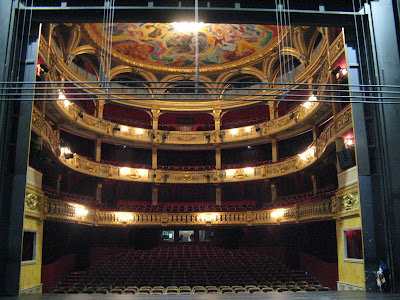
... where we paused a while on our way to the Bon Marche--a department store on the Left Bank that Ellie remembers of old and wanted to revisit. En route, we also walked past the Odeon, a venerable theater from (I think) the 17th century...

... where a back door to the stage area just happened to be open, allowing us this view into the auditorium...
Thence to the Saint Sulpice church in Saint-Germain...

... home to a couple of huge murals by Delacroix. This one depicts the battle between Jacob (?) and the angel. Correct me if I'm wrong...

And here's a fine view of the altar...

From there, we walked on toward our destination, passing this strange sculptural work by Cesar along the way...

Here's a view we took of the fashion departments at the Bon Marche, before a security man rushed up and all but seized our camera. He rushed off again immediately, and my guess was that had spotted my misdemeanor from a TV camera in the ceiling.

We had a pleasant if unremarkable lunch at a sidewalk cafe off the Boulevard Raspail, then continued on to the main destination of the day, the Musee du Quay d'Orsay, which houses the great French public collection of Impressionist and Post-Impressionist art. A true feast for the eyes. The photos are, of course, inadequate to give even the smallest impression of this awesome collection. Here's a Monet haystack, among my personal favorites...

... and a couple from the whole gallery full of fabulous Van Goghs...


... and one of many paintings by Paul Gauguin...

A view of the museum, giving a sense of the old railroad station from which it was converted...

... and another, with marble polar bear in foreground...

We stopped for another vastly expensive cup of tea and coffee on the way back to our hotel...

... where I now lie on the bed, typing in this entry. My feet are killing me!
More, probably, from England, where we stop for a couple of days before returning to California on Sunday.

... where we paused a while on our way to the Bon Marche--a department store on the Left Bank that Ellie remembers of old and wanted to revisit. En route, we also walked past the Odeon, a venerable theater from (I think) the 17th century...

... where a back door to the stage area just happened to be open, allowing us this view into the auditorium...

Thence to the Saint Sulpice church in Saint-Germain...

... home to a couple of huge murals by Delacroix. This one depicts the battle between Jacob (?) and the angel. Correct me if I'm wrong...

And here's a fine view of the altar...

From there, we walked on toward our destination, passing this strange sculptural work by Cesar along the way...

Here's a view we took of the fashion departments at the Bon Marche, before a security man rushed up and all but seized our camera. He rushed off again immediately, and my guess was that had spotted my misdemeanor from a TV camera in the ceiling.

We had a pleasant if unremarkable lunch at a sidewalk cafe off the Boulevard Raspail, then continued on to the main destination of the day, the Musee du Quay d'Orsay, which houses the great French public collection of Impressionist and Post-Impressionist art. A true feast for the eyes. The photos are, of course, inadequate to give even the smallest impression of this awesome collection. Here's a Monet haystack, among my personal favorites...

... and a couple from the whole gallery full of fabulous Van Goghs...


... and one of many paintings by Paul Gauguin...

A view of the museum, giving a sense of the old railroad station from which it was converted...

... and another, with marble polar bear in foreground...

We stopped for another vastly expensive cup of tea and coffee on the way back to our hotel...

... where I now lie on the bed, typing in this entry. My feet are killing me!
More, probably, from England, where we stop for a couple of days before returning to California on Sunday.
Wednesday, April 15, 2009
So Many Pictures...
... so little time! Few words today, then. My I-Phone weather forecast once again proved wrong in predicting rain, and we awoke to a glorious day. Breakfast on the rue Monge again, and a walk across the Seine...

... to the Right Bank, the smart boulevards, the shops...

... and the Palais du Louvre...

 ... which we plan to visit this evening. For this morning, it's the Musee des Art Decoratifs, where amongst other delights we found this recreation of a Renaissance bedroom...

... this detail from a Medieval painting ...

(I took many pictures of paintings, including details such as this one. But I can't post them all!)
And this Art Nouveau dresser, with a familiar face in the mirror...

Here's a Deco study, which I wouldn't mind importing to Los Angeles. I nice space for a laptop, I think...

Here's a view of the Musee des Arts Decoratifs (a part of the Louvre) taken from the third floor, looking down over a special exhibition ot Deco jewelery, to which we were denied entry by one of those officious guards because we had the wrong kind of ticket...

... and here's a part of a wonderful exhibit in a special section set aside for toys. I would have showed you the horses, the space ships...

We stopped for lunch in the Rivoli area at a restaurant that was showing the Tour of Turkey cycle race on wide screen TVs...

It did not look promising, but they served us what we agreed was one of the best omelettes we have ever eaten. A long walk after lunch, starting in the gardens of the Palais Royal, where we found this young man smiling charmingly at his uninvited guests...

... and this rather strange lady feeding her invited ones--pigeons and sparrows both, if you look closely...

Walking around the back streets, we came upon the Passage Choiseuil, an historical arcade I had somehow missed on previous visits. Ellie found an art supply shop where she spent a happy twenty minutes, whilst I enjoyed an unexpected encounter, outside the store, with a fellow enthuiast of the Buddhist teachings who had traveled widely in the 60s and had met several of the important teachers along the way. We agreed in our hope that the world is on the cusp of a great transitional moment. Patrick, my new friend, is expecting some important shift of consciousness starting in 2012. His theory has to do with 2,500-year cycles, too complicated to explain...
We continued on to the Place de l'Opera and down the rue de la Paix (the most expensive street on the French Monopoly board) to the Place Vendome...

... by now looking with some desperation for a place to sit and enjoy a cup of tea. Not the best area to be looking, unless you want to spend fifteen dollars for your cuppa. We did eventually find one on a back street, but paid too much and got too little in return. On, then, to the far end of the Jardin des Tuileries for the walk back to the Louvre. By this time, the rainstorm long promised by my I-Phone was threatening to arrive...
... and did, in fact, for a few minutes, break. (Remember that Richard Serra corten steel sculpture I showed you a couple of days ago at this precise location? Gone! Each of the two huge slabs of steel must have weighed tons, and the task of removing them must have been monumental. But they were gone. Vanished. We were somewhat relieved...) Anyway, here you see people starting to flee from the storm's onset...
... and the mini dust storm blown up by the sudden gusts of wind...
... but miraculously, our weather karma held good and we had no more than a few drops of heavy rain before reaching the Louvre. Ellie's research once again proved invaluable: she had found a less-used method of entry to the museum, so we managed to avoid the huge crowds gathering for the less expansive evening access at six o'clock. Neither of us has visited the Louvre for years--not since the I.M.Pei remodel job--but we were not surprised to find ourselves awed, once more, by the spectacle of the Victory of Samathrace at the top of a long, majestic flight of steps, no less awesome for the crowds that massed around her.

Unbelievable crowds--most of them, be it said--rushing headlong down the Grande Galerie...
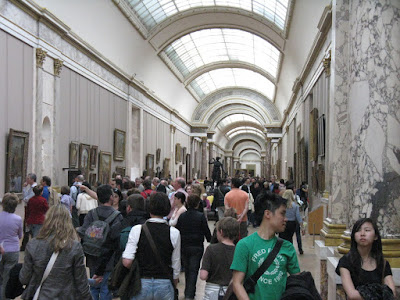
... for a glimpse of the Mona Lisa!

We did wonder a bit what she has done to deserve so much more attention than any of the other sublime works of art in this incredible collection--including several other pictures by Leonardo. We did take lots of pictures along the way, but too many, really, to be useful; and besides, the quality of the photographs conveys little sense of the images themselves. You need to be there! You might be amused to know that I--or someone very much like me...

... was scheduled to give a lecture in the auditorium. I wish! Here's a view of one of the great atria from above...

... and a spectacular view of the storm taken from one of the upper floors...
... and another from the Pont Neuf as we crossed back to the Left Bank for dinner.

We had noticed a Lebanese restaurant on our walk the previous evening, and opted for it as a change from the usual Parisian menus. A good choice. We enjoyed an excellent array of Middle Eastern far, and the company of a charming French couple--Chris and Naoumi (sp?)--at the neighboring table with whom we exhcanged a lively bi-lingual conversation about San Francisco (where Chris had lived for several years); America and France and our respective presidents (they do NOT like their new one, but DO like ours, and proposed a swap that we declined!); and the world at large. This is the kind of experience that makes travel truly interesting.

... to the Right Bank, the smart boulevards, the shops...

... and the Palais du Louvre...

 ... which we plan to visit this evening. For this morning, it's the Musee des Art Decoratifs, where amongst other delights we found this recreation of a Renaissance bedroom...
... this detail from a Medieval painting ...

(I took many pictures of paintings, including details such as this one. But I can't post them all!)
And this Art Nouveau dresser, with a familiar face in the mirror...

Here's a Deco study, which I wouldn't mind importing to Los Angeles. I nice space for a laptop, I think...

Here's a view of the Musee des Arts Decoratifs (a part of the Louvre) taken from the third floor, looking down over a special exhibition ot Deco jewelery, to which we were denied entry by one of those officious guards because we had the wrong kind of ticket...

... and here's a part of a wonderful exhibit in a special section set aside for toys. I would have showed you the horses, the space ships...

We stopped for lunch in the Rivoli area at a restaurant that was showing the Tour of Turkey cycle race on wide screen TVs...

It did not look promising, but they served us what we agreed was one of the best omelettes we have ever eaten. A long walk after lunch, starting in the gardens of the Palais Royal, where we found this young man smiling charmingly at his uninvited guests...

... and this rather strange lady feeding her invited ones--pigeons and sparrows both, if you look closely...

Walking around the back streets, we came upon the Passage Choiseuil, an historical arcade I had somehow missed on previous visits. Ellie found an art supply shop where she spent a happy twenty minutes, whilst I enjoyed an unexpected encounter, outside the store, with a fellow enthuiast of the Buddhist teachings who had traveled widely in the 60s and had met several of the important teachers along the way. We agreed in our hope that the world is on the cusp of a great transitional moment. Patrick, my new friend, is expecting some important shift of consciousness starting in 2012. His theory has to do with 2,500-year cycles, too complicated to explain...
We continued on to the Place de l'Opera and down the rue de la Paix (the most expensive street on the French Monopoly board) to the Place Vendome...

... by now looking with some desperation for a place to sit and enjoy a cup of tea. Not the best area to be looking, unless you want to spend fifteen dollars for your cuppa. We did eventually find one on a back street, but paid too much and got too little in return. On, then, to the far end of the Jardin des Tuileries for the walk back to the Louvre. By this time, the rainstorm long promised by my I-Phone was threatening to arrive...
... and did, in fact, for a few minutes, break. (Remember that Richard Serra corten steel sculpture I showed you a couple of days ago at this precise location? Gone! Each of the two huge slabs of steel must have weighed tons, and the task of removing them must have been monumental. But they were gone. Vanished. We were somewhat relieved...) Anyway, here you see people starting to flee from the storm's onset...
... and the mini dust storm blown up by the sudden gusts of wind...
... but miraculously, our weather karma held good and we had no more than a few drops of heavy rain before reaching the Louvre. Ellie's research once again proved invaluable: she had found a less-used method of entry to the museum, so we managed to avoid the huge crowds gathering for the less expansive evening access at six o'clock. Neither of us has visited the Louvre for years--not since the I.M.Pei remodel job--but we were not surprised to find ourselves awed, once more, by the spectacle of the Victory of Samathrace at the top of a long, majestic flight of steps, no less awesome for the crowds that massed around her.

Unbelievable crowds--most of them, be it said--rushing headlong down the Grande Galerie...

... for a glimpse of the Mona Lisa!

We did wonder a bit what she has done to deserve so much more attention than any of the other sublime works of art in this incredible collection--including several other pictures by Leonardo. We did take lots of pictures along the way, but too many, really, to be useful; and besides, the quality of the photographs conveys little sense of the images themselves. You need to be there! You might be amused to know that I--or someone very much like me...

... was scheduled to give a lecture in the auditorium. I wish! Here's a view of one of the great atria from above...

... and a spectacular view of the storm taken from one of the upper floors...
... and another from the Pont Neuf as we crossed back to the Left Bank for dinner.

We had noticed a Lebanese restaurant on our walk the previous evening, and opted for it as a change from the usual Parisian menus. A good choice. We enjoyed an excellent array of Middle Eastern far, and the company of a charming French couple--Chris and Naoumi (sp?)--at the neighboring table with whom we exhcanged a lively bi-lingual conversation about San Francisco (where Chris had lived for several years); America and France and our respective presidents (they do NOT like their new one, but DO like ours, and proposed a swap that we declined!); and the world at large. This is the kind of experience that makes travel truly interesting.
The rain held off even after dinner, and we arrived back at our hotel quite exhausted from the day--but dry!
Subscribe to:
Posts (Atom)




 Posts
Posts


