Sunday, October 31, 2010

THE RALLY


We were there. We made it to the Rally to Restore Sanity. If you look closely, you can see us right... there! We couldn't see, couldn't hear, couldn't move. It was great.

I'm not going to call it "Jon Stewart's" rally, because it was far more than that. I urge you to treat anything you read in the papers or saw on television with skepticism. I caught a couple of reports on TV last night which gave absolutely no sense of the occasion. I ran through some of the front page reports in the newspapers this morning. I heard that the Park officials had declined to give an estimate of attendance. I found a link to this report on attendance in Capitol Hill Blue which seemed a bit closer to the mark.

Let me describe my own experience, which will give you some idea. Ellie and I got up at five-thirty in New York City and made our way to an already crowded Penn station to board the fully-booked 6:45 AM Amtrak train to Washington. At Union Station, we were met with already dense crowds as we made our way to the Metro to get out to our friends' house in the Chevy Chase area. Greeted by our friends, we dropped off our bags and headed back to the Metro a little before noon, knowing we'd be a bit late for the start...

The Friendship Heights Metro station was a mob scene...

People were waiting in lines ten deep to board the downtown trains. It was clear that the Metro system was utterly unprepared for the invasion. The first train came by, so packed that not a single one of those on the platform could board. We decided to head in the opposite direction, hoping to find a station further out where we'd at least be able to board a train. Unfortunately, half the other people had decided on the same tactic. The outbound trains were almost as crushed as the inbound.

We did manage to board this time, and detrained at the next station out. The situation there was identical. Huge crowds waiting to board, packed trains arriving and departing. Determined to make it, I literally dove through the door of the next train, dragging Ellie behind me. A very large woman in a very large motorized wheelchair gained enough sympathy from passengers to make space for her, and she motored forward--over Ellie's foot. Ellie screeched. The doors closed, leaving our friends gesticulating from the platform. The train moved off.

The rest of the stations along the way were all the same. The platforms were packed with people, the train so full...

... that not one single person could squeeze aboard. In all this mass of people, one man got angry, shouting at those who were trying to board the train. He was soon quelled by fellow passengers. The large woman in the wheelchair needed to get out from the opposite side of the train at Dupont Circle. Miraculously, the crowd opened, inch by inch, ahead of her, and closed, inch by inch behind her. There was a great cheer when she managed to make it to the platform.

We all got off at the Archives station. The flow of people was incredible...


A few hardy souls were trying to make it back in the opposite direction. The tenor of their remarks was "You don't know what you're in for." The monster crowd made its way up to street level, disgorging onto Seventh Street...
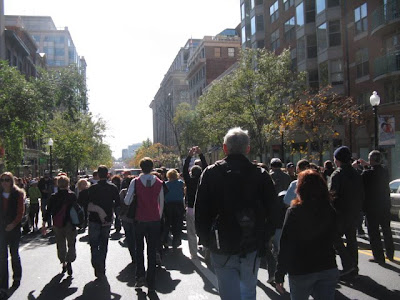

... which was as packed, as far as the eye could see, with crowds nearly as dense as the enclosed Metro car. We elbowed our way through three or four blocks to the Mall, meeting more and more resistance along the way. By the time we reached the Mall, it was a matter of shouldering a path through the recalcitrant masses until we reached the middle of the Mall. From here, across the oceans of people, we could just catch a distant glimpse of the single large screen erected by the stage, hear the snatch of a song by Cat Stevens or a speech by Sam Waterston...


(In the far distance, beside the statue in that last picture, you can just make out a corner of the large screen beside the stage.)

Police cars and ambulances parted the crowd a foot at a time with screaming sirens. Otherwise, it was a single giant sardine can of serried ranks of people. The big moment in our part of the rally came when a young man tried to scale a tree to get a better view. He had a hard time, couldn't make it despite hands reaching down from above to help him up. Couldn't, and couldn't make it... The crowd began chanting, "Yes, we can," "Yes, you can," and finally, finally, with help, he scrambled up into the branches. A great roar of approval from the crowd, as though we had all managed the feat ourselves.

We stood there, trapped...


... for a good two hours, surrounded by people who, like us, had showed up. We saw nothing, heard nothing of what was happening on the stage. It was great! But it was clear that, like the Metro system, neither the rally organizers not the Mall officials had been prepared for the numbers that showed up. A lot more amps, a lot more big screens would have been helpful to the literally hundreds of thousands who were in the same position as ourselves: they saw nothing, heard nothing. And yes, I think everyone shared the view that it was great.

When we finally gave up, we reconnected with our friends via cell phone (mobile phones were inoperative on the Mall) and found them a couple of blocks further back towards the Washington Monument...


Rejoining them there...


... we spent another hour watching the crowds with their wonderful signs...


.... and, many of them, with their Halloween costumes. The crowds were less dense here: people could actually move back and forth, but the flow was constant, consistently huge.

Deciding to move on, we found ourselves now more in the flow of traffic leaving the Mall. The restaurants and coffee shops were chock-a-block: no seats, no possibility of service. Anticipating still heavy traffic on the subways, we spent another hour or so in the downtown area, strolling down toward the White House...

... and finding, thankfully, a bench in Lafayette Park where we could sit...

... and rest the weary bones before heading back to the Metro station. Even then, two hours after the rally was over, we found ourselves in the same situation as earlier in the day. Incredibly crowded platforms, trains running by, so full there was no room for additional passengers. We headed back to the street and thought ourselves lucky to find a taxi to take us back to our starting point.

The news reports on television, as I wrote above, had little relationship to the experience I've described. The same with this morning's papers. The media have portrayed this as a light-hearted entertainment event with a handful of stars and two well-known comedians. But as I see it, the rally was only in small part about what was happening on the stage. The vast majority of us had no idea what was happening there, anyway. No. The rally was about showing up. It was about the people who showed up in vast numbers to be counted. And to judge from media reports thus far, we were discounted. It was also about the mood and spirit of these vast numbers of people, whose signs--and whose behavior in highly adverse circumstances--reflected the civility that has been missing in this year's political discourse. It was about an aspect of the American character that is too often ignored--and which the media seems determined to continue to ignore: a mutual tolerance and compassion, a great space in which we all agree on what is right, and just, and needed for our common humanity.

The End..


A FOOTNOTE

Well, not quite the end. A last word about those numbers. I'm becoming a bit of a conspiracy theorist when it comes to the media. I heard Wolf Blitzer slip in to his monologue that "there were thousands of people" out there on the Mall. Well, no, Wolf, if I may be so familiar. Not even tens of thousands. Hundreds of thousands would have been a fair way to put it. While no crowd size estimator, I believe that the estimates of 200,000 have to be low: do they take into account the masses on every access street to the Mall? The media, I believe, have a vested interest in minimizing this event, which contradicts their carefully-constructed narrative about this election--a narrative promoted by the Republicans and their corporate sponsors, who DO have a vested interest in the election's outcome. Aside from a front page picture, the New York Times featured its report on the rally on page 24!

Saturday, October 30, 2010

PITMEN


I'm writing this Friday evening, because we leave via Amtrak for Washington DC early tomorrow morning, Saturday, and I will not have time to make an entry, probably, before Sunday. The Rally to Restore Sanity is scheduled to start at 12 noon, and we'll hardly have time to drop off our bags at our friend's house before heading back to the Mall. I'm "fired up," as Obama likes to say.

I did not have time, after my long entry on the Chelsea galleries, to mention our evening's theater outing. Briefly, then...

It was a strange feeling to be sitting in a New York theater in 2010 and to be taken back to the precise place (Newcastle-upon-Tyne, England) and time (mid-1930s) of my birth. My father was at the time the vicar of St. Cuthbert's Church, and his parishioners were mostly miners and their families, and all Geordies (Tynesiders.) I'm inordinately proud of being a Geordie, even though I spent only the first year and a half of my life there; and no one could possibly tell my origin by my accent (mid-way across the Atlantic.)

The play that took me back all those years was Lee Hall's The Pitmen Painters...

... the story of the Ashington Group, a small company of proud Geordie miners who took to painting under the tutelage of one Robert Lyon, a pit of a toff and an art historian and painter, and ended up wowing the pre- and post-war art establishment with their raw realism. The play is about their struggle with identity, masculinity and, particularly, class, at a time when England was more strictly divided than it is today.

It's also about art--about the clash between realism and abstraction, about the social responsibility of the artist, about what, and how art "means." Needless to say, there's a lot of talk and the talk--even though the Geordie accents are somewhat attenuated for an audience which otherwise would not understand a word!--is sometimes hard to follow. The ear--and the mind--tend to tire towards the end, and I myself longed for a little more action that I was allowed. Still the often heated exchanges were a lot of fun, the passions ran high, and the conflicts were real and touching. And I was glad, for a couple of hours, to be taken "back home" to Northumberland and reminded of the grand, unquenchable spirit of those who spent their lives down in the mines.

Friday, October 29, 2010

FROM OUR BALCONY


Chelsea: The Best Show in Town


If you're headed for the Chelsea gallery district in New York, as we were yesterday morning, here's a great way to go: get yourself to the 14th Street subway station and walk west on 14th to 10th Avenue, where you'll find stairs leading up to the wonderful High Line Park, recently reclaimed from an old elevated railway line that ran up the west side of the city, above the traffic. The steel railroad tracks are still visible among the plants and grasses and small trees that line the boardwalk...


... high above street level and the city's constant roar, and you're offered fine views of the river and the city below. Here's a glimpse of the Empire State Building...


You end up, currently, at the lower end of the gallery district, at 20th Street, where there's a charming piece of entropic art by Valerie Hagerty.


But work continues on a northward extension of the path, just visible through the chain link fence.

Now you're going to have to forgive me for a rave. We saw a great deal of art in Chelsea, much of it ho-hum, some of it more appealing to the eye and mind. But I'm choosing to ignore the rest and write about the Best Show in Town. (Well, I have to admit I haven't seen them all, and a good number of the big-name galleries were closed for installation. But I'm choosing to call this the Best Show in Town.)

It's at the Jack Shainman Gallery, and the artist is a Cuban named Yoan Capote. The show's title is "Mental States." The first work we encounter is a massive seascape in stark, deeply impasto'ed black and white...


(The decent images come courtesy of the gallery; the crummy ones are mine)

Gaze at it for a while, approach it a little more closely, and you discover that what you thought were thick swaths of black paint are actually densely massed barbed fish hooks. Suddenly, the huge painting becomes not merely beautiful, but dangerous.

Though epic in scale, this is poetic work which relies heavily on the richly associative quality of metaphor. (I'm reminded very much of the tradition of magical realism in Latin-American literature--a tradition also evident in Latino art of recent years.) The next work we come across in Capote's show is a crude representation of the Stars and Stripes, created out of bricks and mortar. A parallel pair of videos...


... allow us to watch its creation, cut out as a rectangular window from a wall that opens out to a view of a blue stretch of ocean, and we realize that this work is not only an object of seductive beauty in itself, but also a poignant reminder of the split between the United States and the tiny island so few miles off its coast; the flag embodies not only the spirit of freedom, but also its denial--a poignant symbol of the wall that seals off access to the promise.

That promise is evoked again in Capote's large-scale fish-hook paintings of New York.


(detail)

Though he lives in Cuba today, the artist experienced first-hand the siren call of the Big Apple on a visit a few years ago, and these paintings powerfully suggest both its seductions and its dangers for an artist--and an immigrant. The barb of the hook is unmistakable.

It is said that all art is political. If you take the time to think it through, the politics of Capote's art range from international issues of freedom, world capitalism and the history of colonialism to the personal and sexual, and its themes are as evident in the objects he creates as in his paintings. Compare, for example, the massive "Status Quo"...


... to the more modestly-scaled "Beautiful People."


The former, despite its avoirdupois and its seriousness of intention, is a rather humorous indictment of social injustice and inequality, in which the scale of the ordinary, dull bronze is heavily outweighed by its huge, polished golden counterpart. "Beautiful People", when closed, evokes the serene minimalist aesthetic of a Donald Judd...


Opened up, it delights in every form of sexual penetration know to the human species...


The politics of human sexuality is pursued in secrecy, beneath the polished veneer of respectability. (Pornography, by the way, is strictly censored by the political authorities in Cuba.) Capote is not afraid to have fun with his subversions.


I love the way Capote is able to make art that is at once beautiful to look at, radically simple in its compression of idea and image, and radically complex in associative meanings. It's the kind of art that compels you to keep looking even when you think you've got the message, whose presence is a reminder of the best of which we humans are capable. The exquisitely carved pair of sneakers in Carrera marble is at once a humorous commentary on the pretensions of art history, the "market" and the "value" of art, and finally nothing more than an admirable, beautiful and seductive object in itself.

(This image should be white, white, white!)

If ever I saw a "museum-quality" show in a commercial gallery, this one is it. It is extraordinary not only in its range, depth and scale, but also in the quality of the artist's workmanship and the passion of his ideas. If I had any influence with museum curators, I'd say, Take note!


Thursday, October 28, 2010

Masterpieces; and Bits & Pieces


What a strange and telling contrast between the two museums we visited yesterday! We went first to the Frick Collection, walking kitty-corner across Central Park to the Upper East Side and ending up, providentially, exactly one block south of that grand palace that Henry Clay Frick built for himself at a prime location on Fifth Avenue at the turn of the last century. Like many of the very wealthy of his era, he participated heartily in the "rape of Europe," using American money to buy a vast amount of the European patrimony--which Europe, be it said, was happy enough at the time to sell off in exchange of vast amounts of American dollars.

Ah, well. What an astounding collection Frick managed to put together, and to make available to the public as a museum following his death. It's a long time since we visited the collection, and were glad we had chosen to do so again this time. Today's wealthy collectors, if they chose to go for masterpiece art, have frankly slim picking compared to this treasure trove of some of the finest of works by some of the greatest European artists, from the Italian Renaissance through the late nineteenth century. The most recent work we spotted as an interesting bullfight scene by Manet, placed interestingly adjacent to a number of paintings by Goya. Nearby, exquisitely installed to best advantage, Velasquez's masterpiece portrait of King Philip IV of Spain, "The King at War.

The great period of English art--Constable, Reyolds, Turner--was well represented in the great gallery, built specifically to provide wall space for paintings of heroic scale. Wonderful, to stand in the presence of this extraordinary output of human skill and aspiration. But my personal favorites for the day was the pair of portraits by Hans Holbein of mortal enemies Sir Thomas More and Thomas Cromwell...


...the latter instrumental in arranging for the former to lose his head at the hands of the Henry VIII, and only a short time later losing his own to that same murderous monarch. And two, almost twin, tall portraits of infinitely elegant ladies, done with the modest palette and decorative style made fashionable by the discovery of Japanese art in the Western World.

A feast of masterpieces, then. We left the Frick and walked over to Madison Avenue, stopping for lunch at a corner bistro before heading for the Whitney Museum of American art where we wanted to see the exhibition Paul Thek: Diver, A Retrospective. Thek's brief life and strange contribution to the history of contemporary art ended with AIDS in 1988. After a moment of great acclaim in the 1960s for stomach-churning, hyper-realistic sculptures of raw meat and viscera exhibited in plexiglass boxes--and uncomfortable with the acclaim--Thek left New York for Europe where he spent more than a decade working on complex, collaborative installation pieces that occupied entire gallery spaces. His many paintings were essentially throwaways, done on butcher paper or newsprint, often involving washy blue underwater scenes evoking the Thek's belief that the artist's job is to mine deep into the reality of the inner self. In this context, the meat pieces seem like self-portraits of a peculiarly agonized intensity.

The most moving part of the exhibition, at least for this observer, were the two spaces at the end showing work from the last year or two of the artist's life, when he knew that he was dying. At this time in his life, he seems to have accepted--embraced--the transience of his own flesh and to have wittingly produced work that refined the spirit of suffering and ephemerality that had also characterized his earlier work. Installed at knee height in the last gallery of the Whitney exhibition, as they had been in the last show of his life, a series of small blue paintings seem to adumbrate the artist's death with a serenity that is at once remarkable and deeply moving...


The overall impression of this artist's work reminds us that, for better or worse, we have largely abandoned the motion of the masterpiece. We are left, as in Thek's work, with "bits & pieces," fragments of perception, fragments of feeling, fragments of life, put together with that sense of the authoritarian absolute that justified the masterpiece.

An interesting day. By the time we left the Paul Thek show, we found ourselves in the first rain of our New York stay. Setting out to walk across the park for a movie on the West side, we must have lost our way because we walked full circle and ended up exactly where we had started on the Upper East Side. I had walked, by this time, as far as was pleasant or comfortable, but taxis are scarce in New York in the rain, so we gamely walked back across the park--this time taking care to ask for orientation at key intervals, and found our way to Central Park West. And eventually to the theater, where we enjoyed the luxury of comfortable seats to watch "The Social Network." Excellent movie, but no review here.

Home for a soup and cheese dinner, only to find that our host has no can opener. A bread and cheese dinner, then. With a glass of wine.

Tuesday, October 26, 2010

A GREAT CITY


It's a great city for walking, this New York. After lazing about a bit at home, we set out into the streets and walked from our place on 56th Street down Broadway and across to the Rockefeller Plaza, where we stopped to watch the ice skating...

... and catch a cup of coffee. We enjoyed the irony of these two fellows, one with a hammer, the other with a sickle..


etched in relief into the wall of this monument to American capitalism (under the guise of homage to the "worker"); and noted the sadly optimistic inscription about the entry: "Wisdom and Knowledge Shall Be the Stability of Thy Times."


Not much of either around these days...

From the Rockefeller Plaza, we followed Fifth Avenue south. It's a chronicle of wealth, from the Guggenheim and the Met and the discreetly opulent hotels and apartments of the Upper East Side, past stores like Tiffany's and Bergdorf Goodman in midtown to the endless rows of souvenir shops at the southern end. We stopped a the great New York City Library...


... repository of the collective wisdom of the Western world--and some of the East, and spent an hour in its timely exhibition of Three Faiths, Christianity, Judaism, and Islam, whose devotional texts are copied, illustrated and eventually printed with a loving care that sadly belies the strife that has existed historically between the three. It was amazing, to me, to stand looking at a copy of the Gutenberg Bible!


Back on Fifth Avenue, on the same note, we passed the church where Norman Vincent Peale preached his version of the Christian gospel of prosperity, and where the outer railings, today...


... have become a memorial to those killed in action in the Muslim countries of Iraq and Afghanistan, row upon row of ribbons, a fluttering yellow and blue-green prayer for peace. And passed the elegantly deco Empire State Building, a reminder of those American "empire" days which seem, now, about to pass. We are going the way of all empires, all human societal constructs and all vain aspirations for power and dominance.

Reaching the Flatiron district, I recalled that my first novel was published by St. Martin's Press--at that time (still?) installed in the Flatiron Building itself. We stopped for lunch at the new Italian-flavored food emporium, the Eataly...


... where New York-style crowds jostled for places at bars and gelato counters, coffee shops and restaurants set in amongst the many stores hawking cold cuts and vegetables, fish and cheeses, beer and wine... We were fortunate to find a table fairly speedily at a pizza and pasta restaurant, where we were served by a jaunty young man from Seattle with, I suspect, theatrical ambitions.

We stopped at the gelato stand to indulge the sweet tooth, and took our tubs across to the Madison Square Park, relaxing for a few minutes and enjoying the spectacle of the dogs of all shapes and sizes frolicking joyfully in the dog park, and the squirrels, pigeons, sparrows and starlings--New York's principal wild life, and not very wild at that--competing for a handout with their fellow, two-legged homeless ones.

From the park, it was just a couple of blocks north to the Museum of Sex. Yes! It had been highly recommended by the young man who came to fix our online connection, so we decided to stop by and see for ourselves. We were not, honestly, that enchanted. The bottom floor is devoted to a somewhat scant history of eroticism and pornography in film, still photography and video, with a few genuinely entertaining glimpses into what was considered naughty in the past. All genders and orientations happily included. The second floor devoted to kinky sex, from cross-dressing and mechanical means to technology and sado-masochism. Good for the occasional chuckle and raised eyebrow: really? On the third floor, I learned more about the mating habits of animals than I ever needed to know--with a rather heavy emphasis on same sex encounters, including a startling case of duck necrophilia. Don't ask.

We walked west to Broadway for the long walk north--a compleat encyclopedia of the hustle. At the southern end, endless open storefronts leading into interiors crammed with stuff of every imaginable kind: cheap jewelry and watches, luggage, underwear and overwear, electronic goods and camera and video equipment... everything imaginable in wholesale quantity. Everywhere, too, particularly further north, as we approached Times Square, men and women with signs for goods and services, barkers handing out leaflets to the gathering stream of pedestrians--a stream that became a river, then a flood as we continued north. Times Square, brilliant with neon and flashy commercial images...


... was so crowded it was barely possible to elbow one's way through. (These pictures taken from the middle of an intersection, and give no sense of what I'm talking about.) A seething mass of humanity, a single, vast living body, a fine Buddhist metaphor for the body each of us inhabits, not the firm, stable body it so often seems but rather an activity, a process in which change never, for one instant, stops.

It was a moving and a humbling experience, but I was happy, further north, past Times Square, to be back on a simply crowded sidewalk. We made it back to our apartment, rested a while, then headed out for a Thai dinner around the corner. We have no television here, as I may have mentioned, and it's a new and somewhat unsettling experience to be cut off from the news. We found Comedy Central on the computer, and settled for late night's Jon Stewart and Steven Colbert.