Wednesday, June 30, 2010

BRUTALITY

I have been slowly catching up with the fourth season of “The Tudors,” and finally watched the concluding episode last night. Henry VIII died—none too soon, probably, for those who still risked incurring his wrath, in the unlikely event that there were any left around. His underage and sickly son, Edward VI, inherited the throne, but died after a few strife and calumny-filled years. The disputed succession went for a nine-day stint to Lady Jane Gray, summarily executed for her pains, then to the vicious Catholic, “Bloody” Mary, who reigned for five terrible years before she died and left England in the hands of her sister, Elizabeth I.

I don’t know whether another season is planned, to cover those subsequent reigns before the Tudors were succeeded by the Stuarts (the two Charles and two James, interrupted briefly by the “Commonwealth” under the Cromwells.) There should be, given the ample supply of bloody intrigue—not to mention the temporarily stabilizing reign of Elizabeth who expanded her country’s power beyond anything seen before. The series was so well done, give or take a few liberties with history, that another season would be welcome. But I set out to write about one lamentable aspect of the 16th century reign of Henry VIII that was unsparingly re-enacted on the 21st century television screen: its brutality.

Whoever thought that strapping a living human being to a stake atop a cord of wood and setting it alight was an acceptable punishment for one’s religious belief, or that such treatment was sanctioned by a merciful God? In at least two episodes of “The Tudors,” we were treated to the spectacle of heretics dying this agonizing death, to the delight of crowds gathered to witness the event. Almost worse was the casual ease with which sentences were dealt out, by men with agendas that were inspired more often by politics than by religion. The lives of human beings, as convincingly portrayed in these historical dramas, counted for little more than pawns on an arcane chess-board of court intrigue.

Burning at the stake was primarily reserved, of course, for those “heretics” who were beginning to embrace a new Christianity in the form of Protestantism. For those daring to challenge the monarch’s absolute authority or swept up in the swirling intrigue that surrounded the throne, there was imprisonment in the Tower of London, the torture chamber, and the execution block. And such kind treatment was reserved for nobles. For more grievous, or more common offenders, there was the ritual of hanging, drawing and quartering, whereby the victim was hanged, cut down before death, publically mutilated and disemboweled, and cut literally into quarters. It took a while, it seems, before death came to the rescue.

This was my country, half a millennium ago. But the history of human brutality predates this period by far and, sadly, still shows no sign of coming to an end. From the human sacrifice of pre-history to the bloody spectacle of Christians slaughtered by wild animals for the sport of Roman emperors and citizens, from Auschwitz and Bergen-Belsen to Cambodia and Rwanda and Bosnia, the brutality continues unabated.

So what is it about us human beings? In part, of course, it’s about enmity, about righteousness—whether political or religious. It’s sometimes about perceived territorial imperatives, about worldly resources and possessions. About “Lebensraum.” It can simply be about difference and prejudice. Or indeed a combination or exploitation of these factors. But too often it ends in the same way—in brutality and mass slaughter. And too often it is accompanied by sadistic pleasure, not merely a tolerance but a delight in the infliction of pain and the spilling of blood. On a small scale, we delight in watching it on our movie or television screens.

It may seem trite to be pointing these things out, but I wondered as I watched the horrors play out on “The Tudors”—was this instructive, or demeaning of my own humanity? Instructive, yes, in that it brings me to these words, to this understanding and appraisal of my own complicity in the common brutality of our species. I am at once horrified and spell-bound. I am sickened by the knowledge that human beings can do such things to other human beings; but also by the knowledge that I share the DNA of both Henry and his torturers and executioners. When I feel the anger boil within, as I sometimes do, as I assume most human beings do, am I somehow in touch with that DNA, that shameful heritage of hatred and brutality?

The Buddha teaches us to do no harm. He does not suggest, I think, that evil is inherent in the human species—nor certainly that it is absent. I like the realism of the Buddhist teachings: that awareness brings with it discernment, and that discernment brings increasing skill in doing those things that have good results and avoiding those that don’t. The actions of that English king and those around him, back in 16th century England, led their world deeper and deeper into the pit of fateful consequences. Sadly, here in the 21st century, we persist in the same delusional folly, that brutality is needed to secure power.

Tuesday, June 29, 2010

Two Movies: Haute Couture

We watched Valentino: The Last Emperor last night--a movie about the Italian fashion designer who just recently retired, after watching his business gradually consumed by corporate interests. It made for an interesting comparison with a movie we watched last week, The September Issue, about the preparation and publication of a season-opening issue of Vogue magazine. I woke up puzzling over the fact that I really quite liked one, and disliked the other enormously. I'm hoping that it's not just a matter of gender bias on my part...

Both movies are essentially about massive egos. They belong, respectively, to Valentino, the designer, and Anna Wintour, Vogue's editor-in-chief. Both, clearly, are set in the niche world of high fashion--an industry that caters primarily to the egos of the very wealthy and the very famous. It's all about appearances. Male and female beauty--or what the fashion industry promotes as male and female beauty--are idolized. The clothes that drape their perfect figures are for the most part over-the-top, sometimes frankly ridiculous to those of us who shop at the nearest department store. The pages of the glossy magazines in which they are marketed offer only the superficial thrill of glamor. It's not a world that I admire, let alone aspire to be a part of.

So why did I like one of these movies and despise the other? I'm sure it has to do with the two main characters involved, and with my judgment--based, of course, only on the way in which the movies presented them--that one was driven largely by a genuine love of beauty, the other by ambition and marketing. Both of them are "driven." Their work is their life; all other concerns and considerations fade into the background. Their relationships with those who love them come in a clear second. Each of them can be dismissive, even cruel to those who work for them--I almost wrote "slave" for them, because that's how it seems. The exclusivity of their ambition is at once commendable and repellent. Without it, they would not have been able to achieve what they have created in their lives, but it comes at a certain cost to their likability as
human beings.

Given all this, I found myself liking Valentino a lot more than I liked Anna Wintour. Am I falling victim to male stereotyping when I respond negatively to her aggressive, demanding nature, a kind of cold and calculating approach to work and other people, a dispassionate obsession with the success of her work? I found no warmth of common humanity in her, only professional ambition. In Valentino, ambition seemed motivated by a passion to create something beautiful, and to honor beauty in the world, using the talent he was given. He seemed driven as much by emotion as by calculation, as much by aesthetics as by money. He also seemed capable of laughing a little at his own excesses, of glimpsing himself, at odd moments, as faintly anachronistic, even a little bit absurd.

Seen, too, at the end of a remarkable career, there was a certain pathos to his character. Amazingly fit and nimble at the age of seventy-five, he was shown as a man in inner conflict, a man caught between his reluctance to grow old and the inevitable fact of aging; and between the old world of courtesy and professional integrity in which he came of age and a new world where what counts is no longer the quality of design or the quality of life, but the corporate bottom line. For Wintour, this interesting and difficult conflict did not exist. She is planted firmly in the new world.

I enjoyed, too, the detail in "Valentino"--the scenes where the seamstresses were shown at work with their needles, where the nitty-gritty of the design world was on view. And I enjoyed, just a little, being wowed by the life-style of this man who has acquired incredible wealth and fame, and by the way he accepts it all, almost modestly, as his due. The climactic scene of his anniversary party, complete with fireworks, gourmet dinners, champagne, and airborne dancers at the Colosseum in Rome was so over-the-top excessive as to be kind of charming, in its own peculiarly outrageous way...

Monday, June 28, 2010

In Fort Worth & Dallas

It's a little strange to be sitting here, shivering, in Laguna Beach this Monday morning, after sweltering for three days in one hundred degree heat in Fort Worth and Dallas. As I write this entry, the "June gloom" has lasted all day for two full days, and the sun shows no sign yet of appearing.

Texas was, yes! hot and humid. We arrived there late Wednesday afternoon, emerging from a flight with the worst seats we have ever encountered in an airplane. (Warning to all: DO NOT trust any seat reservations you make on Expedia, the airline is apparently not obliged to honor them!) We found ourselves in the very back row, prevented by the bulkhead from adjusting our seats while those in front of us adjusted theirs, our window view completely blocked by a large jet engine which roared deafeningly throughout the journey. Still, we arrived safely, and had that to be thankful for...

Grateful, too, to have a cheerful greeting at the airport from our friendly chauffeuse, Jackie, who regaled us with ample information about Forth Worth, the art education department atTexas Christian University, where I was to speak on Thursday, and the art of living in the state of Texas. She dropped us off at our hotel whence, once installed, we took a taxi to Sundance Square...

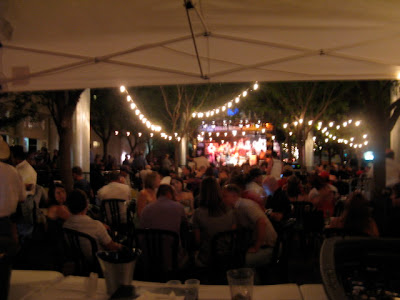
... in downtown Fort Worth for dinner, and found a lively city center with outdoor bars and restaurants where loud country rock bands...

... blasted out their music, and more modest soloists stood at the street corners playing their guitars. Dinner at a good Tex-Mex cafe, where Ellie appropriately downed a beer while I enjoyed a fine margarita and we shared an excellent table-side concocted guacamole. Hungry from the journey, I subsequently ate a perhaps overly generous carnitas plate. Arriving back at our hotel, we watched a dramatization of the Quentin Crisp story on television, and learned about Jack Kilby--the man who invented the microchip in a moment of genial happenstance. The latter provided a useful introduction for my lecture on creativity the following day.

And it turned out to be a great day. The Fort Worth museums are a feast for the art lover. We went first, in the morning, to the Kimbell Art Museum, and what a treat that was. This natural light-rich, Louis Kahn designed building...

... offers a perfect environment in which to see a collection that features a small, manageable number of choice works by some great, some lesser-known artists in the Western tradition--so fine that the meaning of that overused word "masterpiece" becomes immediately clear. We worked backwards through the ages, from Matisse, Picasso, Braque, to the Impressionists and Post-Impressionists (including a wonderful, small painting by Van Gogh that neither of us had never seen before: no photos--this one was on loan and pictures were not permitted) all the way back to the Italian Renaissance. Of special interest was "The Torment of St. Anthony"...

... the first painting ever made by Michelangelo (at age 12!) along with a thorough x-ray documentation of its subsurface. This extraordinary museum accompanies its exhibits with useful art historical information, so we were left without time to explore the non-Western collections.

From the Kimbell, we walked across the street to the newly constructed Modern Art Museum of Fort Worth, pausing at the corner of the building to admire a spectacular, towering corten steel sculptural work by Richard Serra, a riff on the Italian campanile which offers an echoing, somewhat claustrophobic interior chamber...

... from which one can look up to a small patch of sky far overhead...


This museum, too, is a treasure house, and we were struck immediately by the installation of the art work. Not only within the particular galleries, but from gallery to gallery there are carefully planned rhymes and echoes that delight the eye and enlighten one's perception of the individual works.

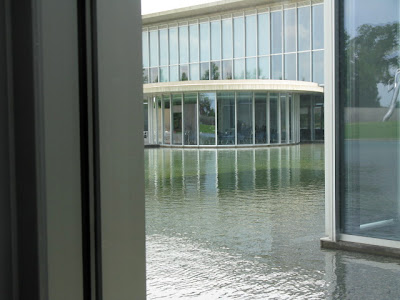
Sitting over lunch by the expanse of water...

... that reflects the architectural grace of the building itself, we recalled that a friend from many years back, Michael Auping, is now the Chief Curator at the Modern, so I went to the front desk to leave a message for him, in case he should have a moment to say hello and renew acquaintance. We were delighted that he came right down from his office to chat with us as we ate...

... and even more delighted when he offered us a personal tour of the lower floor of the museum, which we had not yet visited--in the course of which he treated us to endless fascinating insights about his collaboration with Tadao Ando, the building's architect, about the wonderful support he gets from the Forth Worth cultural community, about his choices for the museum collection and their installation. One of the highlights, where art and architecture come together to mutual advantage is the small elliptical gallery whose high concrete walls create a stunning environment for an Anselm Kiefer winged book...


Taken together, Michael's curatorial choices offer an interesting, non-stereotypical history of art since World War II.

I could wax on about these two museums. We should have, would have wanted to spend much more time there than we could afford. A morning and an afternoon were not enough. We left time, though, to stop in quickly at the Amon Carter Museum, which houses a pre-eminent collection of American art--though we were two days too early to see the exhibition that would have interested us the most, "Constructive Spirit: Abstract Art in South and North America, 1920s-50s." A sprint through the permanent collection allowed us to enjoy a few glimpses of artists like Thomas Eakins and Frederic Remington, along with modernists Leon Polk Smith, Charles Scheeler, and Georgia O'Keeffe.

Time enough, then, for a quick shower and a change of clothes before being picked up at the hotel for the drive to Texas Christian, where we met up with Amanda Allison, who heads up the Art Education Department and Susan Harrington, who teaches the course for which "Persist" had been ordered as a text. The talk there...

... went well, to judge from the response. The audience consisted largely of teachers, all of whom had received a copy of the book as a part of the package accompanying their summer course. The title I had been given was "Nurturing the Artist Within," and the idea was to re-motivate some of these teachers of art to get back in touch with the artist they may have left behind in the demanding business of their lives. I used the opportunity to explore what "nurturing" might entail, basing my talk on the example of what it takes to nurture a child. Having fed ourselves so richly on what the local museums offered, it was not hard to expound a bit on the nourishment needed to feed the visual appetite of the mind.

After the talk, our hosts entertained us generously to dinner at a nearby Middle Eastern restaurant, and it was a pleasure to spend this time with people who take the trouble--and the risk--to be authentic in their lives. We each have our challenges, I learned again; they can defeat us--or enrich our lives if we choose to confront them with open eyes and a willingness to grow and change.

Friday morning, our friend Midge...

... arrived at breakfast time to drive us from Fort Worth to Dallas--a longer distance than I had imagined. First stop, once we arrived, was at the offices of Quin Mathews, who had heard of my interests through the MAC, where I was to talk that evening, and who had generously invited me to interview for his radio broadcast "Art Matters" on the local radio station WRR. Having learned about the monthly discussion group that Ellie and I call "Artists' Matters," he included Ellie in on the interview session that we recorded in his sound studio. I don't have details yet about the broadcast date, but will be sure to keep readers of "Persist: The Blog" informed. In addition to his work in radio, Quin is a film-maker, and we were to catch up with that aspect of his work later in the day at the Dallas Contemporary Art Center, where his documentation of the current installation was included in the show.

We made the pilgrimage from there to the Sixth Floor Museum at Dealey Plaza, where the most dreadful moment in the history of this city is commemorated. It was strange, indeed, to be standing where Lee Harvey Oswald stood, looking down over that infamous "grassy knoll" and re-living that moment which all of us who are old enough remember with anguish--the moment when JFK was shot and killed. The museum offers a complete and fully documented history of that tragedy, with multiple display panels, video installations and a guided audio tour. Much of the material was familiar to us from previous accounts, but the drama of being on the actual spot was nonetheless intense--and, for me, intensely moving. I noticed many others around me who made no effort to conceal their tears.

Next we drove on to the Nasher Sculpture Center, another architectural treasure designed byRenzo Piano. (We wondered at the fact that Texas manages to support this marvelous projects, while Los Angeles seems to lag behind in this regard.) A fine, light-filled space where we found a show of drawings by the British artist Rachel Whiteread that we had already seen at the Hammer in Los Angeles, so we opted instead for lunch in the very pleasant cafeteria and a walk through the sculpture garden. It includes a good number of fine works by artists of all kinds, from Aristide Maillol...

... to Henry Moore and Mark di Suvero, but the highlight for me was the James Turrell room, where one can sit comfortably...

... and gaze up into the sky through the open square cut into the ceiling...

On the right day, it can be a monochrome painting of infinite, but on this particular day, with clouds constantly in motion, it was a moving picture of shifting shapes in white and grey. A very lovely meditative interlude.

Walking across the street, we found a retrospective of the contemporary Belgian painter Luc Tuymans at the Dallas Museum of Art. I have seen quite a number of his paintings separately in the past, and did not expect to be quite as impressed by this exhibit as I was. I had thought somehow that the artist's attenuated palette and understated dramas...

... might become less interesting when viewed in quantity, but I was quite wrong: they seemed only the more intense and moving. I had also underestimated the depth of his social and historical consciousness, and found myself much stimulated by his engagement with issues ranging from the Holocaust to the still-current Iraq war. Tuymans turns out to be a deeply committed humanist, who observes the world through a troubled and compassionate eye.

After a brief stroll through some other galleries at the Dallas Museum, we decided it was time to call it a day and drove on to The MAC where I was scheduled to speak at 6PM. We arrived in the area in time for a restorative cup of coffee and a cookie at a local cafe, and to wander through the galleries, admiring especially the beautiful, delicately constructed foam sheet hanging sculptures by the Japanese artist Kana Harada. I gave a briefer-than-usual talk and allowed more time for questions and discussion, which I think was an appropriate strategy for the cafe-style environment, with the audience grouped around small tables. It seemed to work well, and there were plenty of questions and observations. It was particularly nice to have our good friends Midge and Larry there, and to note the presence of our new friend Quin Mathews, who is also a board member at The MAC.

Dinner al fresco in still hot and humid weather with Midge and Larry and their friend--our new friend--Nancy. It seems that wherever we go we find ourselves in touch with genuinely human people who experience the same weird blend of suffering and joy that we know from our own lives. The deep pleasure is to be able to share it all, and to recognize others in ourselves, ourselves in others...

Midge had arranged for us to occupy the guest suite in their spectacular new digs at the South Side on Lamar, a gigantic, redbrick former Sears, Roebuck mail order distribution center...

... which has been converted into a small city unto itself, with shops, cafes, galleries, and markets as well as studio lofts and apartments for comfortable living. It offers everything a person could need in one (thankfully!) air-conditioned environment. Midge and Larry's 2,500 square foot space...

... allows ample room for a studio for Midge...

... along with spacious living quarters. The guest suite was perfectly comfortable, though we did regret the lack of windows there, at the center of the building. It was strange to sleep in a totally darkened space.

A final breakfast with our hosts, downstairs at the cafe, where we had to compete with a lively and growing crowd of songwriters, gathering there for a weekend workshop. En route to the airport afterwards, Larry was kind enough to indulge Ellie's wish to see what the residential areas of Dallas looked like, and we drove through some quite lovely suburbs--and past some quite substantial mansions along the way. A fond farewell to our hosts at curbside--and we took advantage or our early arrival to ensure good seats on the return flight! All in all, a great trip, and one that we'll remember for some time to come.


Tuesday, June 22, 2010

Chimps: Learning Compassion


Chimpanzees: An Unnatural History , which re-played in PBS's Nature series this past Sunday night, is a heart-breaking lesson in compassion for our fellow living beings. It documents the work of centers like the Fauna Foundation, Save the Chimps, and the Center for Great Apes, havens for animals abused by humans in a variety of ways--whether as inappropriate "pets", as performers for our entertainment in circuses or movies, on on television programs or, at worst, as the living objects of medical or scientific experiment. The program shows animals that have lived the majority--some of them the entirety--of their 35-40 year life span in the cramped quarters of small cages, injected with noxious or toxic substances like the HIV virus, and subjected to horrors of all kinds. It also shows a number of kind-hearted human beings who come to their rescue, offering them loving and respectful homes for the last years of their life.


The first and most fundamental of the Buddha's teaching is: DO NO HARM. We humans, sadly, are an unkind species, and seem incapable of following that simplest and most obviously ethical of all rules. We treat our cousins, the animals, with the cavalier and deeply disrespectful assumption that we are their superiors and that they exist on this planet only at our pleasure and for our benefit. As this video shows, their dignity and forbearance shame us. It was impossible to watch--at least for the two of us--without tears for the dreadful history of some of these unmistakably sentient beings, but also for the compassion of those determined that their last years will be marked not by abuse, but by genuine respect and love.

NOTE: I leave for the Dallas-Ft. Worth area tomorrow morning. I have not decided yet whether to attempt to keep up with The Buddha Diaries; but if you don't hear from me until the coming weekend, please don't be surprised. I will be back. In the meantime, if you don't hear from me, please join me in sending out goodwill, compassion, and wishes for the happiness of all living beings--not forgetting those we dislike, or those who do us harm. As Thanissaro Bhikkhu constantly reminds us, the world would be a much better place if all of us could find true happiness--the kind that takes nothing from others and allows us all to give the best part of ourselves.

Monday, June 21, 2010

Father's Day...

... yesterday. I'm not much of a one for these "days" that have been promoted over the years by commercial interests until they have become matters of obligation and guilt. Still, it was a joy to hear from each of my three grown-up children in their variously different places--Matthew in Harpenden, just north of London; Jason in Coralville, near Iowa City, Iowa; and Sarah in Glassell Park, just across the 5 freeway from where we have lived in the Los Feliz/Silver Lake area of Los Angeles these past forty years. (It strikes me, by the way, as odd that we have no useful word for the oxymoronic "grown up children." "Offspring" is too clinical, and I never liked the word anyway. Should we not have a word for people who are certainly no longer children but to whom we are equally certainly still parents? I wonder if such words exist in other languages?

I spent a part of the day working on an essay in preparation for my trip, this coming week, to the Dallas-Fort Worth area, where I'm booked to give a lecture at Texas Christian University and a book-signing event of some kind at an artists' organization known as "The MAC." The essay is called "Nurturing the Artist Within"--the title of the lecture at TCU. I was using the occasion to explore the idea of "nurturing," and using the analogy of child-rearing to think a bit about how best to treat that "artist within" who so often gets abandoned or neglected by creative people of all kinds in the contingencies of life--a common phenomenon which leads to a great deal of unhappiness and frustration.

More of this later. In the meantime I have been noting with some bemusement to what extent I am becoming my own father. Every time I stand in front of an audience, I think of my father in his pulpit, or sanding at his lectern to read from the Bible. As I think I have said before in these pages, he was essentially a performer. He had wanted to be an actor before going into the church, and his acting instincts remained strong--in both his personal and professional life. Even as a child, there was a part of me that saw through his act: beneath the belief he needed to project in the work of his ministry, there was a deeply doubting man. And, in a curious but profoundly human contradiction, beneath the familiar act of Harry, the "humble parish priest" there was a man of a certain vanity--the one I recall as the "show-off."

Like most of us, I guess, at the earlier moments in our lives, I would never have believed that I could be anything like my father. Now, though, I find the preacher in myself as I go out to share my "wisdom" with various groups of people; and, as I have noted before, I have begun to discover the pleasures of the "show-off," too. I wonder. Here's a poem I wrote about this several years ago. It's called...

ECHOES

Sometimes I hear his voice
in mine: my father's turn
of phrase, a sudden, plaintive
note, a particular tonality,
a hint of affected modesty.
I hear it when I read a line
aloud, or start to preach
my version of the gospel.

Sometimes, more startling,
I hear my own voice in my son's:
a raising of the timbre to sound
a note of protest, indignation,
the anger carefully concealed
behind a conventional politeness
or a charming smile, the quick,
ingratiating deference of tone.

And thinking this, I wish now
I had heard my grandfather,
who died before I could recall
his voice. From his stern picture
I imagine it firm, but gentle,
the master copy of the voice
from which my father's
was imprinted, and my own.

And I hope now, too, to live
for long enough to hear in Joe,
my grandson's voice that echo
of the generations, father down
to son; and perhaps not least
for him to recognize in his,
when he is grown to manhood,
some echo of the sound of mine.

Sunday, June 20, 2010

Glass, Steel..

Even these...


... can be beautiful, from the right angle, viewed in serenity! (I wish the moon had showed up better. You can see it as a tiny white dot, slightly right and down from center.)

Saturday, June 19, 2010

RED COIN, BLUE COIN

It was a word we had learned from the Buddhist teachings that came to our rescue, and allowed us finally to arrive at a peace treaty. The only surprise was that it eluded us for so long.

We're entitled to a disagreement once in a while. Ellie and I have been married for nearly thirty-eight years, together for over forty, and what would a relationship be without the occasional fight? A sorry and insipid affair, I judge. We are both feisty people, each in our own way, and we each have our needs and attitudes. It would be surprising if they did not lead to conflict now and then.

This time, as is so often the case, the facts of the matter are embarrassingly trivial, but grew rapidly into something far beyond themselves. Here's the scene: it's bedtime. I'm in the little bathroom off my study, down on the lower floor of our house adjacent to the main bedroom. I'm cleaning my teeth and, in my own estimation, pretty much minding my own business. I have just shut down my computer for the night. It's at this moment that Ellie chooses to poke her head around the door to suggest that I turn off my computer and come to bed. She has it in mind that I'm doing a last check on the email--as I often do--and she is frankly a little miffed by this habit.

Well, I explode with righteous indignation. It's a tiny trigger, but one that sets off all my instinctive rebellion against what I perceive to be any attempt to control me. I can attribute all this "stuff," as the pop psychologists call it, to my twelve years at boarding school obeying all the rules--or accepting the sometimes harsh punishments that ensued if I did not; or to all kinds of personal fears, inhibitions and self-imposed restrictions that have proved hindrances to my path as a wrier. Silly “stuff”, really. And though the sources of my negative reactions, as I decided long ago, are multiple and complex, they really don't matter that much anyway. What matters is to remain conscious of the power they can exert and the reactive patterns they trigger, preferably before the damage gets done.

So we get into this head-to-head. Ellie, incomprehensibly, refuses to understand my simple and inarguable logic: it was she, was it not, who came into my bathroom--an act of undisguised invasion--in a transparent effort to control my life? And I in turn refuse adamantly to hear her patently illogical argument that my addiction to the computer and the email feels just as much like control to her.

It's this tiny and basically insignificant event that leads to a full-blown exchange of grievances. You know how that can happen, don't you? It gets to be about, well... everything. Ellie and I usually manage to resolve these things before going to bed, but this time proved an exception. We arrived at an impasse, a silent truce in which neither of us believed, and we went to sleep angry. Well, actually, we both had difficulty falling asleep because of the anger, slept fitfully through it, and awoke with it still there. After a long silence, we got into it again. Once more, our arguments passed each other by without connection. She wasn't listening, didn't understand what I was trying to say. Worse, she accused me of exactly the same! She couldn't see how right I was, and actually accused me of being wrong! And this despite that fact that I happened to know that I was absolutely right, if only she could see it...

And then, finally, we hit upon that Buddhist word. It's so obvious, so simple. We were both being "unskillful." Ellie could agree that her action, the previous night, had been unskillful; and I that my response had been the same (probably more so, but I didn't need to go that far!) There was no right or wrong, on either side. Or there was right and wrong on both sides. But it really didn't matter.

Why did it take so long to reach this deliciously simple and so obviously healing resolution? We were clearly each so blinded by our own take on the situation that we were unable to conceive of the other side…

I have on my desk a coin--an ordinary quarter--to remind me of this simple truth which I am so often in danger of forgetting. One side is painted blue, the other, red. It's a teaching piece. Occasionally I find myself sitting with someone who finds him- or herself in this kind of a bind, and I show them one side of the coin.

"What color is this coin?" I ask.

The response comes with surprise, because it is so obvious: "It's red."

"You're sure it's red?"

"Absolutely."

"No questions? No doubts?"

"Why should there be? It's red." Unquestionable.

"What if I were to tell you that it's blue?"

"That's ridiculous."

"So I'd be wrong?"

"Of course."

So then of course I turn the coin around and sure enough, it's blue.

Red coin, blue coin, it doesn't matter. Right and wrong are simply weapons we deploy against each other, a matter of which side you happen to be looking at. The trick is always to allow that the other side might be different than the one I see.

Friday, June 18, 2010

The Oil Spill: Projections in All Directions

I don't know about you, but I find that when I make some harsh judgment about another person, I find it useful to remind myself that my judgment usually has more to say about me than about its recipient. If I look at my friend, for example, and judge him to be self-important, uncaring, unfocused... I have much to gain by looking into the mirror and asking myself to what extent I'm being offered the opportunity to learn an uncomfortable truth about myself. This is a perhaps overly simplistic way to understand what is referred to by psychologists as "projection," but it works for me.

In this light, I found myself watching yesterday's public roasting of BP and its CEO, Tony Hayward ("the most hated man in America," the media keep insisting!) by the congressional subcommittee with a certain skepticism. There were hot, indignant accusations of negligence, of dereliction, of deliberate carelessness, of putting corporate profits and cost-cutting ahead of the well-being of those to whom the company owes responsibility. Now I have little sympathy for BP and am as determined as the next person to hold it accountable for its actions, but listening to these irate congressional representatives, I could not but see BP's CEO as a lightning rod for their own projections. Who, I wanted to ask, has been negligent in their responsibilities; who has been ranting about cutting costs at the expense of those they serve; who has allowed the concern for corporate profits to dominate decisions that affect the lives of people?

By extension, are we not now, as a nation, dangerously projecting all our anger and frustration on the current president and his administration? As Jon Stewart inconveniently reminded us in an excellent piece on last night's episode of The Daily Show, "Day 59--Judgment Day," no fewer than eight presidents over the past forty years, including Obama, have held forth to the nation on the need for energy independence--and the need to protect the environment--and we have to this late date permitted our leaders and representatives to do virtually nothing. Who, we must look in the mirror and ask ourselves, has been furiously penny-pinching at every opportunity? Who has been putting their own interests ahead of those of the country as a whole? Who has been refusing adamantly to change their profligate ways?

Projection is a wonderfully convenient way to sidestep my own responsibility, whether in the small scale of my personal life or the global scale of the welfare of humanity. We like to say: It's them! It's those incompetent and unconscionable rascals we mistakenly elected to solve our problems for us. They're the ones who are greedy, lazy, incapable of action, self-interested, and mired in partisanship. No, friends. Sorry. It's not them. Let's use that mirror to find the real culprits. It's us.

Thursday, June 17, 2010

Art Shacks


Today's entry for The Buddha Diaries is posted at my Huffington Post side. Click here for a review of the current exhibit at the Laguna Art Museum--an engaging and thought-provoking installation of installations based on the participating artists' interest in shacks. This way, please...


Have fun!

Wednesday, June 16, 2010

"Cloud Nine": A Tough Watch


Bodies age. Human bodies age. I believe I’m right in saying that the bodies of all living beings age—some much faster than others. We’re fortunate in that ours age relatively slowly. Or is that a blessing? It’s all, really, the blink of an eye…

Dare I add that bodies generally don’t become more beautiful? Despite the denial of some and the efforts of many, in our country these days, to delay or stall the process, the body continues stubbornly to age. There is, too, that familiar attempt to promote the idea that the aging body has its own particular beauties. It’s a judgment, of course, but I’m afraid I disagree. Faces, yes. Faces can grow truly beautiful with age. The eyes, I think, do not age at the same rate as the flesh surrounding them. But the body, sorry, no.

Take my own. I look in the mirror and I see a body less beautiful than it once was. (I’m speaking of the beauty of youth, not touting my good looks!) Despite my best efforts to control it, the girth expands and the belly droops with the natural force of gravity. Legs and arms, by contrast, seem to grow scrawnier by the day. The once resilient flesh begins to lose its inner elasticity, and wrinkles at the surface. Brown mottling and blemishes are everywhere. The hair grows grey at an alarming rate—and in alarming places.

I will refrain from showing you the picture. Words must suffice. And I say this not to denigrate myself in any way, but simply to be real, . I take reasonably good care of this vehicle I’m given to walk around in, and treasure such health and well-being it continues to provide me. I have no complaints. But yes, the body ages. You will not find me exposing its (debatable) glories at the beach so readily as I once did. And to be real is also to be honest, to be conscious, to acknowledge the truth. This, after all, is what I lay claim to be writing about: unearthing the truth, wherever I can find it.

I take note of this particular reality in the context of a film that Ellie and I watched with distinct discomfort the other night. It’s a German film called Wolke Neun (“Cloud Nine”) about Inge, a sixty-something woman who for thirty years has been reasonably happily married to her husband, Werner, but who now suddenly falls in love (well, lust, actually) with the mid-seventy year old Karl.

We are spared no detail of their bodies as we see them undress, and watch them making love through that slow, deliberate, lingering lens of the European camera. It’s at once quite lovely and unsettling—lovely because of the spirit of the thing and unsettling because their bodies are, well… old. They sag in all the expected places. They crease and wrinkle. They grow rapidly tired with exertion.

It’s wonderful, and right and proper, that older people should continue to love and care for each other’s bodies. The human desire for touch has no expiration date, to my knowledge, nor has passion, nor the desire for erotic experience or the need for sexual release—and I do not, please, exclude myself! Watching the movie, I sympathized with the film-maker’s earnest desire to show us that sex over sixty is the most natural and beautiful thing in the world. That older people should not be afraid or reluctant to explore the needs and potentials of their older bodies. All those in favor? Aye.

Then, too, Wolke Neun is a slow and thoughtful movie, one that explores not only the physical but also the emotional and moral implications of the love relationship. Inge is a woman trapped between bliss and pain; Werner’s rage is palpable, as is his anguish. She cannot understand his inability to understand that her suffering is as great as his. He, of course, in the justice of his moral outrage, can’t understand how she could “do this to him.” They race along the tracks of their own destinies like the trains that Werner loves and which, for me at least in this German film, invoke that “unbeweltigte Vergangenheit”—that still-living but unconscious past—that gives the film a bass line of historical depth. These people are of an age to be carrying the dark burden of a rapidly receding past, nowhere overtly mentioned but rumbling in the background of so many scenes.

This is a part of the unsettling nature of the film. The other is those naked bodies. Both seem to be asking, are there things we should not see? Things we do not wish to be shown? Truths we do not wish to have revealed? Was T.S.Eliot right, suggesting that “human kind/cannot bear very much reality”? (“Burnt Norton,” in Four Quartets). The mirror offered me by the movie, as a man, does not flatter me. Far from it. It asks me to contemplate the persistence of sexual desire even as the body follows the course of nature. It asks me to contemplate the persistence of ego as both a driving force and a barrier between myself and others, a rock against which I continue to stub my toe. It asks me also to confront the extent to which that ego is contingent on the body I inhabit, and the reasons for which I dread the aging process.

These are not easy exercises in self-examination. If you rent this movie—as I believe you should—know that, if you are of our age or anywhere close, you’re likely to be as uncomfortable as Ellie and I, in watching it. The mind will undoubtedly come up with all kinds of good excuses to turn it off—like, “this is boring.” And indeed, it is slow, there is not much “action” here to keep you engaged or entertained. But if you can tolerate the reality of it, you’ll stand to learn a good deal about yourself. Perhaps more, even, than you would have wanted to know. Here's the trailer.

Monday, June 14, 2010

Golf, and the Art of Seeking Spiritual Wisdom

There was a repeat yesterday on CBS Sunday Morning (my favorite network show!) of a Bill Geist segment on blind golfers. In case you missed it, these extraordinary people swing their way comfortably around the golf course, assisted only by "coaches" who choose their clubs and line them up for the next shot. Coincidentally, I am just finishing a book by a sighted golfer, the journalist Josh Karp, about his long self-exploration in quest of his "authentic swing." It's called Straight Down the Middle, and it has one of those fashionably long subtitles (not unlike my own!): Shivas Irons, Bagger Vance, and How I Learned to Stop Worrying and Love My Golf Swing.

If you don't know a thing about golf and you don't really care, join the club (and forgive the pun...) I do not play golf. Never have. I hesitate to say "never will," because I'm reluctant to close the door on any future adventure, no matter where it leads me. To the golf course? Unlikely. But who knows? My only contact with the sport, aside from the knowledge that some of our friends are avid golfers, was when I was a child, surely less than ten years old... (Fair warning: I'm about to veer wildly off course.)

Long-time readers of The Buddha Diaries may remember that my father was an Anglican priest. Prone to debilitating stomach ailments, he spent many years chasing after numerous diagnoses, therapies, cures, and palliatives for his pain. (One of them, I recall, involved ingesting enormous tablets with the memorable name of Poudres de Coq--"cock's powders." Make of that what you will.) It was another doctor who, in a grave misunderstanding of my father's temperament, prescribed the game of golf for the relief of tension. No sportsman at the best of times--though he had oared for his Cambridge college in his youth--my father proved a particular duffer on the golf course. He struggled with it obstinately for a while, but decided to give up after a particularly embarrassing display of distinctly unministerial language... in front, it turned out, of the local verger and his wife (no, worse! my sister reminds me, it was a couple of choirboys!) whose presence had been unfortunately concealed by a stand of gorse bushes.

I believe myself to be deficient in whatever gene supports the visual ability to locate objects moving in space, particularly those moving at speed like say, a soccer ball. As for an object as tiny as a golf ball, well... let's just say I'm better off keeping a sensible distance from it.

Which brings me--with apologies to the author for my long digression, to Straight Down the Middle. Why would anyone send me, for mention in these pages and possible cross-posting to blogs with greater numbers of followers, a book about golf? Better yet, why would I read it? Because, as it's subtitle suggests, it is only tangentially about golf. It's real subject is the author's quest to perfect--well, to improve--his golf game by apprenticing himself briefly to every golf guru he could find. And a surprising number of them turn out to be, well... Buddhist.
They are, it seems, quite plentiful, as are the books they write--not to mention readers to consume them. In reading this one, I discovered a whole sub-genre of works devoted to the honing of sports skills by "spiritual" means, starting with seminal works like Michael Murphy's Golf in the Kingdom and Steven Pressfiled's The Legend of Bagger Vance, later made into the movie of the same title. Zen, of course, comes into play with everything from motorcycle maintenance to tennis, and golf is no exception. I have not, truthfully, read a word of any of this literature, so count me a non-expert in both the sport and the books it generates.

But I did read Karp's book, and I did enjoy it. He brings into the mix a Jewish heritage of self-conscious angst and an obsession with irresolvable internal debate and agonized self-criticism, along with an oversized dose of highly intellectual skepticism. And he takes us on an often hilarious, always self-deprecating romp through the highways and byways (and, may I say it, the fairways?) of our seemingly inexhaustible supply of contemporary cultural gurus. Along the way, Karp introduces us to many delicious "characters", each of whom has her or her own key to the kingdom of the perfect golf swing--which allows him ample room to poke fun at the sometimes silly pretensions of today's innumerable spiritual paths, but also to learn from whatever wisdom they have to teach.

And it turns out there is really plenty of it. The goal is a simple one: to get this self-confessed eternal worry-wort out of his head and into the flow of the moment--a place where his golf swing is unencumbered by self-conscious and self-critical hindrances. It's about "shedding the inner Woody Allen," as he puts it, and learning to trust the body and its wisdom; about learning "doing" instead of "trying." Along the way, of course, it also gets to be about all kinds of quintessentially Buddhist teachings, like impermanence, non-attachment to outcomes, and attaining (or really not quite ever attaining) satori. Into all of which the author steps lightly, inviting us along for the ride without ever getting preachy.

My father, the preacher, would have enjoyed this book, and he could have learned from it. Would have. My father kept an open mind. I'm not sure that it would have encouraged him to return to his golf game, but it could certainly have introduced him to a variety of ways to reduce the stress that caused him such physical and emotional distress. It represents a wisdom he was striving for and which, in a certain measure, he attained later in life; though he was still struggling when he died. I'm sure that he would also have had a good, healing laugh along the way. Which would have helped.

Friday, June 11, 2010

Decisions

I have a long piece, today, on Persist: The Blog, about some difficult decisions in which I have been involved this past week. I trust it might be of interest to readers of The Buddha Diaries.

Thursday, June 10, 2010

Elections: The Success of Women

I wish I felt more inclined to celebrate what all the pundits were noting yesterday: the success of women in Tuesday's political primaries. And I would be celebrating, heartily, if I felt that this success were a harbinger of greater feminine energy in our political life. To judge, at least in California, from the way the women candidates chose to represent themselves, there's little evidence that this is the case.

I understand that I risk annoying an awful lot of people. To talk about masculine energy and feminine energy is to flirt with stereotyping and the dangerous half-truths of generalization. But this is a risk I choose to take, in the hope that I can discover for myself some new light on the discomfort that I feel. First, I know that I am not alone in the belief that male and female energy have only partly to do with the configuration of our bodies--the shape and function of our upper bodies and what we happen to be born with between our legs. I'm thinking of a kind of psychic and emotional energy, the yin and yang, if you will, in which the two energies are fully co-dependent. I agree with those who argue that men are at their fullest human potential when they are able to acknowledge and activate their feminine side. And vice versa. In the light of this thinking, what disturbs me about Tuesday's election results is that the women who have been selected by their parties to run for office in the fall have chosen to project the kind of take-no-prisoners, competitive, win-at-all-costs energy that I associate--rightly or wrongly, and without great pride or endorsement--with my own sex.

Let me be quick to add that this is in no way a reflection on who these women are. It is based solely on the image they have allowed to represent them, and the way they have chosen to conduct their campaigns. They come across as hard-headed, pitiless in their condemnation of others, intolerant of ideas other than their own. That Meg Whitman and Carly Fiorina both base their qualifications on success as corporate executives is indicative of the course they intend to chart as politicians. And while I wish in no way to denigrate that success--more "power" to these women for what they have achieved!--it's a matter of considerable regret to me that they bring little in the way of feminine energy to the political arena.

It's a curious irony, isn't it, the former Governor Jerry Brown projects more feminine energy than his rival for the Governor's office in the fall? I'm speaking, here, of an energy--and a world view--that is compassionate, nurturing, embracing rather than competitive, receptive (listening) rather than aggressive (hectoring.) I'm speaking of an energy that respects the needs of the poor and the powerless among us, the matriarchal energy that we associate with "Mother Earth"--whose protection, at this moment, is so sorely needed. I heard Brown, this morning on the radio, speaking of the need for "an agenda of humility." Imagine! And I sometimes wonder whether much the criticism of President Obama is not rooted in anxieties about his blend of masculine and feminine energies: I see him as a new kind of leader who lacks the bullying qualities we too often associate with successful leadership.

It may be trite to note that our national politics have been dominated by masculine energy. But even a glance at the national news on television confirms the still-dominant presence of men in positions of power. That energy has brought us wars, of course. The potential for we-can-do-no-wrong hubris has also brought us, recently, to the brink of financial meltdown, and to the kind of devastation wrought by overweening corporate greed that we see in the Gulf today. That same hubris is at work, it seems to me, in the religious hierarchies that wield such baleful influence in the contemporary world. Again, I'm not trying to say that masculine energy in itself is bad. On the contrary, I deem it to be a wonderful and necessary aspect of our human differences. But it can readily turn into misguided, paternalistic power-mongering ill-suited to the dire straights in which we find ourselves at the start of the twenty-first century. That those women who run for office feel obliged to present themselves to the voters in this way is a sad reflection on our culture.

What we need to survive, not only as a country but as a human species, is an evolutionary shift that will bring us into better balance, each within ourselves and all of us with our fellow humans. The same is true of relationship with our natural environment, which we seek to "master" mercilessly, rather than to "husband" in true partnership. We need, in a word, more yin with our yang. More humility in our agenda. More woman to our man.


Wednesday, June 9, 2010

Art & Money/Art & Celebrity...

... two of my favorite topics. Please go one click further find my entry (well, two entries, actually) on today's Persist: The Blog. You may have heard the story there in some other context, but it's worth another thought...

Tuesday, June 8, 2010

Helen Thomas

I'm thinking, what a sad way to go out. My first thought was to somehow excuse her gaffe as the ramblings of an aging, confused mind: she's past it, she doesn't know what she's saying any more. But then I realized of course that thoughts like this don't come out of nowhere; they have been hidden in the deep recesses of the mind, like all prejudice, unsuspected perhaps even by the one who hosts them. What Helen Thomas lost was not her marbles, which would have been forgivable, given her age, but rather the social and intellectual inhibitions which kept those secret thoughts under careful scrutiny and control.

Sad, though, to have ended her long, legendary years as gadfly of the White House press room in this way. She was, as they say, an institution in herself, and was privileged to have been a close witness to some of the major historical events of the latter part of the 20th century. And not only a witness, but one with the opportunity to participate in those events with her sharp questions. It was a special privilege to have been in a position to hold so many presidents' feet to the fire.

So I wish her well. I send compassionate thoughts her way, and trust that she may be granted that other, deeper privilege we all so much desire: the ability to take care of herself with ease and dignity in her final years.

Monday, June 7, 2010

Oil

Along, I'm sure, with everyone else, I have been watching the seemingly unstoppable horror in the gulf, these past fifty days. As always, I also watch the (understandably) emotional finger-pointing with some dubiousness--in particular the heapings of criticism laid by the pundits on Obama. It took David Brooks, I think, a conservative columnist, to point out that we elected a thoughtful, steady-handed, rational, solution-oriented guy, so why are we now expecting him to swagger about and shoot from the hip like his predecessor? Maureen Dowd, on the other hand, condemned him for failing to be our "Daddy" when we needed one. And it does seem that we behave, collectively, like a bunch of children, who expect the world to be fashioned according to our wants and needs, and stamp our feet and pout when things don't turn out that way.

Here's the best thing I've read on the subject of the oil spill. Written by Mark Morford of the San Francisco Chronicle, it acknowledges the dark side of this whole event: our common complicity in the demand for oil. We have known for at least forty years that this dependency was a threat to our well-being and to the natural environment, but have done nothing to address it. Indeed, the reverse, our demand has only increased, our addiction deepened. It has clearly not been a national priority to even assure the safety of the drilling operations that service that addiction, particularly those offshore. No, we Americans have embraced the notion that we deserve cheap gasoline, unlike the citizens of the vast majority of nations who pay through the nose for it. Our aversion to paying our fair share in the world has meant that no politician in his or her right mind would speak out for the obvious--a gasoline tax. It should have happened decades ago. Oh, and sensible government regulation, which might have inconvenienced our corporate sponsors... Socialism!

Morford also points to the opportunity we are being offered by this disaster: to finally recognize our responsibility and come to our senses. We could learn to recognize that we depend on these fossil fuels at a potentially devastating cost to our environment and our well-being as a nation, and that we need to agree on immediate action to come out of denial and get ourselves into rehab--the 12-step program offers a workable model, depending as it does on personal honesty and responsibility, and the support of community; to conserve, protect, and assure the safe recovery of the fossil fuels that remain to us; and most importantly to devote our national energies, resources and innovative skills to the development of alternative sources of energy.

Sounds simple and obvious. Those of us on the left look to the man we elected as President for leadership, but we tend to forget that leadership is impracticable without followership. We are in extreme danger of leaving him up the flagpole on which we have hoisted him, flapping helplessly in every unfriendly gust that comes along. No one, it seems, is prepared to sacrifice an iota of personal well-being--or personal opinion--for what is so clearly the common good. Absurdly, we conspire against our own best interests. So now, with the results of our short-sightedness in plain view to all, will we persist in exculpating ourselves and assigning our responsibility elsewhere? Or will we be able to look into the mirror of this murky mass of filth that pollutes the Gulf and see the reflection of the dark side of ourselves?

Saturday, June 5, 2010

UP NORTH


May 28 – June3, 2010

Our Road Trip (Sans George)

Ah, yes. This time poor George was left behind. We dropped him off with his dog-sitter, Lisa, and his chum, Chazzie, a King Charles Spaniel like himself, with whom we assume he is good friends. When we said goodbye, at least, there was not a single reproachful backward glance…

It’s a long drive, up to San Francisco, particularly on Interstate 5, inland, which we chose because it’s the fastest way and we were anxious to get a good start on the journey. Past the Grapevine, at the end of the Tejon Pass, the highway is long, straight, and boring. It’s surprising how far you can travel at eighty miles an hour without seeming to get anywhere very much. It took us the better part of the day to reach our destination, near Sausalito, and we made the mistake, near the end, of choosing to drive through the city and back over the Golden Gate Bridge, instead of staying on the east side and dropping back down from the northern end of the bay. Either way, the traffic would have been terrible on a Friday afternoon, but we made it across the bridge in time to relax for a few minutes to get our bearings.

The Cavallo Point Lodge was formerly the officers’ quarters at the Fort Baker U.S. Army post under the Golden Gate Bridge...

The buildings have been restored into a rather expensive hotel and spa, gathered in a rough horseshoe around a wide, open central green...

... where deer come to graze—or at least two of them did, the evening we spent there. The gourmet restaurant was, we decided, a bit fussy and overpriced, but it offered us the opportunity to relax in comfort over dinner, and to enjoy a well-deserved cocktail...

... and a glass of wine. By bedtime, the rigors of the drive were long forgotten.

Up in good time, on Saturday, to drive up into the small town of Sausalito...


... where we enjoyed breakfast on the front in the company of many locals—and a King Charles cousin to George. (Ah, poor George!) Then we took the ferry...


... across the bay to the Ferry Building in San Francisco, where we found a busy weekend market in full swing, and jostled our way through the crowds to Market Street, walking the dozen or so blocks to the SF MoMA, our destination for the day. Loved the two big temporary murals in the atrium by an old friend (and one-time student) Kerry James Marshall—who has since emerged as one of the leading African-American artists in the country. These two murals took a poke at our “Founding Fathers,” lording it over their estates in which, on looking carefully, you could discern the hidden figures of the slaves who go unmentioned and unnamed in the same history that celebrates their masters. This is a poor detail shot...

... but you might be able to make out the (purposefully) distorted image of George Washington on the right, and some shadowy slave figures hidden here and there.

We spent a couple of hours at the museum—interesting shows from the permanent collection, with a special little gallery devoted to Paul Klee—and ended up in the delightful cafeteria for a memorable primavera omelette. Which was pretty much all the time we had before heading back to the pier for the return ferry to Sausalito. The ferry, by the way, is an easy and enjoyable way to avoid the city traffic and the nightmare parking: once you reach the Ferry Building, everything downtown is a pretty easy walk.

It took us barely an hour to drive up to our next destination, Napa, where we had arranged to stay with friends we have known for more than forty years. A great treat to find them both in good form, and to sit for a couple of hours catching up on family and mutual friends. Lacking dinner reservations, we went out early to a nearby Italian restaurant for good salad and pizzas, then on for a long walk down to the far end of town and the boardwalk alongside the river—I was surprised by its width and depth—and back to our friends’ “Granny Attic” where we spent a comfortable night. Granny, apparently, never fails to reward visitors with a great night’s sleep!

Did I mention that I had a speaking engagement in Napa, Sunday morning? I think I did. Sadly, it was a bust. In our correspondence, my understanding was that I should show up at 12 noon, to speak to a group of spiritual seekers after their regular 11AM session. Their understanding was different: that I should show up at the 11AM session and be introduced at some point to do my piece. I showed up at noon. They were breaking up, heading home… It was, of course, a disappointment—but a useful lesson in communication. I learned, also, that it’s a mistake to rely solely on the sale of books, especially for out-of-town events. A speaker’s fee goes a long way to ensuring that communications do not so easily get messed up.

No matter, we continued our journey north, following directions past Calistoga and way up into the mountains, a half-hour’s drive from the main highway up a narrow, winding country road to the amazing property...


... recently acquired by our friend, Arminée Chahbazian..


... an artist with whom Ellie has worked closely for many years (you can see her work here); and Vince Tofanelli, who works a family-owned vineyard near Calistoga. We found them both at the end of a day’s work in the garden, where they cultivate all kinds of fruits, vegetables, and flowers...


... and chatted for a while over a glass of ice-cold chai before heading out to explore the magical environment in which they live—not only the still-expanding garden but a sizeable pond..

... or small lake? Big enough, anyway, for the rowboat pulled up among the reeds…


... and a big barn at the top of the hill which serves, among other things, as a studio for Arminée.

Everything around here seems to turn into art! Even the boulders become pedestals for random found objects, which take on a new life in their new context...

These are two remarkable people, Arminée...

.. and Vince...

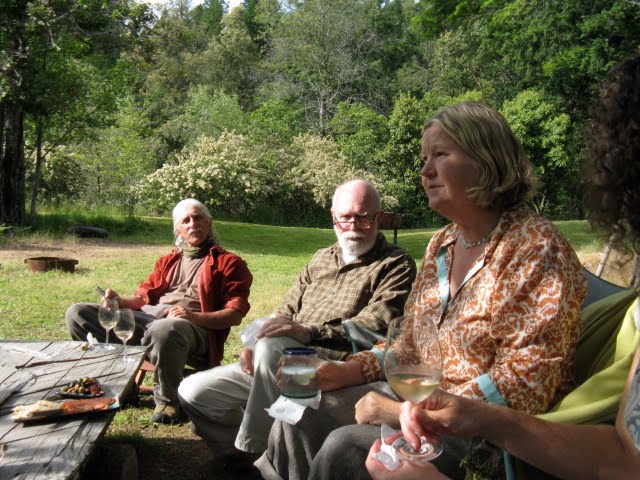
Aside from tending to their new property with extraordinary earth-stewardship and devotion to the land, they both have work schedules that most of us would find beyond daunting: aside from hiring seasonal day labor, Vince works his 26-acre vineyard by himself, producing 1,000 cases of his own label and providing grapes for a number of others—a labor of love that keeps him busy from early morning. In addition to her studio work, Arminée has created for herself a niche profession as the California representative for a French cooperage (oak wine barrels.) Yet they both manage to make all this work seem light and pleasurable, and still make time for generous hospitality. Sitting by the pond before dinner...

... with drinks and snacks with our hosts and a group of friends...


... felt a little like an alfresco Tuscan picnic—the profound kind of pleasure that good food, good wine, good conversation and good friends can bring.

We spent two nights and a glorious day in between with these good friends. Arminée was kind enough to take a rare day off, and after breakfast led us on a long hike down through the woods...


... to the creek that flows through their property, and up along the road that leads past adjacent properties hidden from sight. The early part of the walk involved a good deal of scrambling over rocks and moss-covered fallen tree trunks and branches, along with the occasional sighting of such delights as a wild turkey carcass...

... the remains, no doubt, of some predator’s feast—and bulbous mushrooms...

It was all a timely reminder of how hungrily the human soul feeds on the wealth of nature, and how rare the opportunities are for those of us who live in and around cities to enjoy that treat.

Monday, Memorial Day, was the forty-first anniversary of the day when Ellie and I met for the first time...

For our second evening at Vince and Arminée’s, we sat out by the pond again with other visiting friends for wine and treats and toasted the occasion. Before returning to the house at dusk for dinner, Vince offered us a tour of the pond in the rowboat to celebrate...

We managed to board without incident, and spent a few delicious minutes with the gentle rocking of the boat, the gathering twilight, and the voices of the bullfrogs, deep and resonant as the chanting of Tibetan monks…

A great conversation over Arminée's wonderful dinner...


... where we weighed the future of the planet and of the species that inhabit it—particularly our own. Are we destined for extinction—perhaps self-inflicted?—like so many other species that have disappeared? Or are we perhaps, finally, beginning to learn the lessons that nature and history have to teach us? Does consciousness have a chance to put the brakes on human greed and the fouling and exploitation of our natural environment? We had passionate arguments on both each side…

Tuesday morning I woke early, to find the property shrouded in a gentle mist...

And after breakfast it was departure time. We were due back south. Arminée led us off the mountain in her classic little Citroen 2Chevaux...

... a strange and wonderful apparition in this remote area of the American west!—and down to the vineyard where Vince had already been long at work with his tractor, turning the soil between the rows of vines.


This same ground has been tilled, and the vines tended by his family since 1929—one of the first vineyards to have been planted in the Napa Valley. It’s clear that at this point Vince could choose to sell out to some large neighboring enterprise, and walk away with a nice chunk of money and a whole lot of freedom from work and worry. But that’s not the path he chooses. It’s people like Vince who inspire me to stay, thus far, on the positive side of last night’s discussion!

A long drive south. We by-passed the Bay Area this time, heading around to the east and rejoining 101 to the south of San Jose. Then on for countless miles to Templeton, just south of Paso Robles, where we were booked for a couple of nights into a B&B. We arrived in time to unpack and enjoy a good dinner at a local restaurant, and headed back for an early night, to recover from the dreary miles of travel. Next morning, though, we were up in time for an excellent breakfast prepared by our hostess, Elaine; and to hear about the couple’s passion for road cycling. Scott, her husband, is a one-time racer, well-informed, as I discovered, about the history of the Tour de France.

We started out our wine country tour with a stop a a goat farm...

... to buy fresh made cheese; then spent the day on a tour of the beautiful local farmland, with frequent stops along the way at some of the many the wineries...

to taste their wares....

The rolling hills are already golden with the sun-drenched grasses, reminding us, not for the first time, just why California earns the name “Golden State.”

(This picture gives only the barest idea of the golden hue!) It’s not just about the precious metal that was discovered here in the nineteenth century; it’s about the incredible color of the hills throughout the state, once the green of spring is over and the summer approaches. The landscape simply glows.

These days, of course, a lot of that land has been cultivated by the vintners, and at this time of years the vines stand in endless, neatly kept rows of sturdy stalks and luscious green foliage—a lovely sight in themselves. And there are still small family farms, with horses and cattle out to pasture in the fields to left and right of the winding, narrow roads. Along the way, we stopped at a deli for a sandwhich and shared it at a picnic table at the Denner winery, with its hilltop view of miles of carefully tended vineyards and wheatfields. At the tasting counter, after lunch, we met up with a nice young woman who is off to art school this fall, and who much appreciated the gift of a copy of “Persist.”

The remainder of the afternoon was spent driving from winery to winery--our favorite was the beautifully tailored Justin, with its beautifully-tailored wines—and getting lost for miles way out in the country before finding our way back to Templeton. A brief drive south from there brought us to Atascadero, where we had learned a farmers’ market was in progress, and Ellie wanted fresh fruit and vegetables to bring home. Then back to Templeton, where we had been invited to join our B&B hosts on the green at the center of town for a glass of wine and a salad dinner as we listened to the band at one of their weekly summer concerts.


A fine evening’s entertainment, in the kind of friendly, active community that gives one hope that all is not lost in the political mess in which this country finds itself... The hardest part of the trip was coming back to the television news, and the dreadful story of the desecration of the Gulf.