Monday, January 31, 2011
The Entertainer
Saturday, January 29, 2011
The Arab Street
Friday, January 28, 2011
"KEEF"

Thursday, January 27, 2011
The Leonard Bernstein Story
Wednesday, January 26, 2011
Obamatics: The State of the Union
letting high-end tax breaks expire won’t raise enough revenue to pay for needed investments or reduce long-term deficits. Mr. Obama proposed to simplify both the corporate income tax and the personal income tax, but he did not call for raising other taxes. Americans may not want to hear that taxes have to go up, but until Mr. Obama and other political leaders are willing to say so, credible deficit reduction will remain out of reach.
Tuesday, January 25, 2011
Another Transition
Monday, January 24, 2011
Some Thoughts Prompted by Dick Cheney's Heart
All joking aside—and I confess to having enjoyed the Tin Man and Darth Vader jokes as much as anyone—I have been concerned for a number of years about the condition of Mr. Cheney’s heart. One concern, to be sure, was the possibility of a man with so shaky a vital organ ending up in the Oval Office. Another was of an even more speculative nature: is the physical heart—that muscular pump—truly the source and generator of human compassion, or is it simply an age-old metaphor for the same?
I do not, of course, have the pleasure of any personal acquaintance with the former Vice President; but based on what I have seen through media reports about his actions and his words, my judgment from afar is that he is markedly lacking in the quality of compassion. Most recently, aside from the television news interview mentioned above, I saw an excerpt from a report covering his participation in George H. W. Bush's reunion with some of the former President’s key cabinet members. On both occasions Cheney seemed remarkably affectless, remarkably disconnected from the human consequences of his actions—particularly his aggressive promotion of the invasion of Iraq. For him, it seemed to me, an action that cost countless human lives and caused unfathomable misery was nothing more than a business decision.
My cheerfully uninformed judgment, then, is that this is a man whose severely dysfunctional heart is the physical manifestation of an equally severe spiritual and emotional dysfunction.
As readers of "The Buddha Diaries" will know by now, it is my habit when I find myself making powerful negative judgments about others, to spend a little while looking in the mirror, in order to see what I might need to learn about myself. In this instance, my mirror reminds me of the many years I spent in denial of my own heart. While my head was wonderfully well educated, my heart was taught at an early age to armor itself against the dangerous and hurtful world outside. In this I became so skilled that by the time I entered into young adulthood, the very mention of the heart was an embarrassment to me. In poetry, my chosen medium, I deemed it capable of generating little more than squishy, self-indulgent sentimentality. I dismissed the heart as a foolish and inconsequential thing, though in retrospect I think this was probably because I was afraid of what I might find there if I dared to explore its hidden depths.
It took me, I regret to say, more than fifty years to admit to myself and the world that I actually possessed a heart. I described the painful process of discovery in great depth in a book I wrote nearly twenty years ago. It was called While I Am Not Afraid, and its subtitle was “Secrets of a Man’s Heart.” The short version is that I was confronted with a moment of appalling crisis which shocked me into the understanding that I could no longer continue my journey through life neglectful of the need for a functioning heart; my own deficient organ was revealed to me in all its shrink-wrapped vulnerability in the course of a memorable weekend’s retreat in which I was quite simply cracked open like an egg. It was a humbling and a shattering experience, and one that radically changed the direction of my life.
I have made every effort, since then, to keep my heart in mind, and I look back at certain youthful acts of heartlessness with shame. I have come to believe, in good part through what I have learned from Buddhist teachings, that the heart is the true center of our humanity, the seat not only of the love we put out into the world but also of the courage and honesty with which we observe our actions and evaluate them; and of the loyalty that characterizes the best of our relationships with others. I love the notion of “a stout heart,” and aspire to have one.
The heart, as Blaise Pascal reminded us, also “has reasons which reason knows nothing about.”(“Le coeur a ses raisons que la raison ne connait point.”) It has "a mind of its own," a thinking capacity as powerful as the brain’s, and one we allow the brain to override at the risk of losing touch with our humanity. For this reason, it is also the seat of our integrity—if we think of integrity as the way of having all our faculties in balance and ensuring that they work together for the benefit of others and ourselves. This way, according to what I know of Buddhist teachings, lies happiness. Here’s Thanissaro Bhikkhu:
If we think of the heart as the side of the mind that wants happiness, the head is the side that understands how cause and effect actually work. If your head and heart can learn to cooperate — that is, if your head can give priority to finding the causes for true happiness, and your heart can learn to embrace those causes — then the training of the mind can go far.Thanks to Dick Cheney’s mechanical heart, I have been more careful in the past few days to watch the workings of my own. The best moment to do this is during meditation, when I can observe both its physical and its emotional activity. I bring my attention to its location in the chest and hold it there, intently focused on the physical sensation of the beating organ, the muscular contraction and release; on the flow of blood as it pulses out through the arteries and saturates the furthest extremities of the body; and on the cleansing process as it returns to the point of origin for recycling.
All this is fascinating to watch. But the other part of the work is to activate that cooperation of which Thanissaro Bhikkhu speaks. I find a special additional delight in using the intentional focus of the mind to open up and soften the heart. The practice of metta affords me the opportunity to practice compassion toward, first, myself (if I fail to feel it for myself, how could I feel the same for others?) and then to the human and other living beings with whom I share this planet.
My thanks, then, to Dick Cheney--but this is not intended to let him off the hook. I find it instructive to look back at the Cheney/Bush relationship in terms of the head and heart. Seen in this light, George W. Bush would be all heart (not necessarily the compassionate kind!) and no head; and Cheney all head and no heart. But rather than working in a benign, symbiotic collaboration where each would have corrected and modified the other—head softened by heart, heart tempered by head—the pair charged ahead in the grip of the worst impulses and excesses of each. The result, fatally, was the most disastrous eight years for America in living memory, and a cautionary tale about the consequences of ignoring either head or heart when it comes to taking action in the world.
Sunday, January 23, 2011
A NOTE
Friday, January 21, 2011
Costa Rica/Panama, Part IV
... toward our destination, the Barrio Colorado Island and the Smithsonian Tropical Research Institute based there.
Originally just another hilltop, BCI was created when the waters rose after the construction of the Chagres River dam as a part of the Panama Canal. As our daily briefing noted, “Its small area (a total of 1500 hectares) and new island condition made it a natural choice for a laboratory, important in studying both tropical ecology and biogeography.” To give us a fuller sense of the work being done there, we were offered a lecture by one of the senior staff scientists. I should have taken notes, but memory tells me that his lecture was largely about biodiversity and the interdependence of species. It was, believe me, utterly fascinating.
After, breakfast, then, we dropped anchor in the sheltered harbor and made our final excursion aboard the Zodiaks to the research center’s dock. We were greeted there by the open jaws of a small crocodile...
... perched comfortably in the sunshine atop a buoy just across from the pier. Following instructions (long pants, tucked into socks at the beginning of tick and chigger season!) and the now familiar drill of slipping out of our life vests, we met our guide—a charming young woman whom I presumed to be a graduate student...
She led us up the hill past the complex of research buildings...
offices and dormitories to the start of the “Fausto” trail...
... the hardier of the two hikes being offered that day.
There was much of interest along the trail...
... a beautiful hollow tree, looking up...
... (looks brown here; it was mellow yellow--see croc pic, above) toward the second set of locks leading down to the Caribbean.
... a Panamax car carrier from Kobe, Japan, whose bulk left only inches on either side and whose towering height effectively blocked our view of the way ahead. Still, it was once again a fascinating experience to watch our progress through the locks...
... and into the waters of the Atlantic Ocean.
We docked, at the end of our voyage, in Colon, and it felt strange to be back in a busy industrial environment.
We were sad, that evening, to have to say goodbye to new friends. Sitting down to feast at the traditional “Captain’s Dinner,” we had the opportunity to raise a toast to our fellow travelers, as well as to the staff and crew who had done such a great job in guiding us and taking care of our needs. Still, knowing that we had to take a very early bus ride back to the airport in Panama City, we made an early night of it to be ready for the long trip home.
Saturday, January 15
Sleep came hard. We were up and about at 4:30 AM, even earlier than necessary for our 5:30 bus departure. Bags parked outside our cabin door, we had time for a leisurely cup of coffee and a snack breakfast before heading down the gangplank and out onto the dock.
It was a long drive, mostly through darkness until we reached the outskirts of Panama City at daybreak. The skyscrapers glittered regally in the distance as we drove through crowded streets past rickety roadside stands and clustered shacks in hectic, sauve-qui-peut traffic, past lines of working people waiting for the brightly painted buses or besieging the food stalls, past billboards advertising everything from beer to underwear and luxury automobiles, past decaying industrial buildings and brand new shopping centers. Humanity, in other words, at work…
Arriving at the airport in good time for our Miami-bound flight, we bought another cup of coffee and waited for our boarding announcement. The rest—the arrival in Miami, the US customs, more security checks, the crowded airport restaurant at lunch time, the flight back to Los Angeles with an overworked, hastily heedless crew—all this is best forgotten. There were too many good things to remember, including a much enhanced sense of the incredible beauty and diversity of our planet--as well as its infinitely delicate balance and its vulnerability.
And it was good, finally, as always, to be back home.
Thursday, January 20, 2011
At the 16th Annual Los Angeles Art Show
Wednesday, January 19, 2011
I Interrupt Myself...
... briefly, to celebrate this gracious visit from a hawk, outside my office window.
Costa Rica/Panama, Part III
We woke after cruising during the night to find ourselves anchored off the tiny Granito de Ora island in the Coiba National Park in Panama. The island is basically just a chunk of rock...
... jutting out of the Pacific Ocean, with a mop of dense vegetation atop and a few smaller rocks clustered around it...
On one side, a small stretch of sand provides a sheltered beach...
A cozy desert island, in other words, and an ideal spot for our morning of gentle relaxation. Here's the Sea Lion, from the shore:
The Zodiaks shuttled us with our snorkeling equipment from the Sea Lion to the beach, where the staff and crew had already been busy before breakfast, off-loading kayaks, underwater cameras and other gear for our enjoyment...
Since we were still relatively early in the day, Ellie and I decided to do our kayaking before the midday heat and, this time, requested the singletons. Barely launched from the beach, I somehow managed to lose my balance and overturn the little craft completely, ending up upside down in the shallows. Once aware of what was happening, I worried for a few moments about the possibility of being trapped in this position; but I actually just slipped out and came quite easily to the surface. Had I not, there were plenty of willing rescuers on hand. We had a good laugh about the incident—particularly when I heard that this was a first. Apparently no one before me had ever managed this feat.
(Sorry, no pictures!)
Once righted, I joined Ellie in a paddle around the entire island—not a huge achievement, since the island is so small, but a quiet pleasure in these blue waters, with a clear view, even at some depth, to the ocean floor.
Safely beached again, we donned our snorkeling gear. (How did we manage to miss this photo-op?) Like Ellie, I have had difficulty with this paraphernalia in the past; perhaps our equipment was of a cheaper, less reliable variety. This time, with the application of a little Vaseline around the mustache, I managed to get a good seal with the mask, which made everything a whole lot easier. (We had been advised, too, when the gear was initially distributed, to smear the inside of the mask with toothpaste and leave it to dry; once immersed and cleaned off, the toothpaste left a film on the inside of the mask effectively kept the lens clear of fog and condensation. A useful tip.)
The wild marine garden below the surface was magical. We swam around the rocks, above the coral beds, amongst fish of all shapes and sizes, some with lovely, bright, iridescent colors, who seemed as incurious about us as we were curious about them. Some spotted a shark lurking in the depths, but I was not so fortunate. I did, though, see a moray eel snaking in and out among the seaweed. We found ourselves in a beautiful, silent, constantly shifting alien world where we humans seemed the clumsy intruders—as odd, in a way, as if we were suddenly flying with the birds. Again, no underwater pictures, I fear: we did have a waterproof camera bag, but were too much concerned with other things to be willing to risk it. A little more familiar with how it should be done, however, we are encouraged to repeat this wonderful experience in the future.
I have always loved beachcombing...
... collecting shells, a hobby that’s now as inappropriate as collecting birds’ eggs—another of my youthful sins, as a boy in the English countryside. After our swim...
... and with the understanding that nothing could be removed, we combed the beach...
... and found some lovely shapes and colors....
Nothing very complete, to my astonishment. Mostly fragments. We made a collection of them...
... knowing that the tide would soon restore them to a more natural location. I suppose there must still be places in the world where perfect seashells are to be found. Here, those that remained intact, the small ones, were mostly occupied by the hundreds of hermit crabs scurrying everywhere along the shoreline.
Late morning, the Zodiaks arrived to take us back on board...
... where, after lunch, we enjoyed a slide lecture by Patty Hostiuck on butterflies and moths. Her talk was packed with fascinating, often surprising information; and once again, we were amazed at the complexity and refinement of the natural world, its innate intelligence, and the extraordinary perfection of its relationships.
After enjoying the luxury of a peaceful nap, we made our way to the ship’s prow, where we watched in more amazement as a quartet of dolphins sped through the water just inches ahead of us, rolling joyfully and leaping clear of the water to splash back down—as though to prove their agility so much superior to this human mode of marine transportation. A joy to watch. I’m afraid, again, that I did not manage to click my camera at the precise moment to catch the best of their leaps and rolls, but here they are...
Thursday, January 13
We had been warned. The Sea Lion’s captain took a moment a dinner time to announce that we would be traveling a good distance, all night, in fact, toward the Panama Canal; and that we would be passing, along the way, the Punta Mala—the “bad point,” where waters could be rough. And indeed, there were moments when the pitch and roll was quite dramatic. I do not suffer from motion sickness, but I did feel more than a little queasy at times during the night.
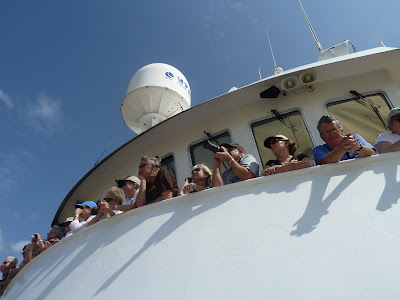
We were still sailing when we awoke, and came to anchor only at breakfast time, off the Otoque and Bona Islands in the Gulf of Panama. This is an area, our daily information sheet tells us, where “a break in the mountain chains that parallel the western coastline of several Central American countries allow the trade winds to blow over the Gulf, pushing surface waters away. Nutrient-rich waters from below upwell to replace these, bringing about an extremely high productivity that forms the basis of a complex web of life.” This last stop in the Pacific, then, was to allow us the opportunity to take a final Zodiak ride around one of the islands and enjoy the spectacle of some of the millions of seabirds who take advantage of this ecological wealth.
We joined the first of two expeditions, speeding across the gulf...
... to the remote island home of many of these birds...
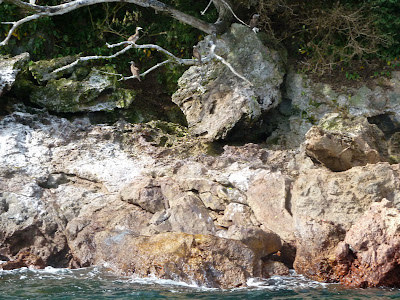
The rocky coastline was an amazing sight...
The cliffs were crowded everywhere, mostly with Pelicans, Blue-Footed Boobies...
... and soaring Magnificent Frigatebirds—so named for the M marking on their plumage. We had arrived, it seemed, at the beginning of the nesting season, and already the white, fluffy hatchlings of the boobies were clearly visible...
... their parents perched close by in attendance. Again, our naturalist guides proved a well of information; and again, I have already forgotten much of what I learned. What stays with me are the majestic images, the moving experience of being with so many living creatures in their wild habitat. It is comforting to know that such places continue to exist in a world where human beings have so wantonly co-opted much of nature’s wealth.
Of which we were soon to be reminded, sailing on toward the Canal and finding ourselves a now tiny vessel amidst an international armada of massive cargo ships...
... all waiting at anchor for their turn to make the transit to the Caribbean. Beyond them, in the far distance, a view of Panama City with its (to us) surprising skyline of towering skyscrapers...
... many of them still under construction. Our own passage had been booked, so there was little waiting to be done. Approaching the entrance to the canal, we were boarded by the pilot...
... who would see us through the locks, and by a crew of blue-shirted line handlers...
... whose job it is to work with their counterparts onshore...
... to secure the towlines to the powerful locomotives...
... that move the traffic from their rails along the docks. A rowboat...
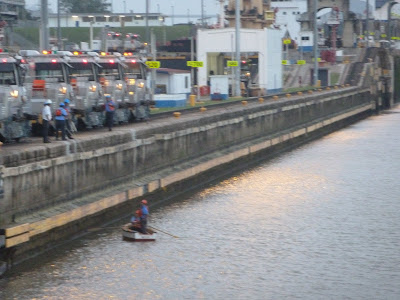
... ridiculously tiny and primitive beneath the hulking cargo ships, is used to assure the connection of lines thrown out between ship and shore; even an outboard motor, we were told, would risk tangling lines. All this was narrated, along the way, by Christian, a Panamanian, proud of his heritage, who had been one of our guides during the cruise.
Oh, here's Ellie, windswept, margarita in hand, as we approach the Bridge of the Americas:
... upward through the Miraflores and the Pedro Miguel locks and through the Culebra Cut to the man-made Lake Gatun, which separates the rising from the falling set of locks; and we all stood out on the decks, transfixed by the process—and by the engineering feat that made it possible. (We had watched, in the lounge with Christian, the David McCullough Nova episode on the amazing history of the canal, from its disastrous beginning in the hands of the French to its triumphant completion by American engineers—all at the cost of hundreds of human lives.) The canal is certainly one of the great engineering achievements of the human species. It is an awesome experience, to watch the “Panamax” ships—designed to just squeeze through the locks—being lifted by the rising water level between the massive concrete walls; but, all in all, I’d rather be in the rain forest.
Once through the locks, the Sea Lion set sail once again across Lake Gatun in the direction of the penultimate mooring place of our cruise... Still more to come.