Friday, December 30, 2011

"PHENOMENAL"


A post-Christmas drive took us down to San Diego, to visit the Museum of Contemporary Art for an exhibition in the Pacific Standard Time series, Phenomenal: California Light, Space, Surface installed at both the downtown gallery and the original MCASD space in La Jolla. A big enthusiast for this great period in the history of California art, I had been planning to get down there for some time, but had been postponing the trip for a variety of reasons. It proved worth the drive.

Before heading for the museums, though, we made a stop at Ellie’s sister, Susie’s house in the heart of San Diego, just to deliver our holiday greetings in person and wish her well for the coming year. Susie is an ardent and knowledgeable fan of “mid-century” architecture and interior design, and has a great eye for quality when it comes aesthetic choices. Her present abode is filled with delightful objects—art works, pottery, textiles…—that make it a real pleasure to visit. It’s a hobby, a lifestyle, a passion that obviously brings joy into her life and helps her to create an environment that manages to be at once spare and rich in meticulously chosen detail. Good for her, in a world where so much is hasty and utilitarian, to devote herself to simple elegance and beauty.

As I've said, I’m a sucker when it comes to California Light/Space art. I arrived in California in 1968, when the movement was still at its height. (I tend to see it as a logical historical development both from the impressionistic “plein air” tradition of the early years of the 20th century; and of the hard edge color abstraction of the forties and fifties.) At the time, I had little exposure to the work of contemporary artists, and this work intrigued me particularly because it had avowedly to do with the phenomenology of perception—how the mind/eye perceives the world about it, how this phenomenon itself can be brought into service as a medium for the artist, and how our perception can in turn be changed and enriched by the artist’s vision. I came to California as a poet; this art did not ask me to bring my intellectual, verbal self to “understand” it; it offered itself instead to my openness to the experience of the moment.

Larry Bell, untitled, ca. 1970, Inconel coated glass in 5 panels. Courtesy of the artist and the Hendrickson Family Collection. © Larry Bell. Photo by Philipp Scholz Rittermann.


I have to say, the show in the downtown galleries left me initially disappointed. I brought those high expectations with me and the work seemed somehow tired, not the sparkling display of vibrant light and energy I was looking for. Perhaps it was the installation: the lighting was low, and seemed dull to me. I found myself agreeing with Ellie’s assessment: “old chestnuts”—not exactly what you’d want to be saying about California Light and Space. Even the sheer, perfectionist beauty of some of the work...

Doug Wheeler, DW 68 VEN MCASD 11, 1968/2011, white UV neon light. Courtesy of the artist. Photo: Philipp Scholz Rittermann.

James Turrell, Stuck Red and Stuck Blue, 1970, construction materials and fluorescent lights. Collection Museum of Contemporary Art San Diego, Museum Purchase, Elizabeth W. Russell Foundation Funds. © James Turrell. Photo by Philipp Scholz Rittermann.


... seemed a bit jaded, no longer quite so exciting to the senses as it once had been. (Actually, they look pretty brilliant in these images!) But I did find that excitement in an unrelated gallery, the one devoted to a huge installation by Jennifer Steinkamp, a digitally- generated heir to Light and Space, where layered, constantly moving images of flowers and blossoming trees evoked the random, ceaseless motion of the subatomic world writ large, expanded to the scale of three aircraft-hanger sized walls, as visually intriguing as they were awe-inspiring in their beauty and their shifting patterns of relationship.

The La Jolla galleries devoted to “Phenomenal” did much to restore my disappointed love. Several of the artists seemed to shine. What a pleasure to see Helen Pashgian stand out so well, with several stunning works in cast polyester resin—particularly a group of three small spheres...

Helen Pashgian, Installation view of three untitled works, 1968-69, Courtesy of the Museum of Contemporary Art San Diego, Museum purchase, International and Contemporary Collectors Funds; Pomona College Museum of Art, Claremont, California; Norton Simon Museum, Pasadena California, Gift of the artist. Photo by Pablo Mason.


.... affording a long view through their gleaming irises; and a couple of fine, illusory two-dimensional “paintings” in the same translucent material. And I have more than a soft spot for the mysterious, high-polished, monochromatic planks and other geometric forms by the late John McCracken...

John McCracken, Blue Block in Three Parts, 1966. Lacquer, polyester resin, fiberglass, plywood. Collection Museum of Contemporary Art San Diego, Museum purchase with funds from Ansley I. Graham Trust, Los Angeles. (c) The Estate of John McCracken. Courtesy David Zwirner, New York. Photo by Philipp Scholz Ritterman.

... they remind me of the monolith at the start of Stanley Kubrick's "2001: A Space Odyssey"—presences that seem to have arrived, unexplained and inexpicable, from outer space.

Then there’s the long, narrow, neon green corridor installation by Bruce Nauman...


Bruce Nauman, Green Light Corridor, 1970, painted wallboard and fluorescent light fixtures with green lamps, dimensions variable. Collection Solomon R. Guggenheim Museum, New York. Panza Collection, Gift, 1992. Photo by Pablo Mason. (c) 2011 Bruce Nauman / Artists Rights Society (ARS), New York.


....which you can navigate only sideways, at snail’s pace, through eerie green light; when you emerge at the far end, everything is suddenly violet, slowly changing into pink. And you find yourself released into a gallery with a Robert Irwin work, installed long ago, in which the artist simply removed certain geometric sections from the slightly tinted windows, looking out over the deep blue Pacific Ocean, creating in each case a “hole in space” that reminds us how often we fail to see clearly, because we do not pay attention unless invited or compelled to do so.

And finally, the wondrous black hole created by the late Eric Orr—a room so dark that it seems, as you feel your way in from the entry, completely devoid of light. Once inside, you stand in total darkness, never imagining it to be penetrable in any way. Stand there for three or four minutes, though, and the eyes, amazingly, adjust. The silhouettes of other visitors start to emerge, black against the barely detectable glow of light, coming from you know not where. A few minutes more, and you begin to be able to see detail, soon quite clearly, as the darkness recedes. It’s an amazing, slightly dizzying experience, and one that works on the mind in somewhat the same way as the anechoic chamber works with sound—or the absence thereof. You watch yourself becoming aware.

All in all, "Phenomenal" is an ambitious show, and a welcome resurrection of a piece of the unique history of art in this part of the world—an area so singularly blessed with natural sunlight that it inspires its artists to investigate that property in their work; and seemingly so receptive to creative freedom that they readily dispense with convention and received ideas about what art should or should not be. It becomes whatever the human mind is capable of perceiving and experiencing with delight, whatever expands our vision and potential. Which makes it a special privilege to live and work in Southern California.

Wednesday, December 28, 2011

"PATIENCE": A BOOK REVIEW

I have just finished reading Patience: The Art of Peaceful Living, by Allan Lokos, the founder and guiding teacher of the Community Meditation Center in New York City. It’s a timely read for a season in which the stresses seem to multiply in direct proportion to the peace and joy we’re supposed to be feeling—and too often don’t!

In many ways, the book is a very readable course in Buddhism 101, a primer in Buddhist thought and practice for those who will value the introduction; it is also an important refresher course for those of us who have been practicing for a while—and who recognize that it’s still, and always, about “beginner’s mind.” Patience is at the very heart of Buddhist practice: without it the noble Eightfold Path would be impracticable for even the most ardent of its followers. A wise and, yes, patient guide, Lokos leads his readers through the benefits of patience with, first, ourselves and then with others in our personal and professional relationships. He offers the inspiration of notable exemplars, and includes not only the words of wisdom of great teachers in the Buddhist tradition, but also simple, do-able exercises and practices to help us along the way.

Patience is not an easy virtue, particularly in today’s world where we rush about our daily lives and readily succumb to the siren call of multi-tasking—at the cost of our peace of mind and happiness. I observe the suffering I create for myself when the traffic backs up on the freeway, when my computer fails to perform in conformance to my expectations or needs, when those around me make demands on my time and energies that I am reluctant to share. I watch the feelings of anger and frustration that arise when I don’t get what I want exactly when I want it. (Lokos includes appendices with useful lists of keywords to identify those fleeting feelings and other sources of stress; being mindful of them is helpful way to avoid the reactive patterns that contribute to our suffering without our knowing it.) When spoken in impatience, my words not only cause others to suffer, they do nothing to alleviate my own. Impatience takes a heavy toll, on my body, too, manifesting in the form of headaches or belly aches, fatigue, and general physical discomfort.

“Patience” is a thoughtful and always interesting book, and one that engages our attention. It challenges many of the assumptions and misconceptions we have about ourselves and the world we live in, reminding us that there is always another side to every view. It invites us to do the hard work of continuous mindfulness, and offers us the means to find release from self-inflicted (and other-inflicted) pain. As its subtitle and its final chapter suggest, “peaceful living” is indeed an “art” that can be learned through mindful practice—a valuable lesson to all who seek surcease from the stress we bring, often unconsciously, upon ourselves. As the Beatles sang, memorably, many years ago, “we all want to change the world.” “Patience” would be a terrific place to start--not to mention an excellent New Year's resolution!

PICTURES....

... have now been added to yesterday's post, as promised.

Tuesday, December 27, 2011

CHRISTMAS... AND BOXING DAY!

It has been, for The Buddha Diaries, a long silence. Time to catch up on an amazing week that culminated, yesterday, in a disaster. But let's start with the good part...

It was the "holiday season," as those of us who wage a joyfully vindictive war on Christmas like to call it. (I actually have nothing against Christmas per se, but I do have it in for what has come to be the yearly celebration of crass commercialism in the name of religion; and the abandonment of virtually every value that religion espouses in favor of the acquisition of "stuff." But let's not get into that.) Our daughter, Sarah, arrived last Wednesday with her now seven-week-old son, Luka...

who brought with him nothing but joy and wonder at the miracle of new human life.

Ellie and I spent a good part of the week in preparation for his arrival, and for the large number of guests we expected to join us for dinner on Christmas Eve. There was plenty of food shopping to be done--on numerous expeditions because, of course, something was always forgotten or something new was needed. There were what seemed like hours of chopping and dicing: I am the sous chef, Ellie the menu preparer and the main chef. We made casseroles and salads, soups and stuffed peppers, cakes and muffins... food for an army: Ellie does not like the prospect of running short or anyone going hungry. In between times, we entertained our grandson...


... while his mom enjoyed the luxury of some quiet moments for herself, and took long walks with the baby in the stroller. He also went downtown with us to do some last-minute gift shopping and a visit with Santa...


I found him a fine Laguna Beach baseball cap...


Our Christmas Eve dinner was a great success. Sarah's friend Azalia and her sister Jan arrived in the early afternoon, followed shortly by Ed, Luka's dad, fresh from work; and soon thereafter by Ed's brother, Stan, and his girlfriend, Kelly...


... and finally Stan Hudecek senior...


We drank our traditional family toast in the champagne that Ed had brought with him, remembering not only those close at Christmas, but also those in more distant parts of the world, from Iowa to England and the Czech Republic, where Stan senior was born and where his family still live. And sat down for the feast at our Christmas table...


Much merriment at the table, along with the appreciation for the excellent--and, in honor of our daughter preferences, exclusively vegetarian--fare. With many of our guests leaving after dinner, the rest of us settled down to a game of team Scrabble, in which Ellie and I gloriously--and decisively--defeated the Hudecek brothers and their mates.

Christmas Day, Ellie and George and I were up at our usual early hour, abducting our grandson for a walk...


... down to the cafe near the beach where we often go for breakfast. We sat with a cup of coffee and a muffin in the beautiful, warm sunshine, thinking that life could not get much better than this. Then back home for our traditional brunch with, this year, the substitution of buckwheat pancakes for our usual English scrambled eggs, along with lox and bagels and a mixed fruit salad. No one, again, went hungry. Not even George...


After brunch we did the Christmas stocking bit--usually an early morning event, but postponed beyond its normal time in honor of Ed, who is a night person, and rarely puts in an appearance before noon! When Sarah was no more than a tot, one of the graduate students I worked with made her this enormous Christmas stocking...


... which has proven quite a challenge, in succeeding years, for Santa to fill. Somehow he manages each year, and our now not so little daughter still delights in the ritual...


... as do her parents. Many wonderful gifts, then, all around, and much pleasure in the spirit of generosity with which they had been found, wrapped, and given.

I had discovered earlier that there was to be an unusually low low tide at four in the afternoon, so we headed down to the park around the Montage hotel for a walk on the beach. We were surprised by the traffic and the crowds, and had a hard time finding a parking spot; but soon headed down the path in front of the hotel and transferred Luka from his stroller to a sling carrier before crossing the beach to the water's edge.


A glorious late afternoon, with the sun heading down to the horizon over Catalina Island, reflecting pearlescent colors in the breaking waves as they reached the shore...


Out beyond the breakers, to our delight, a school of dolphins leapt and played, while cormorants and pelicans dive-bombed for fish in the fading light. It was all almost too beautiful to be true--a superb ending to one of the most wonderful holidays in memory.


Sarah and Ed and Luka left for Los Angeles later in the evening, and Ellie and I were looking forward to a day of rest and relaxation Monday. Alas... (Now for the bad part!)

I had noticed, Sunday evening, a suspicious little puddle gathering around the clean-out valve for the drain that leads from our cottage to the city mains, and called in the morning to arrange for the plumber to come later in the week and do the semi-annual roto-rootering necessitated by the insistent growth of our neighbor's tree roots. We had decided to postpone our scheduled visit by a month--a decision that was to prove foolhardy this Boxing Day. With some chairs to return to their place in the basement storage area, I opened the door to Ellie's studio under the cottage and was greeted with a foul stink and hideous mess: the raw sewage had backed up from the drain and exploded through sink, flooding the studio and soaking books and sketch pads along with everything else in reach.

The plumber graciously responded to an emergency call and arrived to clear the drain. But the mess that remained behind him required hours of painstaking clean-up—not to mention the loan of a neighbor’s industrial power fan to help air out the space and drive out the stench.

What kind of karma was this, we wondered, following so close on our week of love and generosity? No doubt, in retrospect, it will seem a lot funnier than it seemed yesterday. And I guess it will make for a good story. Still, no way to spend a Boxing Day…

Thursday, December 22, 2011

HEART-TO-HEART

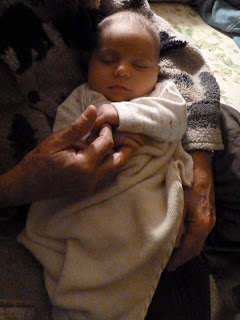
It's a great feeling, to have a good heart-to-heart with another human being. I had one just yesterday afternoon with my grandson. No words, of course. He's only seven weeks old, tomorrow. But his mom and grandma went out shopping, and Luka was left in his grandpa's care for an hour or so. At first he was quite restless, squirming away in my arms. I though he was maybe wanting to get a bit of exercise, so I laid him out on the couch; but no, he didn't like that. So I picked him up again and bounced him around, walking back and forth in the living room, and before long he was fast asleep. We sat down on the rocking chair together, heart-to-heart, communing at some level way below language...

... until his mom came home.


Then, a little later in the evening, we all watched "The Cave of Forgotten Dreams"--Ellie and I, for the second time in as many weeks. Which gave me the opportunity to reflect a bit on our many thousand-year past, and on this tiny bit of human future I had been holding in my arms.

Wednesday, December 21, 2011

200,000

Around the first of the year, or soon thereafter, we expect to have our 200,000th visit on The Buddha Diaries--that's not counting the 300,000 plus "page views," whatever they may be. It seems only the blink of an eye since we passed the 100,000 milestone. On that occasion, I promised a signed copy of "Persist" to the 200,000th visitor, a person I'm able to identify at least numerically on Sitemeter. I can also tell where in the world that person happens to be, but not the particular individual. My plan was to contact him or her via email if contact information was available, and get a street address to send out my thank-you gift.

Well, okay, a bit gimmicky. But why not? This time around, my offer is this: the very first, brand new, hot-off-the-press, copy of "Mind Work" to go out from its author, signed and dedicated to the actual 200,000th visitor; or, if that individual is not traceable or responsive, to the first successor in line. AND, for the first ten in succession thereafter, a signed copy of "Persist." Between us, Emily and I will do our best to reach out and identify recipients, and let them know of their, um, good fortune. I value every one of my readers, and this is but a small--and admittedly rather random!--way to say so.

In the meantime, the holiday season is upon us, time is short, and family comes first. I expect to be more remiss that usual with my posts--but then I often surprise myself with an entry at the busiest of times. In just a while, our daughter Sarah arrives on the train at Irvine Amtrak station with little Luka! I've no doubt I'll be reporting on the first Christmas for this wonderful new arrival in our family; as well as on missing the other grandchildren, celebrating the occasion at their own home in England. If I don't see you before, have a blessed holiday!

Tuesday, December 20, 2011

A DAY OF TIME

It's a strange feeling. We have just bought ourselves a day of time. Our plan had been to leave in good time this morning for the drive down to San Diego, for a visit with Ellie's sister and an opportunity to see the two-part Pacific Standard Time show at the two branches of the San Diego Museum of Contemporary Art. But late afternoon yesterday, we changed our minds. There is so much stress around the holidays already, we did not need this extra demand upon our resources; easy enough to postpone until next week. Tomorrow, our daughter arrives with our new grandson, to spend the rest of the week; and, on Christmas Eve, Luka's dad and an unknown number of his family. There are dishes to be planned and prepared, presents to be wrapped--and, in some cases, still to be shopped-for and bought. Enough, we decided, was enough.

So now we have a whole unanticipated day of time. What a luxury! Thus far, we have relaxed in bed with the New York Times and George, the dog. George is, of course, unaware of his reprieve: he will not have to spend the entire day by himself, and will likely get his customary play time up in the park. He is sleeping blissfully. I will probably, eventually, bestir myself and head down to the gym for an hour's workout. I plan to finish reading the book that has been sent me for review. Outside the bedroom door that looks out onto the patio, the sun is shining in a pleasantly blue sky; the weather is cool and clear. It looks like a good day to have bought some thus far unencumbered time.

Monday, December 19, 2011

CHRISTOPHER HITCHENS: ATHEISM

I was moved by the death of a countryman, Christopher Hitchens, last week. I am not a big fan of swagger, whether physical, moral, or rhetorical--and from where I sat, not knowing him personally, Hitchens had them all and made a very public practice of them. He was, in debate, something of a bully, cocksure, intolerant of the opinions of those who disagreed with him. Some interpret this as laudable strength and conviction, and deplore the lack of it in those who tend more to listen well and include the views of others in their thinking. I see it rather as a cover-up for a deep inner insecurity and doubt. Whichever is true, it grieves me that a man of formidable intelligence--and one who contributed to the national dialogue with verve, insight and humor--should have died at so young an age.


What interests more above everything else is his virulent and outspoken atheism. I, too, am an atheist. I do not believe in any of the gods our species has invented over these past many centuries, not even the One God most of us seem to have arrived at in our present culture--though there is disagreement, obviously, over which One is the True One. Still, I remain uncomfortable with the certainty of disbelievers. Only death itself will bring any clarity about what reality, if any, exists beyond this life; and death is the ultimate problem that all religions seek ultimately to address. There must, we humans long to believe, be more to it than this brief life we're given to lead on earth.


I arrived at something of a breakthrough in my own thinking yesterday, and wrote about it in The Buddha Diaries. Earlier in the day, before our weekly sit in sangha, I had been reading the New York Times piece about Hitchens and his atheism by the Roman Catholic conservative columnist Ross Douthat. "When stripped of Marxist fairy tales and techno-uptopian happy talk," he wrote, "rigorous atheism casts a wasting shadow over every human hope and endeavor, and leads ineluctably to the terrible conclusion of Philip Larkin's poem, 'Aubade’--that 'death is no different whined at than withstood.’"


I disagree with both of them. It's not merely a belief in God that justifies "every human hope and endeavor." We can still strive to better ourselves and our common condition with other beings without the expectation of eternal reward. Is that not the essence of “hope” and “endeavor”? And, Larkin notwithstanding, there is an alternative to either whining at death or, in the words of his fellow poet, Dylan Thomas, to opting for the other path: to “rage, rage against the dying of the light.” As we can choose to learn from the wisdom of the Buddha, if we’re willing to put in the work it takes it’s equally possible to find a place in our heart where we can address death calmly, with equanimity, and to prepare for it as the ultimate experience of life—the next adventure. But this is not belief. It’s practice. I cannot claim to have reached that point in my own life yet, but I’m working at it.


Is it possible, I wonder, that the deep insecurity Hitchens chose to convert into swagger was hidden precisely in the swaggering atheism he chose so loudly to preach?

Sunday, December 18, 2011

REBIRTH, REVISITED

A wonderfully useful discussion at sangha this morning, after our hour’s sit. It being the holiday season, and there being so few in attendance, I was about to leave right after the hour of silent meditation, but Bob—one of our three Bobs in the group—held me back with a thought about rebirth. He had brought a copy of Than Geoff’s “The Truth of Rebirth”, and knew that I had always found this a sticking point. What, he wanted to know, was my question about it?

Well, I have read the first twenty pages or so of Than Geoff’s book, with a good sense, I thought, of his argument: that the Buddha’s word about rebirth, contrary to much Western thinking about “Buddhism without beliefs”, are in fact central to his teaching. The principle of karma, Than Geoff argues, is critical both on the micro and the macro scale; and it makes fullest sense only if it works life-to-life as well as in this one life we are currently experiencing. It leads him to what I interpreted as a kind of Pascalian bet: no matter whether God—and heaven and hell—exist, we have nothing to lose and everything to gain if we bet in His favor.

I (mis)understood the Buddhist belief in rebirth to be the same kind of bet. And it’s true, there is some shared ground between the two. What Bob came up with that was truly helpful to me was the formulation of a “working hypothesis”: the insight to which he led me was the realization that I don’t have to see it as one thing OR the other. True OR not true. So it doesn’t have to be the “leap of faith” I had always imagined. As always, it seems, the Buddha was inviting our consideration of the hypothesis, challenging us to test out his idea to see how well it would work. It’s not a question of some absolute concept in which I am required to belief as an article of faith; it’s a proposition that may—or may not—prove valid in the light of lived experience.

Now, I am well able to watch karma in action in the one life that I know: my actions lead to demonstrable results. The skillful ones result in less suffering for myself and less suffering for others; ergo, my own greater happiness and greater happiness for others. The unskillful ones contribute demonstrably to greater suffering for all. But there are instances of karmic action that have no such immediate or comprehensible outcomes—and, of course, instances of outcomes that have no apparent relation to karmic action. Why, asks that unanswerable question, do bad things happen to good people? And why do people who do terrible things often seem to reap great rewards rather than appropriate comeuppance? In the light of such considerations, the theory of repeated rebirth makes much more plausible sense. AND it can still remain a hypothesis.

Friday, December 16, 2011

THE ONE PERCENT

There are plenty of people, it seems, who are willing and able to bid in the hundreds of thousands of dollars for baubles from the late Elizabeth Taylor's jewelry chest. I read in yesterday's New York Times that the Christies sale had brought in a record $116 million, no problem, many times the pre-auction estimates. Bidding, as they say, was brisk. I keep hearing the name Kardashian these days, in the context of outrageous ostentation; I have no idea who they are or what they do to make them rich and famous, but apparently they are the darlings of the media. One Kim Kardashian shelled out a cool $64,900 for three jade and diamond bracelets; the pre-auction estimate was $8,000.

Thanks to the Occupiers, the "One Percent" have acquired a certain notoriety--a fact that does not appear to discourage them from their conspicuous consumption. Ellie and I were chatting with an art dealer on our gallery rounds the other day. She had just returned from Art Basel-Miami Beach, the annual December mother of all American art fairs, proximate offspring of the granddaddy of them all, Art Basel. With a glee not unmixed with a certain horror, she told us that her hand was still sore from writing out invoices. She and her two associates, she said, had expected a little fun time at the fair; instead, the three of them were kept busy without a break from opening to closing time each day. We heard much the same from several other dealers. Most were not only delighted at the fair's success, but also aghast at its social implications. Art dealers are people, too. They represent artists who, for the most part, are gifted with a social conscience.

You have to wonder a bit, though, about art folk like the dealer Larry Gagosian and his milk cow (one of them!) Damien Hirst--he of the formaldehyde shark and diamond-encrusted skull fame. Hirst had the inspired idea to take over every one of the eleven palatial galleries in Gagosian's global fleet, in order to showcase his early "spot paintings"...

(photo purloined from the New York Times, with apologies to Andrew Testa)

... many of them already sold into prestigious collections and reassembled for the occasion. Some will undoubtedly be available for resale--at many times their original price. Do we dare to hope that Hirst is using the occasion to make a grand statement about the venality of the art world?

And then, the crown jewel of the moment... Thanks to an article that caught our attention in yesterday's Times, we tuned in to watch a show called Selling Spelling Manor on House & Garden Television. Poor Candy Spelling, an empty-nester who also found herself a widow after her husband, TV producer Aaron's death in 2007, came to the heart-breaking decision that it was time to down-size and move to smaller quarters. The modest, 56,500 square foot family home was on the market. Asking price: $150 million. She had to settle for $65 million less. (You'll find some of the details on the site above. Curiously, the Beverly Hills realtor who did the deal turned out to be the same woman who negotiated our daughter's purchase of a tiny, starter home just off the San Fernando Road in Glendale years ago--for a hundred and some odd thousand! We still get her Christmas cards...)

Well, let's not forget that billionaires are people too. Does Candy Spelling suffer any the less than the rest of us, for all her wealth and social connections? She freely boasted having designed every last detail of her mansion, and supervised its construction. With her designer,

Thursday, December 15, 2011

THE HUMAN CLAY


"To me," wrote W. H. Auden, "Art's subject is the human clay,/And landscape but a background to a torso;/All Cezanne's apples I would give away/For one small Goya or a Daumier." Well, I don't go all the way with Auden on this one, but I do believe that what we should expect from art is that it tell us more about our own humanity. An abstract painting, though, can do this just as well as figurative work. So, no, I wouldn't give away Cezanne's apples. On the other hand, there was for years an unfortunate tendency in modern and contemporary art--and in writing about modern and contemporary art--to dismiss the figure as no longer relevant; it still persists, in some quarters. And with that, I disagree. Profoundly.

Still, it's also not much use for an artist simply to repeat today what has been well done in the past, no matter how skillfully. Not that I can get anything less from Goya and Daumier for having seen their work before; as my friend Tony de los Reyes told his high school class last week, we never look at the same painting twice. We bring a new and different self each time we look at it, just as the context in which we approach the painting changes. But to be interesting and challenging, new art must tell me something new about my humanity, something I may recognize and assent to as what I have always known in some profound part of my being, but have never met in quite this form before. I must feel that Yes! resonate in my heart and soul, and must come away a more fully formed--and in-formed--human being.

All this as a preamble to a few words about "eyehand: Selected Sculpture from 1975- 2011," the current Peter Shelton show at LA Louver Gallery. I have known Peter's work for years and have admired it for its ability to evoke in me precisely the response I describe above. A "sculptor"--that word seems a little inadequate these days--he works primarily, though not exclusively, with the human figure. He works at it from the outside and from within, showing us what is recognizably our anatomy. But Shelton is no literalist. His vision takes the literal anatomy and makes it his own...

Peter Shelton
reddress, 1998-2011
red paint over fiberglass
62 x 77 x 55 in. (157.5 x 195.6 x 139.7 cm)
Courtesy of L.A. Louver, Venice, CA

A limb or a torso may be elongated...

Peter Shelton
birthbone[, 1991-92
mixed media
113 x 19 x 7 1/2 in. (287 x 48.3 x 19.1 cm)
Courtesy of L.A. Louver, Venice, CA

... or otherwise distorted; an internal organ may be inflated or distended...

Peter Shelton
twobiglobe, 2011
mixed media, fiberglass
68 x 75 x 38 in. (172.7 x 190.5 x 96.5 cm)
Courtesy of L.A. Louver, Venice, CA

... sometimes with unsettlingly humorous results as we are confronted with the radical strangeness of these bodies we are given to walk around in, their vulnerability, and our self-consciousness about them. I recall the cultural critic, Leslie Fiedler's thesis that we all experience ourselves in some way as freaks--as children, for example, at the earliest moments in our lives, comparing our small selves to the giants who surround us. As adults, we fuss about our waistline, our stature, our physical defects, comparing ourselves constantly to others or to imagined standards of normalcy.

It's this feeling, for me, that Shelton's work taps into most deeply, confronting us with dream--or nightmare--visions of what it means to be a physical being in the world. That he asks us, eye and mind, at the same time, to join in the play of paradoxical relationships between weight and lightness, inner and outer, space and volume adds to the rich texture of associations he engages. The word "avoirdupois" comes pleasurably to mind. We experience a kind of gravity, in both the physical and the metaphorical sense, a heaviness of actual weight combined with a lightness of being. The work asks us to take measure of our own weight and height as we stand in its vicinity; and it manages to be somehow alarmingly monumental and almost painfully intimate at the same time. It intrudes itself upon our physical as well as on our psychic space and leaves us, yes, more fully aware of what it is to be a human being.

As a footnote, this (unofficial, non-gallery!) picture shows me having a little irreverent fun with Shelton's sculpture. I happen to think that it also says something about that element of absurdity that creeps into the work, its friendly grotesquerie...


And, as a bonus, my own snapshot of the installation...


Wednesday, December 14, 2011

SICK...

... with a cold. It started yesterday, blossomed overnight, and leaves me in bed this morning. And much distraught. Tomorrow, then...

Tuesday, December 13, 2011

OCCUPY "THE BUDDHA DIARIES"

The Buddha Diaries has not made a practice of posting entries by guest writers--not because I would not welcome them but rather because, when I have solicited other voices, they have not chosen to make themselves heard. So today is unusual. My post is a piece by a young friend, Azalia Snail. I know her as an accomplished musician and a friend of my daughter, and I was happy to receive her offer of a piece about her experience with Occupy LA. As a 99 percent-er, I support the goals of this much needed expression of popular outrage against a system of politics, government and finance that is by now indisputably rigged against the vast majority of Americans. My excuses for not being out on the streets myself are pretty poor ones; so I'm glad that Azalia stepped up, and that she is here to report on her experience.


MY OCCUPY by AZALiA SNAiL


When I first heard about a bunch of people flocking to a park in downtown Manhattan, hoisting up tents and waving signs with messages protesting the bankers and the corporate elite, I thought, "bloody damn time already." Somebody had to (finally) rise to the auspicious occasion and demand that the bankers take responsibility for the monetary (or lack thereof) mess that we're in. A few days later, I got an e-mail from Sarah, one of my very best pals (and on that day of October 1, 2011, 8 months pregnant) that she and her partner Ed were going to City Hall for Day 1 of our very own Occupy L.A.! Hooray! I could easily ride my electric scooter downtown and meet them there. It was a beautiful day, the lawn was filled with eager citizens, some de riguer protest types, and some fresh young ones, many with handmade signs and devoted agendas. I had heard that Los Angeles was going to arrange for their own Occupy, but I didn't yet have the details, until that fateful e-mail from Sarah. I came with digital camera and photographed the proceedings on the grounds of City Hall, which would come to be known as Solidarity Park and the OccupyLA encampment.


I was thinking: why occupy? I researched as much as I could about the occupy movement over the next few weeks.


So here's some paragraphs that I copied and pasted from a few sources, added my own thoughts, and edited down to an easy-to-digest read.


"The idea of taking a square to try and do a replica of the society you would like to see."


"We need to get back to what America was, and what it should be, and what it can be. Occupy Wall Street is no longer just a place called Zuccotti Park --- Zuccotti Park is everywhere. You can try to pen us in, you can beat us and arrest us, you can mace and tear-gas us , and you can try to "permit" us to death....but you can't kill an idea. You can't keep down people’s hopes and dreams for a better life.....a life with dignity and freedom....for us... and for future generations."


More power to Occupy Wall Street, as it spreads to every town and city - because OWS is us, and for us, and by us. It comes up from the grassroots, and it lifts us up in turn. With OWS, America has found its voice, and that voice demands fairness and justice. This land IS our land! And we want it back! We want our lives back! We want our future back! ....So why not find a quiet place and consider this: We only have one brief life...one chance...and many choices. It’s time to choose, and to act. If not now, then when? If not you, then.....

"We want to set off seven days and nights of unpredictable, creative mayhem in hundreds of cities around the world," an early Adbusters "Tactical Briefing" email quixotically declared. "We want to catalyze a global flash point -- a sudden, unexpected moment of truth -- the birth of a 'slow' revolution that, over the next few years, will radically alter the way the world is run." The event was said to feature "everything from holding mass hummings in shopping centres/commercial areas to standing naked in front of our oppressors in banks carrying signs that say 'What more will you take from us now?'"


One such event was the reality of the Arab Spring, which has shown the world an example of people power not seen in ages. But still more importantly, in my mind, is the fact that Adbusters's call to action intersected with other forces. Occupy Wall Street was, in fact, preceded by "Bloombergville," a similar camp out of activists, mainly young people, who decided to sleep in lower Manhattan in July to protest the escalating budget cuts in New York City. With limited exceptions, the media didn't even bother to show up to be snide about Bloombergville -- but New Yorkers Against the Budget Cuts, which helped organize Bloombergville, was early to take up the Occupy Wall Street initiative and give it some foot soldiers.


Back to our L.A. Story: Of course the cops came and took the camp down, mercilessly, strategically, after having dissected the situation with their own undercover cops posing as Occupiers, per instructions from their supervisors and ultimately, the Mayor. They claimed it was a "peaceful" bringdown. I've heard directly from some of the arrestees that it was not. The media was permitted only on the sidelines, so they didn't see the terrible treatment the arrestees faced on the busses and in their jail cells. I watched it go down on the night of eviction. It was menacing to witness the congregation of 1400 cops coming at them from all sides, including suddenly bursting out from inside City Hall.


We need the Occupy movement desperately. How else to combat the steadily growing downfall of our economic system? The overwhelmingly negative slate of political affairs? Corporate greed and corruption? How about the NDAA bill, one of the worst measures we have been faced with in our lifetimes? A bill that could sacrifice our very freedoms, which we take for granted as that thin fabric becomes ever so transparent.


http://www.wired.com/dangerroom/2011/12/senate-military-detention/


I'm astounded by the apathy of most of my peers and acquaitances. I've posted several times on Facebook about the National Defense Act and what it could mean to our future. Only about 3 people commented, out of over 1300 "friends." This is a very drastic measure that virtually would take away the principles of American freedom. It's a sham and a shame.


I only feel sorry for
those who unfairly criticize the Occupy movement . For they are the stallers and the mockers and the ignorant, and we could all be damned. But I will prevail in my commitment to show them what they are missing. And maybe there still is a reflection of hope in the drowning lake of que sera, sera.


Oh yeah, I once posted on a NYC wall a sort of "art piece" with the following blown-up words: "Each and every day they are killing me. But I'm not dead yet." That, in a nutshell, is how I feel about the importance of the Occupy movement.