Saturday, June 25, 2011

Sorry, friends...

.... This is just too complicated from the road. Please check back with me next weekend! I'll be back.

Wednesday, June 22, 2011

Success!

I finally managed to post a picture on the blog on my I-Pad! What a cumbersome procedure, though!

Photobucket Pictures, Images and Photos

Well, half a picture, it appears...

DOCTORING THE BUDDHA

The Buddha has been acting up recently. The one in the garden, I mean. The fountain...


We have had it for years without problems, but recently--well, a few months ago--it started losing water faster than could be accounted for by splash or evaporation. The fountain is built in two parts: the basin, which catches the water and returns it to the top, via a pump hidden behind, where it emerges again from a lotus and spills down over the upper part, which is Buddha's face. It looks a bit like he's weeping for the suffering of the world. The problem, I discovered through prolonged observation, was that the water had discovered a path along the seam between the two parts, and was disappearing out behind. Over several years, too, the weight of the water, combined with that of the fountain itself, had caused the whole thing to sink down and back, encouraging that wayward flow.

Having tried a variety of minor fixes and adjustments--ranging from museum wax to drilling holes to create alternative paths for the water--it came down to a matter of major surgery yesterday. I enlisted the help of my sturdy neighbor, Richard, and together we dismantled the whole thing, took the two parts down, and leveled out the base on which the fountain stands with bricks and gravel, tamping it down to avoid, if possible, any further sinkage. Then we restored the basin to its proper place, and Richard--who knows about these things--brought in some chemical guck from the hardware store, running a bead of the stuff along the troublesome joint, where it began to swell alarmingly like The Blob from Outer Space. (You can see better what it looks like here...


... where we used it to seal the deck to prevent the rains from flooding the area down below.)

The guck continued to expand even after we had replaced the Buddha himself, creating what we hope will prove to be an effective seal to contain the water and block its route to the rear. Just to be sure, however, we used more of the stuff to block off the rear conduits for the flow, thus...


... directing the water away from the rear. We hope to be able to carve it down to a less unsightly shape today.

I have a twinge of guilt about having used such anti-natural stuff on the Buddha--and indeed in the garden. God knows what damage to the environment was caused in simply producing, containing and propelling it, but I can be reasonably sure that, like much of the stuff we use in our daily lives, it was of no benefit to the planet. Mea culpa, mea maxima culpa...

Let's hope it works. And that we haven't given the Buddha more to weep about.

Tuesday, June 21, 2011

No Mountains. No Desert.

Sage advice yesterday from MandT (see "Comments") "Take a week sabbatical," they say, "go up into the mountains or desert by yourself and do nothing but listen." I know that would be just the thing to do... instead, this Thursday, I'm flying Jet Blue from Long Beach to Chicago, O'Hare, and taking a rental car to drive to Iowa City for a long weekend's visit with my son; then north to Wisconsin, to visit Frank Lloyd Wright's Taliesin East near Spring Green; and east for a couple of days in Madison, where Ellie spent a couple of her undergraduate years, before heading back to O'Hare.

No mountains, then. No desert. Just the Midwest. Ah, well. Still, it will be good to spend a bit of time with my son, and travel usually brings its own rewards. It's the anticipation of travel, I think, that gets to me. Such a hassle, these days. And an uprooting experience. I find I work better when my roots are secure. I'm wondering whether it's that anticipation--along with the pre-flight nerves--that has got me in the stew that I describe.

Today, the Prius needs a service. I'll be spending the morning in the waiting room of Toyota, San Juan Capistrano. No swallows there!

Monday, June 20, 2011

DOLDRUMS

I'm the "persistence" guy, right? I wrote a whole book of essays on the the subject. It's ironic, then, that I find myself in the persistent doldrums. I can hardly bring myself to write. I chastise myself for failing to find anything new or interesting to say. I wake in the morning without an idea in my head, and without the slightest motivation to write another post. The only thing I feel is an unforgiving sense of guilt for not being able to do myself what I have urged others to do: persist.

I was talking about this to my friend Brian at dinner the other evening. At least he helped me find a way to laugh about it. We concluded it was time to take the opposite approach. Write some essays titled "It's Not Worth It," or "Why Bother"? "Chuck It In" might be another good topic. Or "Time to Quit." There was an interesting op-ed piece in this morning's New York Times, "In Praise of Not Knowing." With so much information instantly available to us, we are suffering from a surfeit of knowledge. The author, Tim Kreider, concluded that "learning how to transform mere ignorance into mystery, simply not knowing into wonder, is a useful skill. Because it turns out that the most important things in this life--why the universe is here instead of not, what happens to us when we die, how the people we love really feel about us--are things we're never going to know."

I like that idea, and I see it as somehow related to my problem. It's like I have reached a plateau in my writing where I know what I'm doing, I kind of understand the things I talk about, and for this reason I get bored with myself, get bored with the sound of my own voice. I wish I'd just shut up. And I do toy with the idea of shutting up. Not blogging. Not writing tedious essays. Not trying to understand or explain things, even to myself. Not endlessly stroking my own ego with the imagined importance of what I have to say. Instead, I'd like to be able to "transform mere ignorance into mystery, simply not knowing into wonder." But I'm not sure how to go about it.

At our sangha this morning, after our hour's sit, talk turned to the matter of "letting go." I have two books in progress, one of which--the one I put on the back burner in order to concentrate on the newer one--is tentatively titled "This Is Not Me." The essays in this book have all to do with my interest in letting go parts of myself that are no longer particularly useful but which I cling to simply because I have so much identity wrapped up in them. Suppose I were to let go of "the writer"? A dreadful, fearsome thought. But a challenging one. I might just launch myself into the mystery, the wonder of it all...

Saturday, June 18, 2011

HELP!

I'm traveling next week and would like to be able to post from my I-Pad, but I discover that there's no apparent way to upload images from my photos file. Can anyone spare me a visit to the Genius Bar?

Friday, June 17, 2011

PRUNING (Part II)

... which is, of course, the lesson to be learned. When life gets cluttered and confused, the act of pruning serves to clear away some of the unneeded growth and create space for newer, stronger, healthier sprouts to flourish. I have slowly been putting together a yet-to-be-completed book of essays on this very subject. It's called, provisionally, "This Is Not Me," and it's about the pruning process: shedding parts of myself that once served me well, but which I no longer need at this stage of my life. I have been distracted from that book by what seemed like other priorities. It's time to get finished with those and turn my attention back to that earlier goal.

As for the gardening--of course Ellie is right. It's healthy not only for the body but for the mind. Mens sana... In the broader perspective, it's a useful reminder that the way to maintain one's sanity in a frenzied world where nothing makes much sense any more is to do what Voltaire recommended: il faut cultiver son jardin. (Tend your own garden.)

Thursday, June 16, 2011

PRUNING

(I posted what I thought was an excellent letter from yesterday's New York Times on Vote Obama 2011 this morning.)

My wife drove me out of the house and into the garden yesterday morning. It's Ellie's theory that a spot of gardening is a cure for all ills, including the blahs. She may be right. Well, actually, I know she is...

I do not, honestly, do very much gardening, unless the need becomes obviously pressing or until nagged sufficiently to get off my rear end. I would probably do well to spend more time out there. Yesterday, I first attacked the gardening shed. Our Los Angeles garden was designed even before we bought the house to pretty much take care of itself. We have a sprinkler system, and Joe the gardener comes in to do the bare maintenance. All that's really needed is a once-a-year tree and hedge trimming day, to keep the tall hedges on either side at bay...


... and to prevent the trees from taking over.

For this reason, the door to the gardening shed is opened only rarely, mostly to retrieve the fruit-picker when the oranges are ripe. On venturing inside, I found myself contending with about ten years' worth of cobwebs, above, and an ankle-deep carpet of dead leaves below. A broom took care of both these issues.


Less easy to resolve was a box of large ceramic tiles I had not known were there, several half-opened bags of soil mix, and two bags of long-solidified grout. The tiles and the potting soil proved useful in improving a small area of the garden where Ellie was working...


... which had descended into jungle over the years. The heavy bags of grout now sit outside the shed, awaiting a stronger back than mine--or a dolly--to remove them to the trash.

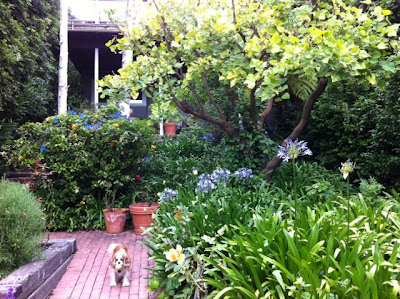
That done, I started on the potted plants on the lower deck. They, too, have been allowed to grow untended for several years, and badly needed pruning back. Armed with a pair of heavy gloves and a handy pair of clippers, I set to work cutting back the foliage, and spent what must have been a couple of hours getting a good start on the job. Sorry that I didn't think to take a before picture, I'll leave that to your imagination. But here's the "after"...


Meantime, the agapanthuses (agapanthi, I suppose) are coming into bloom. And George is impatient to get to work chasing his ball...


Tuesday, June 14, 2011

BOOK ART

(I also have a note today on Vote Obama 2010. Please check it out.)

A lovely visit yesterday afternoon with our friend, the artist Nancy Turner-Smith, to see the book she has been working on for a good long time now, and has finally completed. It's a beautifully bound album of short texts and digitally-altered images taken from her own drawings and paintings. "Album" is an appropriate term, I think, given that--aside from its larger format--the book seems to give an affectionate nod to those intimately personal collections that were wildly popular in Victorian times, updating their spirit of meticulous observation of the outer world of nature and the inner world of feeling.

Still, this is a bigger enterprise. The book is called "Falling Rockets, Shooting Stars and the Sound of Bees," and it measures 11 x 14 inches. The spine is clean, brown leather and the front and back covers are a deep blue cloth, incised with, on the front two, on the back a single, undulating line, flowing top to bottom in an elegant path. Inside, two kinds of image alternate: tiny, black-on-white drawings that have the feel of finely outlined etchings (see bottom right, below...)


(images courtesy of the artist)

... combining nature with the simple sweep of lines or the turn of angles; and delicately colored plates...


...that tease the eye with the evocation of representational image or hand-written text, but leaves it unanchored, fluid, as though seen underwater--or through the warp and weft of outer space. Successive images play on each other with dissonance or rhymes as we turn the pages, suggesting an inner, emotional and visual narrative that holds the book together.

The text seems to flow through the book in the same kind of way, arresting our progress here and there as it moves in and out of focus, allowing the emotional eddy and flow to establish its direction. Set--as are the images themselves--in the expansively white spaces of the page, it allows for the profound mystery of silence as well as for the latent sounds of language, so that the pages seem to offer us the invitation to pause and breathe as we progress through them.

A lovely work then, and one that bears witness to the unhurried thoughtfulness as well as the love and dedication that went into its making. It reminds us that, in the rush of progress toward the future, we are at risk of losing the book as a tactile, sensual experience that can enrich our lives. Its serenity is a gift, and a reminder, too, that we live in the flow of time and space; and that, if we are wise, we will allow ourselves to join that ceaseless flow.

Monday, June 13, 2011

TRIANGLE SQUARE

We watched a very lovely, very touching documentary last night. Often joyful, sometimes simply heart-wrenching, A Place to Live: The Story of Triangle Square traces the hopes, anxieties and fears of seven gay and lesbian seniors as they look for a safe and welcoming home for their elder years. At the same time, it follows the planning and construction of Triangle Square in Hollywood, the nation's first affordable housing facility for GLBT seniors. Since the supply is at present infinitely smaller than the demand, each one had to go through a rigorous pre-application and screening process and, eventually, the cliff-hanger of the selection process itself.

As you can imagine, many were called--and sadly few could be chosen. We meet our seven, first, in a sketchy biographical introduction and learn, more slowly, about their lives and loves, their families, relationships and bereavements. Born in the late 1930s and early 1940s, the better part of their lives was lived at a time when their sexual orientation was socially beyond the pale or, more likely, just plain criminal. Several had lived for years in the closet, a reluctant stranger to themselves, in marriages that failed to cover for their loneliness and their sense of isolation and rejection. It was an unsafe world, where discovery could lead to ostracism, unemployability, and all too often suicide. And all of this was before the onslaught of the AIDS plague, which left so many men bereft of life-long partners and whole circles of friends.

No wonder, then, that this small group of elders clamored to find a place to live where they would feel safe, accepted, and among peers who had shared the experience of living--and loving--in the shadows. All seven are now alone in their lives, and their loneliness is palpable. The joy of simply knowing that such a place as Triangle Square was coming into existence is written in their faces, in their eyes. It brings a glow of hope into their lives, tinged with the dread that they will not be amongst the chosen. We follow their shifting moods as the building goes up and as they begin the application process; the joy of those who receive their application package in the mail, the stoic disappointment of those who don't. We accompany them as they make a preliminary visit to the site and share their wondrous anticipation that one of these small units will become their home.

On moving day, at last, there are tears from our protagonists on both sides--those moving in, almost disbelieving, to their long dreamed-for safe haven; and those who for one reason or another have not made the cut, and must live with disappointment. It's impossible for one watching this drama from the outside not to share the tears on both sides, and to feel the depth of their emotions. It's a rich human story, plainly told, and one that's guaranteed to grab at the heartstrings. If it were up to me, it would be required watching for all those who persist in dehumanizing their gay and lesbian brothers and sisters, and denying them the basic rights of which the rest of America is so proud.

Sunday, June 12, 2011

A LIVELY EVENING...


... at the Los Angeles County Museum of Art, this past Friday. It's music night, and we were both surprised and delighted by the huge crowds out on the plaza enjoying the jazz band, despite the unusually cool weather.


(these are my own cell phone pictures...)

... an exhibit that includes thirty-seven carved figures from the tomb of John the Fearless (1371-1419), the second Duke of Burgundy. These beautifully carved objects, each about 18 inches high, were once lined up around the base of the Duke's tomb, as though bearing his body into eternity. The detail of their postures and expressions...


... is testament to the skill and love devoted to their making, and to the profundity of the religious faith they were made to express. The exhibit does its best, with text, photographs and video, to contextualize them in their time and original location; even so, they cannot help but lose some of their power, once deprived of their ritual and spiritual intent and reduced, as it were, to art works. They become mere things of beauty, magnificently displayed and lit to highlight their unquestionable aesthetic worth, but inspiring something more than anything like sadness for a lost world and a lost faith.

In the next gallery, we found The Clock, by Christian Marclay, an astonishing "24-hour, single channel montage constructed from thousands of moments of cinema and television history depicting the passage of time, excerpted and edited together to create a functioning timepiece synchronized to local time anywhere it is shown." We sat down on of the comfortable sofas in front of a wide screen in the darkened room, intending to stay for five or ten minutes, to get a sense of the thing. Fat chance. We were soon hooked, and managed to tear ourselves away only after an hour or more of mesmerized attention. The moving images glide seamlessly into each other, many of them focusing on a watch...

(this and subsequent images, thanks to LACMA's website)

... or clock, or a fragment of dialogue mentioning the time of day--exactly the moment at which you happen to be watching; or by some visual or narrative theme--a running figure, an opening door--or an object. Equally fascinating is the game of recognition, as we identify familiar scenes from movies or the glimpse of a well-known actor's face. Our mind catches on to a narrative thread, only to be foiled in the next instant by a change of scene, sometimes an abrupt change of direction, but the arbitrary nature of the associations is lost in the compelling visual effects as well as in the uninterrupted flow of time itself. We are left to reflect upon the inevitability and the unstoppable quality of time's passage, and on the arbitrary nature of human experience. An extraordinary, complex and thoroughly entertaining work of art.

Pausing to take in the vitality of the crowds gathered to hear the music, we crossed the plaza to the new Resnick Pavilion to see Tim Burton, a large-scale exhibition exploring the richly imaginative world of this film maker and artist whose work is familiar through movies from "Edward Scissorhands"...


... to "Alice in Wonderland." With our eyes tiring and our brains beginning to overload, we walked through this one, as we did through the beautifully-installed David Smith: Cubes and Anarchy--a fine survey of the modernist sculptor's work. We missed at least two other shows I would have loved to see, Gifts of the Sultan: The Arts of Giving at the Islamic Courts, and The Sound of One Hand: Paintings and Calligraphy by Zen Master Hakuin. But there's only so much you can do...

As we left through the still-enthuiastic crowds, I could not help but think about my late father-in-law, a big supporter and one-time board member at "The County", and how delighted he would have been to see the activity here today. He was such a people person, and so passionate about art that he wanted everyone to share in its pleasures. As a footnote, I might mention that we also saw, last week, the movie Beginners--a brilliant picture, by the way--and, in it, a museum scene that had been shot at LACMA, where the protagonist (a truly great performance by Christopher Plummer) was once the (fictional) director. In the background of the scene, we
spotted Montauk Highway, a superb de Kooning painting, donated to the museum by Ellie's father and stepmother years ago. Greatly, I might add, to the benefit of the museum-going public--and, at our least honorable moments, to our (shhh! secret!) regret. Sometimes we still imagine what it would have been like to have it hanging on our wall! Still, we comfort ourselves with the reminder that the painting is where all good art truly belongs: in the public domain, where it is available to anyone who cares enough to go and look at it.

Friday, June 10, 2011

GALLERY ROUNDS--JUNE


I have written before about my friend Peter Sims’s paintings—in the context, as I recall, of his inclusion in a group show at Cardwell Jimmerson Contemporary Art. Now he has a full-scale solo show at the same gallery, and it’s a feast for anyone in love with the sheer seductiveness of paint. For Sims, paint is material stuff: he uses it to build up luscious surfaces, sometimes over months, until they have the substance, the lush color and the sensual appeal of a super-rich dessert. Think Wayne Thiebaud, with ten times the slather of paint, but without the cake and ice cream...


"Gobelin" (DETAIL)

These are kind of cheeky paintings, too. They tease the viewer with “subject matter” chosen from such mundanities as candy wrappers, bar codes, children’s plastic toys, the corner of a Bauhaus tapestry detached from its original context. These physical objects, now abstracted, become the pretext for what can best be described as a protracted orgy with the artist’s medium...


... a gently mocking challenge to the vast majority of his brethren who treat their medium with greater gentility and tact. Sims wallows in it, and the viewer’s eye is, first, astonished, then beguiled, and eventually seduced by the boldness of his attack. What he offers is an in-your-face invitation to revisit all your previous thoughts about painting, especially about representation and abstraction—and about the relationship between the two.

Our visit to the Peter Sims show was the first in a round of galleries yesterday. Some of the highlights:

At Susanne Vielmetter, another terrific painting show of the work of Nicole Eisenman—three galleries, each with such a markedly different style, you’d almost think they were by three different painters. They range from massive, cartoonish, head-on--and hilarious--“portraits”...


"Break Up", 2011, Oil and mixed media on panel 56" x 43"

(These, and subsequent images, are taken from the respective gallery's sites. I hope you'll take a moment to visit those sites for more images and detail.)

"Guy Artist," 2011, Oil and collage on canvas 76" x 60"

... which play with the history of the genre—indeed, with the history of art, from the “primitive” to the futuristic, and still manage to engage us in the odd pathos of human existence; to a bent kind of social realism, addressing, among other things, domestic politics...

"Tea Party," 2011, Oil on canvas 82" x 65"

... and lastly a Redon-like fantastic symbolism. What holds these disparate works together is a common fascination with the quiddities of the human species.

At Western Project, a show called “Sand Mountain Tractor” by Wayne White, something of a trickster and a native country boy (long-exiled into city life) who joyfully embraces the imagery and verve of rustic America in a spirit of irreverence and verve, combining them with the accomplished, sophisticated skills and irony of a successful New York designer and Hollywood animator. This show includes numerous examples of White’s frantically imaginative drawings, sketchbooks and paintings...

"Fast Twirl by the Edge of the Sea," 2011, acrylic on canvas, 32 ½ x 40"

... along with an array of clunkily assembled marionettes of varying sizes...

(Installation view; in the background, the theater for White's "Punch and Judy" puppet show)

... all oddly human in their posture and expression. An over-the-top exuberance that tickles the funny bone and, oddly, manages to engage the heart.

And speaking of over-the-top, at Blum & Poe there’s Chinese artist Zhang Huan’s “49 Days,” an awesome collection of monumental brick-works celebrating the survival, for 49 days, of Zhu Gangquiang, the “cast-iron pig,” after the catastrophic 2008 Sichuan earthquake. (49, the show’s press release informs us, is also the number of days the soul is believed to remain on earth between death and rebirth.) The enormous centerpiece of the show, “Pagoda”...


49 Days, installation view, 2011


49 Days, 2011 (detail)

... is a complex and imposing work, whose bell shape and hugely labor-intensive brickwork evoke thoughts about the waking social and economic giant that is contemporary China, as well as its ancient historical roots and spiritual traditions. Contrasting with the many images of the obstinately still-surviving pig...

49 Days, South Gallery Installation View, 2011

... (adopted by the artist, by the way, and living as a guest in his studio) are huge skulls...

49 Days, Gallery Installation View, 2011

... reminding us of the vast numbers of dead in the quake—and of course of our own mortality.

At Angles Gallery, we found some remarkable large-scale photographs by the Israeli-born, London-based artist Ori Gersht. Shot, for the most part at night, in the vicinity of the Imperial Palace in Tokyo, the pictures feature the famous cherry trees in full blossom, aglow in light reflected from the palace...

"Imperial Memories: Night Fly 1," 2010


"Imperial Memories: Floating Petals, Black Water," 2010


"Imperial Memories: After Dark", 2010. Archival pigment print,
47-1/4 x 70-7/8"

Their amazing natural beauty is offset by the darkness of the moat water and the sky against which they stand out, suggesting the historical and cultural depth of their associations. They share in the stillness and silence of a certain Japanese aesthetic we associate with the traditions of Zen. Beyond their immediate beauty, we sense an ineffable sadness and a respect for the mystery of being.

Thursday, June 9, 2011

THE BLUES

Feeling blue and a bit sorry for myself yesterday, I wrote a piece that I posted on "Persist: The Blog." It's called Cultivate a Rich Heart. I hope you'll pop over and take a look.

Tuesday, June 7, 2011

Captain Penis

Time for some frank talk about the penis, that endlessly delightful, fascinating, troublesome and seemingly irresistible toy with which about half the human species are endowed at birth. I consider myself qualified to discuss this topic since I am acquainted with it at first hand, if you'll forgive the manner of speaking. I'm the owner-driver, myself, of a now rather creaky old model. I have also sat, on numerous occasions, in circles of men gathered for the specific purpose of discussing the pain and pleasure it has brought into their lives. I know how much we share in common.

The occasion for this frank talk, of course, is the confession of Rep. Anthony Weiner of New York, who is but the latest in a long line of politicians brought low by this all-too prominent member of the male anatomy. I'm not sure why politicians come in for an unfair share of the heat. Would a businessman be exposed to the same kind of potentially career-ending publicity? There is the recent deplorable example of the ex-IMF chief Dominique Strauss-Kahn, but you could argue that he, too, is a political leader. An actor? An attorney? Perhaps it's merely the prominence of the person involved. But in this country, at least, we do seem to expect better sexual mores from our politicians than from others. And we do like to bring them down.

But here's the thing: we all have one, we males. It may appear to have a life of its own, making its needs known in the most demanding ways. Once aroused (sometimes inexplicably so), it demands to be stroked, petted, coddled, cosseted and, yes, admired--which is perhaps why men take pictures of themselves and send them out via Facebook or Twitter. I don't remember ever having actually taken a picture of myself, but I do know that I have been sorely titillated by the prospect, starting with the invention of the Polaroid camera with its promise of instantaneous images and secretively disposable results; if I refrained, I'm sure that it was more out of reticence and timidity than moral restraint. So I do understand the impulse. Nowadays, with digital cameras and cell phones, no matter how easily erasable the images, the ease--and the seeming anonymity--with which they can be put out into the world redoubles the temptation.

The penis, let's face it, is an obsession for vast numbers of men. It's well known, thanks to the studies of psychologists and behaviorists, that we spend a great deal of our time thinking about it. It's one aspect of our lives, I believe, where many (most?) of us never grow out of our teenage years. We fuss over it, experiment with it, compare it, worry about its size and functionality. We wrap our identities around it, allowing it to make us feel belittled or expansive, inferior, neglected and self-pitying, or boastfully self-important. We judge ourselves according to its triumphs or its failures.

It should not surprise us, after so long, but the power of this imperious cuss to drive our lives does still seem amazing. Succumbing in appropriate ways to its demands is the source of infinite and delicious pleasures, but allowing it to lose control can lead to the worst of crimes. Worse, using it as an instrument of domination and intimidation, as men are known to do--and order others to do--is all too common in today's violence-ridden world. Denying its rights seems only to increase its power, as evidenced in what has become apparent in recent years in the scandals of the Catholic church: it refuses to be kept under the cassock. I assume that even the Pope wakes with a hard-on, if only thanks to the nocturnal activity of the bladder. And when the thing is hard, most men will agree that the hand is tempted to stray irresistibly in that direction. I have never had the temerity to ask, but I sometimes wonder how Buddhist monks handle--again, excuse the choice of words!--this natural activity beneath the saffron.

Harder for me to understand is the reckless, adolescent behavior it induces--perhaps because I am not, myself, a reckless person. I readily understand how men can be led around by their penis, but I fail to understand how they think they can get away with it, especially at a time when privacy is a dicey matter at best. Are they blind, or stupid--or both? Is it that their addiction leads them into denial of the inevitable consequences of their actions? Did Weiner really believe that he could get away with lies? Even with admirers of his political skills, myself included, ready and eager to believe them, he must have known that there were an army of antagonists who would go to any lengths to disprove them.

I will say this: an episode such as the one to which we have been treated this past week helps me to identify my prejudice. My natural inclination is to find excuses for a Weiner, to minimize his transgression, and to get mad at those who seek to exploit it. On the other hand, with a John Ensign, I note the happy surge of Schadenfreude, the ready words of condemnation, the hope that it will do damage to his side of the political spectrum. Mind you, the added dose of hypocrisy on that side, particularly from those quick to condemn others for their faults, serves to encourage me in my bias.

There's a useful distinction between shame and guilt: I feel guilt for something I have done; I feel shame for who I am. Shame goes far deeper in the human psyche. Apologies, in this view of things, are appropriate for guilt, but inappropriate for shame. It's pointless to apologize for my fundamental nature. It's my guess that the majority of men share the primal feelings and drives that lead these men to their excesses, but most of us do not act on them in reckless ways. We are held back by a prophylactic sense of shame, which is quite different from, and far healthier than that old Judeo-Christian guilt. The Buddhist rule of thumb in this matter is the same as in any other area of human experience: do no harm. If our action is liable to cause suffering to ourselves or others, we are wise to refrain from it.

Anyway, such is the power of the almighty penis. I wish Weiner well, and will do my best to do the same for his brethren offenders on the right. They are also human. The only difference is that I share Weiner's political views and admire the skill and passion with which he makes them public. I only wish he had been less bent on making his private parts as public as his politics.

Monday, June 6, 2011

The Art of Letting Go

It was a profound pleasure to be back in sangha yesterday. Our little sitting group in Laguna Beach feels like the refuge the sangha is supposed to be--along with the Buddha and the dharma, the Triple Gem of Buddhism. And this is a moment when refuge feels particularly welcome. From the Middle East to Washington and the bleak horizon of American politics, there is little of cheer, today, in the world we humans have created for ourselves. Of greatest concern are those newspaper articles that draw attention to our depleting resources--the waters of the Nile, I read last week, being diverted and depleted by Chinese agricultural interests in the Sudan before ever reaching Egypt; the over-fishing of the seas; the shortage of energy in vast reaches of the world..

All these, of course, are matters over which I have no control. The discussion at sangha, after our hour's silent sit, brought us back to a chapter in a collection of Ajaan Lee Dhammadharo's dharma talks, The Art of Letting Go (translation by Thanissaro Bhikkhu; the link takes you to the Access to Insight website, where the same collection is available in full, under the title "Keeping the Breath in Mind.") This particular talk starts with beautiful simplicity, thus:
When you sit and meditate, even if you don't gain any intuitive insights, make sure at least that you know this much: When the breath comes in, you know. When it goes out, you know. When it's long, you know. When it's short, you know. Whether it's comfortable or uncomfortable, you know. If you can know this much, you're doing fine. As for the various thoughts and concepts (sañña) that come into the mind, brush them away — whether they're good or bad, whether they deal with the past or the future. Don't let them interfere with what you're doing — and don't go chasing after them to straighten them out. When a thought of this sort comes passing in, simply let it go passing on. Keep your awareness, unperturbed, in the present.
My own mind gets hooked on all kinds of distracting concepts, not least the above-mentioned problems of the world and the discouraging prospects of greater social and economic justice in our own country. It's the source of suffering, of course, since the path I consider to be the right one (the fork to the left!) diverges radically from the path on which we are currently traveling. My "concepts" serve little purpose other than to intrude upon my peace of mind.

So it's comforting to be reminded that the dharma offers me a wonderful lesson in the benefits of letting go of troubling thoughts--which does not mean to abandon all responsibility, but rather to acknowledge its limits. I am deluded if I hold myself responsible for the outcome of the innumerable problems of the world; but that does not excuse me from doing whatever is in my power to relieve the suffering of others. Let go of the concepts, then, which have no reality. But do the actions--and make sure they bring about more good than harm.

Friday, June 3, 2011

Plus ça change...

(Sorry about the missing accents in this entry; I haven't been able to find out how to include them. Can anyone help? NOTE: Done! Thanks, Richard!)

What's next? A photoshopped image of Obama with a stripper? It seems entirely possible. Any malicious person with a grudge, a political axe to grind, and minor computer skills is empowered, these days, to send out visually compelling lies to a public willing to believe anything they see and hear--and media more than happy to be complicit in their proliferation. The image of what purports to be the bulge in Rep. Anthony Weiner's underpants, purportedly Twittered to a young woman on the opposite side of the country, suggests that no one is immune from online malice. Much is made of the congressman's refusal to deny that he could be the subject of the offending picture. But that makes sense to me: as he says, pictures can be easily purloined and altered. Suppose it did turn out the picture was of him--snapped, possibly, in the gym or some congressional dressing room and altered to suit the purpose of the theft? He would then be open to public castigation for lying. Is this far-fetched?

The fact that this "scandal" attempts to implicate the most outspokenly liberal of our politicians is strongly suggestive of a smear. I suppose it's possible that Weiner would be foolish and arrogant enough to believe he could get away with Twittering an image of his discreetly-clad erect penis to a woman he does not know, and who claims not to know him, in a distant part of the country. But it does seem like a stretch--if you'll pardon the pun.

A propos of all this, I happen to be reading A Gambling Man, by Jenny Uglow--a marvelous history of the first ten years of the Restoration of the British Monarchy, from 1660 - 1670, the years immediately following the return of the decapitated Charles I's son, Charles II, from exile. It may seem like an odd choice for me. I picked it up at a friend's house and borrowed it, in part I suppose, because this Charles gave his name to the King Charles Spaniel--our George's breed--and in part because I found the Tudor series on television so fascinating. It was a chance to reconnect with some of those British genes.

It's an excellent book, anyway, and one that I'd recommend to anyone interested in 17th century European history, or the history of the monarchy in England. The reason I bring it up is that, well... it merely proves once again that history repeats itself. The politics of that distant time and place is remarkably similar to our own in so many ways--the dangerous absence of religious tolerance, the unpopularity of government and the constant tug-o'-war between the legislative and executive powers, the shifting alliances and the frequent betrayals, the tight-rope walk of the man at the top of the heap, the tense relationship between "the people" and the powerful elite, the unbridgeable (inexcusable) gap between rich and poor, the impetuous rush to war, the resentment over taxes... there's something on every page, in every chapter that reminds us of the old French adage: plus ça change, plus c'est la même chose. (The more things change, the more it stays the same.)

Let's talk about sex, since that's what started me off today. Sex and gossip. Sex and power. From Uglow's narrative, it seems that every man in a position of social or political power, from Charles himself on down, was busy bedding anyone who took his fancy--not just the common actresses (remember Nell Gwynn?) or the denizens of the ubiquitous bawdy houses, but even the (often married) women of the aristocracy seemed fair game. Unable to produce an heir with his wife, Catherine, Charles cheerfully spawned a whole stable of illegitimate children with a variety of mistresses, high and low. None of them was entitled to inherit the throne, of course--that questionable honor went to Charles's brother, James--but they were respected, mostly titled members of the court and high society.

Were these commonly-known affairs, not only of Charles but of other European monarchs and aristocrats, considered scandalous? Yes, and no. It was apparently accepted behavior, but it did generate reams of gossip and numerous political intrigues. Lacking the Internet, the gossip-mongers of the day wrote diaries (Samuel Pepys, John Evelyn), long poems and plays (Dryden, Marvell, and many others), and broadsheets. There was a certain risk involved in stage productions and publications, of course, since the king's disfavor could mean anything from exile from the court to losing one's head. Still, to judge from the generous quotations in Uglow's book, the writers of the day did not hold back from thinly-veiled verbal attacks and ridicule. A sample (referring not to Charles, but one of his close counselors):

This is the Savage Pimp without dispute
First brought his Mother for a Prostitute:
Of all the Miscreants ever went to Hell
This Villin Rampant bares away the bell.
Such wit abounded. Everyone, from the king on down, was expected to be able to turn a phrase in verse or pen a witty screed. Would it were so today--our pundits might be fewer in number. The tediously prosaic and small-minded political attacks from left and right that are served up endlessly on television by way of commentary pale by comparison. It would be wrong, though, to assume that our contemporary, poisonous punditry is a new phenomenon. Uglow's book provides us with a rich tapestry of evidence that innuendo, malicious gossip and self-serving lies are nothing new when it comes to the battle for power between human beings. Ah, well. Plus ca change...


A River of Stones

(NOTE: This is a follow-up on yesterday's entry. Because I like so much what they are doing at "A River of Stones," The Buddha Diaries welcomes Robyn and Kaspa a guest bloggers for the day...)


Kaspa & Fiona have taken over my blog for today, because they need our help.


They are both on a mission to help the world connect with the world through writing. They are also getting married on Saturday the 18th of June.

For their fantasy wedding present, they are asking people across the world to write them a
‘small stone’ and send it to us using this form. You can also post the stone on your blog, or facebook or on twitter using the #aros hashtag.

A small stone is a short piece of observational writing – simply pay attention to something properly and then write it down. Find out more about small stones here.

If you’re willing to help, we’d love you to do two things:

1) Re-post this blog on your own blog any time before June the 18th and give your readers a chance to hear about what we’re doing. You cansimply copy and paste the text, or you can find the html here.

2) Write us a small stone on our wedding day whilst we’re saying our vows and eating cake, post it on your blog, and send it to us.

You can find out more about our project at our website, Wedding Small Stones, and you can also read our blog at A River of Stones.

We also have a July challenge coming soon, when we’ll be challenging you to notice one thing every day during July and write it down.

Thank you for listening, and we hope we’ll be returning from ourhoneymoon to an inbox crammed with small stones, including yours.

Kaspa & Fiona

Thursday, June 2, 2011

SAVING THE WORLD...

... one small stone at a time.

I don't remember exactly how I happened upon this delightful initiative, but I'm glad I did. Am I the last person in the world to find out about it? In case you hadn't, either...

What is a small stone? It's "a short piece of writing that precisely captures a fully-engaged moment"--and heaven knows, we could use more of those in our contemporary world. It's the brainchild of the British writer Fiona Robyn--who has been writing them since 2005--and her husband-to-be (June 18th!) the Buddhist priest and fellow blogger Kaspalita. It's all a little complicated. Together, they have a blog called A River of Stones; their other site, Writing Our Way Home is a kind of parent company/website/blog they have created "to help people connect with the world through writing"; and "Pay Attention: A River of Stones" is a book-length collection of small stones by numerous writers which they have put together and published in order, in part, to make their work and intentions better known to the world. This, I assure you, is not by any means an exhaustive list of their efforts, online, in print and, apparently, in live workshop sessions too.

It's all about paying attention, and using the vehicle of language to sharpen the attention and pin down its object. There is no set form: "Pay Attention" includes everything from haiku to longer, mostly free-form poems and prose poems. Many of them have the jewel-like quality of lovingly polished stones, something you can weigh in the palm of your hand, feel its shape and texture, almost taste it in your mouth. Robyn and Kaspa insist on the object-directed gaze. It's not primarily about the author's insights or feelings, it's about the object--though of course the insights and feelings follow from the object. Was it William Carlos Williams said, "No ideas but in things"? He might have written, "No ideas or feelings..."

A few samples, pretty much at random:

another morning

strands of hair
in the washbasin

--- Chong Lee San


Peel rolls with ginger in the marmalade boil

---Jan Friend


The sapling's
papery bark
peels in strips
like the velvet
from a stag's
antlers

---Margo Roby


Exalt the one,
unfairly belittle the rest.
Each moment a beach stone,
"Pick me! Pick me!"

---Spongebelly

Throughout, some of the small stone writers talk about their attraction to the project. Here's a fine example. Dharmavidya David Brazier writes:
Darshan is a Sanskrit word that means 'to see.' In the Dharmic regions, one might go to a teacher for darshan; to be seen by the teacher as much as to see him or her. In this use of the word there is often a sense that what one is seen by is the divine, or the part of the teacher that is enlightened, and that through this act of seeing and being seen the devotee is transformed.
In this high-speed, high-energy, high-tension world, it's wonderful to be reminded of what can happen when we slow down for long enough to really look at what's out there; and to recognize to what extent it mirrors what's going on within. This possibility for moments of pure presence too often goes unnoticed and unrealized. Good for Robyn and Kaspa, for their effort to save the world, one small stone at a time!

Wednesday, June 1, 2011

MIDNIGHT IN PARIS

Saw the new Woody Allen movie last night. Loved the romantic Parisian glow of the setting, the whimsy of the story, the glimpse of the "Banquet Years"--with Hemingway and Picasso hanging out at Gertrude Stein's salon. Loved the music, especially the Sidney Bechet soprano sax that set the tone--a nostalgic trip into my past. And hated the central character, the Woody Allen clone, the whine mimed to grating perfection by Owen Wilson.

My companions for the evening seemed far more tolerant of this Hamlet-lite wimp than I am. In every manifestation--and he is rarely absent from the Woody Allen film--he never fails to infuriate me. It's a character stuck in the existentialist fifties, an attempt to compensate for a philosophical nihilism with merciless self-absorption and endless trite mock-psychiatric analysis. The whine says it all. It never stops. You sit there wondering why the rest of the characters don't slap him hard across the face--and wanting nothing better than to do it yourself.

And the rest of the characters are either despicable--in this case, the fiancee and her parents, whose values represent the worst of self-indulgent American materialism--or rosy innocent and sweet. Except, of course, in this film, where the maestros from the past are neatly caricatured in cameo roles--though all of them have to share in the neuroses Allen seems to attribute to the entire human species. The result is some truly hilarious moments, as when Hemingway sits moodily in a bistro lecturing our hero on the essence of manly courage--a quality in which this pathetic Woody clone is demonstrably and notably lacking.

Is this dreadful character a necessary ingredient? The impotent, self-doubting intellectual who constantly questions his own manhood and disputes any meaning in life beyond the generally losing battle for sexual gratification. Clearly, he's an unabashed projection of a less than admirable part of the director's persona, and a role that he himself has played in many of his films. The fact that I dislike him so intensely likely has something to say about myself that I am loath to recognize. I should probably examine it--but somewhere one has to draw the line!