Sunday, February 28, 2010
Persist Readings and Events
April, 2010
* Tuesday, April 16th, 7:00 PM, Linda Kunick O Salon, 1147 Coldwater Canyon Drive, Beverly Hills, 90210 (more info)
* Wednesday, April 17th, 4:00 PM, Santa Monica Art Studios, 3026 Airport Avenue, Santa Monica, 90401 (more info)
* Tuesday, April 20th, 5:00 PM, Broida 1610, UC Santa Barbara, Santa Barbara, 93101 (more info)
* Wednesday, April 21st, 7PM, Contemporary Arts Forum, 653 Paseo Nuevo, Upper Arts Terrace, Santa Barbara, 93101 (more info)
*Tuesday, April 27th, 7 PM, Muckenthaler Cultural Center, 1201 West Malvern Avenue, Fullerton, 92833

Saturday, February 27, 2010
Also on Friday...
Friday, February 26, 2010
Rachel Whiteread at the Hammer Museum
Whiteread is known for working with molded forms, substituting a specific object--a table, a chair, a mattress...

... a light switch, even an entire house--for the space it contains, or the space that contains it. The result is what I can best describe as a real-ization, a concretization of absence. Like the wind, the object becomes invisible to the eye, or visible only in the traces it leaves in its wake--the shift of leaves in the trees, the movement of blades of grass. In Whiteread's work, the mind is left to re-create, or imagine what was there, which becomes a ghostly incarnation of its previous existence.
This is intensely elegiac work. The affect is one of ineffable sadness, where emptiness is given tangible form that requires us to make the effort to search for what we can no longer see. It's also intensely human: we live, we experience our presence as bodies in the world, we die and, so far as we can tell, we vanish into nothingness. We experience the same with those we love, those close to us. They vanish from our lives, and yet we continue to sense their presence through their very absence. We are confronted, for example, in this exhibition, with an empty antique bathtub, its absence recreated in solid, adjoining blocks of concrete, and feel ouselves in the presence of a stolid, silent sarcophagus, which seems to demand that we imagine its occupant, some long-departed Marat, say, still haunting its vacant space.
No wonder, then, that Whiteread won an international competition to create a Holocaust monument for Vienna, Austria...

... and how appropriate that she should have envisioned a vast library turned inside-out, its myriad volumes turned spine-in, anonymous, standing in for the absent ones who lost first their identities and then their lives to Hitler's madness. The model for this magnificent memorial is on display, along with the detailed drawings that led to its creation.
Also on display, in a "Vitrine," is a multitude of small objects from Whiteread's personal collection--fossils, kitchen molds and utensils, rocks, shoe-trees, boxes and dental molds--each one casting light on the inner workings of her creative mind; and a collection of postcards, mostly of architectural structures, with areas shaded out or punched with holes which leave the eye searching for the lost structures and forms. These, along with the drawings, offer a fascinating study of the way in which this artist's own distinctive vision sees the world, the objects that shape our human lives and the spaces in which we dwell. If the exhibition's dominant tone is sadness, it is a sadness that leaves us more acutely, more profoundly aware--and more mystified by the wisdom of that old Buddhist conundrum from the Heart Sutra: "Form is emptiness, emptiness is form. Form is not other than emptiness, emptiness is not other than form." Oh, yes!
Thursday, February 25, 2010
A Day in the Country
Too often we denizens of the big cities, especially those of us involved in what we are pleased to call the "art world," tend to think like Warty Bliggens. Never heard of Warty Bliggens? Find out about him here. Warty is a toad who thinks that he's the center of the universe. You'll remember, perhaps, that I mentioned Pete the Parrot the other day, who palled around with Bill Shakespeare at the Mermaid tavern. Warty is another creation of Don Marquis, who came up with so many wry and truthful observations about human foibles and pretensions.
So yesterday I had a speaking gig at California State University, Channel Islands, out in Camarillo, a good way from our little Los Angeles center of the art world universe. To get there, Ellie and I took a circuitous route through a steady, misty drizzle of insistent rain to Oxnard, another small-ish city near Camarillo, similarly distant from the epicenter. We went there to see an exhibition intriguingly titled Harmony Reverberates Optimism, curated by the artist Ronald Lopez. Arriving at Oxnard College, we found not a big institutional building with a white-walled gallery space but a small cottage where the exhibition was installed in what once had been the living space. It was soon crowded with an enthusiastic gathering of students and others, all engaged with the work of the six socially-engaged women artists included in the show.
This is not a review. Suffice it to say that it was a fascinating show, much bigger in its intellectual and aesthetic reach than the tiny space in which it was assembled. Check out the site and look at some of the images. Iranian-born artist Azadeh Tajpour created an installation in one small room, its floor inches deep in strips of shredded paper with the names and some personal details of each of a mere 4%--by one count, there are many of others--those already killed in the conflict in Iraq. The viewer is invited to wade through the "trash" that is all that remains of these human lives, and contemplate the tragic waste. Kristin Ross Lauterbach & Christina Lee Storm present clips from a longer movie, "Flesh," which documents the trade in human flesh right here in the back streets of Santa Monica. Ofunne Obiamiwe, a Nigerian by birth, offers an interactive, participatory installation called "Status of Women", playing on the new medium of social networking by "realizing" the idea of a Facebook page, inviting a dozen women to contribute profiles--along with an intimate article of their clothing--which are then framed and hung as artworks on the gallery wall.
Lea Redmond seeks to raise consciousness about the clothes we wear, and where they come from--perhaps, too, from what kind of sweat shop. She includes a world map, where she asks viewers to note the origin of the clothes they're wearing, to cut out the label that identifies it and pin it to the map. I was surprised to find that my new jacket came from Bulgaria! And finally SaeRi Cho Dobson shows a series, "Seven Deadly Seams," in which she hangs hand-printed garments on a line, as you might see them swathed in transparent plastic covering at the cleaner's, imprinted with socially-conscious messages about the ethnic economic, and labor issues in the dry-cleaning business. Of this seemingly dry (forgive the pun!) material, she creates a lively and provocative visual display.
Kudos to Ronald Lopez, then, for having been able to assemble a show where social engagement blends successfully with visual interest, from the aesthetic point of view, and sometimes powerful emotion content. That all this happens to be installed in a tiny cottage on a modest campus in a small town away from the hub of art activity makes it, for me, all the more interesting. Warty Bliggens notwithstanding.
From Oxnard College we circled back through that persistent slow drizzle--really more like a heavy Scotch mist--to Camarillo, a town I had only every heard of as the site of what used to be called a "mental institution", the one closed down many years ago by Ronald Reagan's draconian spending cuts. Turns out to my surprise that the 1930s era Mission-style buildings are now the site of the newest California State University campus, CSU Channel Islands. Who knew? Obviously not this Warty Bliggens. I had no idea...
But what a delightful campus. You approach it along a winding road, between vast agricultural fields with rows of healthy-looking vegetables--looking all the fresher for the still-falling mist that drifted, yesterday, late afternoon, in and out among the surrounding hills and woods. A bucolic paradise, it seemed to us, which offered no hint of the presence of a university campus at the end of the road. But when you reach it, the campus is indeed an attractive one, with mostly low buildings, tree-lined avenues, and great, grassy expanses of courtyard. At the center of this essentially traditional California environment...

... we were surprised to drive past a truly spectacular piece of contemporary architecture, later identified for us as the John Spoor Broome Library...

.... designed by the noted British architect Norman Foster. This, in what in Warty Bliggens-speak might be disparagingly called "the middle of nowhere." We live, as they say, and learn.
You think that way out here parking would be a snap. Well, no. Our assigned parking lot was crowded, and we were lucky to find the last remaining space. It's clearly a busy, active campus. In the art department, our destination, we were welcomed warmly by Jack Reilly, Professor and Chair of the department, at whose invitation I had come to give my talk. Jack gave us a tour of the department he has nurtured since the opening of the school, just a handful of years ago, and we found a good number of working studios--painting, ceramics and sculpture, a computer animation lab--where students and faculty were hard at work and obviously productive. (Jack tells us that some of the studios are shortly to be moved, as the department continues to expand to take in more students and, soon, a start-up graduate program.) The measure of success, in an art school, is what's happening on the walls and, these days, on the computer monitors; and CSUCI students are clearly getting some excellent instruction and passionately engaged in what they do. A good feeling, everywhere we went.
Then a quick tour of the library. It's an amazing building, within, designed with the full range of a library's purposes in mind--ample, accessible shelving for books and other materials, wide open, comfortable spaces and numerous small niches for private study. In the contemporary educational culture, electronic media form an important part of a library's services, and these seemed state-of-the-art and, again, freely accessible. There's a small gallery--with a current installation by Barbara Drucker, and a computer animation studio. Above all, the library has a great feel to it: it manages to be spacious and efficient, but also warm and uplifting to the spirits, a pleasure to spend time in. We wished we had more...
My talk, I think, went well--to judge by the reception. I felt I was a little slow in getting warmed up and reaching out to the audience, but once I reached the point where I felt comfortable and hit my stride, the words began to flow in a way that felt good to me. One test of success, for me, is the number and quality of questions that I get once I'm done talking, and here the questions were many, and went deep. And the individual responses, at the end, were genuine and gratifying.
All in all, then, a good day in the country. I woke this morning with Warty Bliggens in my mind--along with a healthy reminder of what we too often forget: that no one is entitled to think of himself, or herself, as the center of the universe; and that our ignorance serves us badly when we think ourselves as such.
Wednesday, February 24, 2010
Headshot: Vanity
It was fascinating--and actually a bit embarrassing--to watch myself, yesterday, as I posed for a series of headshots in connection with my current shameless drive for self-promotion. Well, I like to think that it's the book I'm promoting, not myself, but I have to admit there's a good deal of overlap between the two!
I have been using the headshot you see in the right hand sidebar of The Buddha Diaries for quite some time, though I can't remember precisely when it was taken. Turns out it doesn't have sufficiently "high resolution" for print purposes, and my publisher, Paul Gerhards of When This Is, That Is, had written to request one to accompany an interview/review coming out in a Dallas-Fort Worth are magazine. I have, in fact, been getting a number os such requests, so now seemed the time to make a new one...
With neither time nor inclination for a professional job, I dug out our Canon digital and its accompanying manual to find out how to go about making a high resolution photo. The instructions proved surprisingly easy to find, and I summoned all my technical skills to re-set the camera. It happened to be one of the two afternoons each week when Daniel, my part-time assistant, reports for duty, so I had him take the first series of pictures.
I should confess at this point that I had given some conscious thought as to how I should "look" for this picture. My Buddhist critic looked over my shoulder with bemusement as I picked, first, a red shirt, then looked in the mirror decided that the color was too strong and "faded out" my face. Such vanity! I watched myself thinking, in the mirror, that I should look more like a "writer"--such pretension!--and went back to the closet to select a blue work-shirt, one that I in fact rarely wear. It suited, I decided, both purposes, color and style. For effect, I added the black cardigan that my daughter, Sarah, gave me for Christmas. There. The "look"!
Again, with more self-consciousness than modesty would allow, I picked out two backgrounds which I thought neutral enough to make me shine, and put Daniel to work. I noticed the care with which I strove for the right facial expression, the right smile. It's a long time since I paid such close attention to the muscles that govern the movement of the cheeks and the lips...
The results of Daniel's effort, and mine, were decidedly mixed. They ranged from the slightly goofy...

to the plain idiotic...

... though I have to say I scrapped the worst of them in camera. We searched through a dozen or more photos and came up with this...
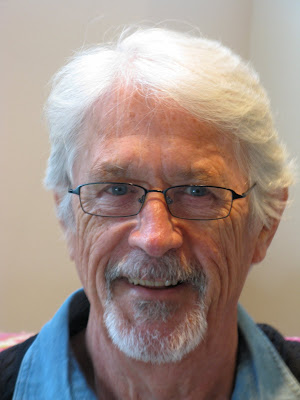
as being the pick of the bunch.
Still, my vanity was not satisfied. The backgrounds, I decided after all, were too bland; the expressions not quite right. Too much scrawny neck. Too many creases around the eyes. I did not, I have to say, appear quite as cool and writerly as I had intended, nor indeed quite so handsome. Since Ellie was due back soon from her afternoon errands, I decided to wait, so that she could bring her skills to bear on the problem. Not only is she gifted with an excellent, discerning eye for location, she knows my quirks well, and can be a demanding sartorial critic. I put her to work.
She scouted the house for possible locations, and came up with one in front of a big painting by Jeff Koegel--the artist, coincidentally, who came up with the cover image for "Persist."
The digital camera, I have to say, comes in remarkably handy on such occasions. You can snap off a couple of dozen shots without having to worry about printing the results, and examine the pictures along the way. Ellie proved adept at refining the angles and distances...

... and came up with a number of perfectly acceptable results. Indulge me (as I indulged myself!) if I show you another...

... somewhat more "soulful", do you think? But maybe a bit "blurry." And here's the final choice:

I tell you all this, I promise, in the spirit of good fun and with a wry sense of the vanity involved. It's important, obviously, for promotional purposes, to get it right. That's one thing. It's quite another to watch myself making those self-conscious choices and posing like a peacock to make myself look good. Then again, I look at the wonderful pictures of Than Geoff (Thanissaro Bhikkhu) that accompany his magazine articles, and wonder: did he pose for his pictures, and did he make choices like I did? Or is he just naturally and unselfconsciously photogenic?
Tuesday, February 23, 2010
Getting Ready...
... to celebrate. I noted this morning, on checking in with my site meter, that my visitor count stood at that moment at exactly 99,000--with another 150,000 "page views," whatever that means. This means that in a short while The Buddha Diaries will top 100,000--or a quarter of a million visits plus views!
I'm amazed. It seems only a short while since I was celebrating fifty thousand. Since the publication of "Persist," in fact, daily readership of The Buddha Diaries has shown a significant increase, and this clearly has to do with all the promotional efforts I have made to spread word about the book.
It is profoundly gratifying for one who identifies himself as a writer, as I do, to know that there are people out there reading what I write--and often returning regularly for more.
I have a plan, to mark the occasion: since I'm very often able to tell, from Sitemeter, the location of my visitors, in order, by city and country, I plan to be watching for the hundred thousandth and will hope to send that person a commemorative copy of "Persist." It can only work, however, if I identify the location--city, country, time--on the following day's entry, and that person sends me an email with their street address. I have no idea whether this plan will work, but I'm keen to give it a try. It might turn out to be a fascinating puzzle...
Monday, February 22, 2010
Persist: A New Review
Please take note of this review of "Persist" on Stephen Schettini's excellent blog, The Naked Monk. I hope you will find ways to pass on the link. Best thanks...
Film Review: Departures
Laying Out the Dead: A Performance Art

The story is that of a cellist, Daigo, brought to the realization that he will not survive professionally as a musician, who returns with his loving and dutifully tolerant wife Mika to the small town of his birth and there stumbles, out of financial necessity, into a job preparing the bodies of the dead for cremation. Initially horrified and ashamed of the work, he hides it from Mika. But he himself is soon converted as he observes the rigorous dedication of a wry and dourly affectionate boss to the tender, ritual art of caring for the dead. The bended-knee ceremony takes place on tatami mats in the presence of mourning relatives--some tearfully grief-struck, some angry, some fearful--and involves the discreet disrobing of the corpse, the re-clothing in ceremonial kimono, the making-up of the face and the reverent folding of the hands before removal into the coffin that will then be transported for cremation.
Along the way, we are offered insights into the social niceties involved, the social structure of a small Japanese town, the lovely cleansing ritual of the bath (about which I have written from first hand elsewhere. The differences between Japanese customs and our own are many, and the respect and discipline that form the basis for their social relationships are at once foreign and appealing to the American heart. The formalities create a distance that makes moments of closeness all the more surprising and intense. They remind us that love can be as deeply felt, as authentically expressed in ways other than superficial acts of intimacy. When Mika decides to leave Daigo rather than accept what she first sees as the shame of his new profession, it comes as a profound and poignant shock.
At the heart of the film is Daigo's lasting pain and anger resulting from his abandonment by his father while he was still a young boy. His love of the cello, associated with that pain, is its constant reminder. He finds in his employer and teacher--a man at once emotionally remote yet almost painfully tender--an ideal father who oversees his transition from boyish isolation and sensitivity into life as an adult with caring but undemonstrative severity. The movie's resolution--I'm not about to give it away here, and risk spoiling the film for you!--brings all these issues to full term in a way that satisfies both heart and soul.
I don't know whether this tradition of respect for the dead persists in Japan today. I suspect, as in all things, that the treatment of remains has become somewhat Americanized. This movie does, however, give pause. I do find that the recent emergence of hospice care has greatly improved the lot of the dying. That's wonderful. Both Ellie's mother and her stepmother were accorded comfort and respect as they lay dying. We have much to learn, though, from what this movie has to teach us about the respect that is equally appropriate after death. We call in the undertaker, who trundles the corpse off on a gurney, to be prepared for burial or cremation in some anonymous work space, distant from both home and loved ones. In this movie, the body is accorded loving care until extinction in the flames.
I trust that no one will be put off by this lovely film's subject matter. Take my word for it, this work makes death look really quite beautiful--of not exactly inviting!
Friday, February 19, 2010
On Greatness: From My Friend, Gary
Dear Peter,
My accident [a broken shoulder] and your questions regarding greatness caused me to search for this in my notes from 35 years ago when after the Nam I had retreated to the Navajo clan my father worked with when I was a child. That clan of Nazzi was close to the Hopi clan Parrot, where I first read this story.
It calls to me now when I most wish to gather strength.
Love to you and Ellie,
Gary
A HOPI ELDER SPEAKS
"You have been telling the people that this is the Eleventh Hour, now you must go back and tell the people that this is the Hour. And there are things to be considered . . .
Where are you living?
What are you doing?
What are your relationships?
Are you in right relation?
Where is your water?
Know your garden.
It is time to speak your Truth.
Create your community.
Be good to each other.
And do not look outside yourself for the leader.
“Then he clasped his hands together, smiled, and said, "This could be a good time!" "There is a river flowing now very fast. It is so great and swift that there are those who will be afraid. They will try to hold on to the shore. They will feel they are torn apart and will suffer greatly.
"Know the river has its destination. The elders say we must let go of the shore, push off into the middle of the river, keep our eyes open, and our heads above water. And I say, see who is in there with you and celebrate. At this time in history, we are to take nothing personally, least of all ourselves. For the moment that we do, our spiritual growth and journey comes to a halt.
"The time for the lone wolf is over. Gather yourselves! Banish the word struggle from you attitude and your vocabulary. All that we do now must be done in a sacred manner and in celebration.
"We are the ones we've been waiting for"-- attributed to an unnamed Hopi elder
Hopi Nation, Oraibi, Arizona
In a postscript, Gary adds:
To be more specific regarding the origin myths of the Hopi, and there are several, the sun is where life came from and it is Spider Woman or Huruing Whuti the Deity of all hard substances, who lived in a Kiva under the sea until the sun evaporated much of the ocean. The gods sent a wren over the land to see if any life existed.
The wren missed Spider Woman's Kiva as it looked much like the earth. Sent back to look again she was found after a very thorough search. She controls all the powers of life along with Snake. Not surprising considering the poison contained in many of these creatures. It is Spider Rock, a 1100 rock spire within Canyon De Chelly at Chinle, AZ where adolescent boys became men by climbing up to meet Spider Woman, always the oldest female priest within the Hopi Tribe who initiated the boys with the hallucinogen peyote.
Their dream/hallucinations were guided by her to instill reverence for the old ways and myths. Spider Woman's Kiva had a hole in the western interior floor where she lived. Humans emerged from this hole guided by Spider Woman towards the outside world. Hopi's believe that an event will occur and they will return back to the ground from whence the came.
To which The Buddha Diaries adds: The great truths are not the monopoly of one religion, nor of a single set of metaphors and symbols. There are many beautiful ways to honor the powerful and mysterious forces of the universe and our place in it. Much of the wisdom above--though not the myth--could have come from the mouth of the Buddha.
Mark Chamberlain: Tribute to an Artist
A great crowd, last night, at the Soka University Art Gallery for the opening of Laguna Beach-based artist Mark Chamberlain's "Reflections of an Armchair Arteologist"--a retrospective that covers several decades of his work. It's a fine celebration of a long career dedicated not only to the art of the camera--his principal medium--but also to large-scale murals and installations, works in collage and assemblage, and collaborative works involving not only his associate, Jerry Burchfield but also, in one notable instance, an entire community.
"Arteologist" is Chamberlain's neat neologism, which aptly describes the way he works. His curious eye impels him to "dig" with his camera into the reality that surrounds him, whether natural or cultural. Acutely aware of the passage of time, his pictures seek passionately to preserve momentary events before they are gone, to mark the occasion of their passing, or sometimes to draw attention to their transition as they wither and die. He is fascinated by "Fossils"--the title of a long series of photographs which document, with sometimes ironic amusement and sometimes gentle sadness, the phenomena that characterize this moment of our American civilization--a gas station, a neon sign, a billboard--with the wise understanding that they are very soon, in the great sweep of time, destined to be things of the past.
Finding the beauty in everyday reality, Chamberlain brings his meticulous craftsmanship to the creation of images that convey that reality in its smallest, most intimate detail. His pictures engage us not only in the phenomena his keen eye selects, but in the enduring mystery of their presence in the world. In his assemblage work--not widely represented in this exhibition--that same fascination with the mystery and temporality of objects leads him to extricate them from their original, mostly superannuated context, and invent for them a new, often whimsical new life in art.
It's this same embrace of the world's reality, I believe, that leads this artist to his broader concerns for the natural environment and for a more harmonious co-existence with the planet. He has been a fierce leader in the defense of the natural surroundings of the small jewel of a city in Southern California where he has lived and worked for many years, against the predatory assaults of suburban developments and the highways built to service them. Included in the exhibition is extensive documentation of The Tell ...

... a huge collaborative photomural project built in part as a community statement in defense of the Laguna Canyon, against plans for yet another new Orange County housing tract. Long protected from all the suburban sprawl by its "green belt" of wilderness land, Laguna Beach is a unique community increasingly hemmed in by commercial real estate interests, and its citizens are engaged in continuing vigilance and activism to maintain its integrity.
The walls of "The Tell" were plastered with family photographs and memorabilia brought in by hundreds of such people in a demonstration of solidarity and communal dedication to a sustainable civic future. "The Tell" itself--its title is a reference to the trove of an archeological dig--was thus a meeting place of past, present and future, a celebration of what is now and a fraught vision of the "fossil" that it might become. (The building of the 73 toll road, also the target of protests by Chamberlain and the town's community, was seen as another step in this direction.)
Chamberlain's activism, as Lagunatics well know, has not been restricted to environmental and civic concerns. His gallery, BC Space, has also long been a feature of the Laguna Beach landscape. Modest in scale--though not in vision--and almost anonymous in its lack of store-front appeal, this gallery has provided continuing, active support for artists of the region; not those "beach artists", I hasten to add, whose work attracts the eye of summer tourists, but serious working artists devoted, for the most part, to the kinds of issues that Chamberlain addresses. I tend to see it as yet another realization of the artist's vision, an act of aesthetic generosity that extends his embrace of what he loves.
Kudos to Soka University, then, for this act of recognition, which is at once well-deserved and timely. We are rapidly reaching crisis point in what we are pleased to think of as our culture, and a great deal of the art we generate is toothless mainstream stuff. Chamberlain reminds us that it's possible for an artist to have a social conscience, and to participate, as an artist, in the preservation of the best of what we have.
Wednesday, February 17, 2010
Greatness
I've been thinking about greatness. My eye was caught by a headline in last Saturday's NY Times Arts section, "Their Goal: To Regain Oscar's Old Luster." And I wondered if that would ever be really possible again. Is it just me, or are even the movie stars smaller than they used to be? Do Brad Pitt and Angelina Jolie and Leonardo di Caprio have the stature of a Cary Grant, a Bette Davis, a Humphrey Bogart? I ask myself whether this is simply the nostalgia of one who looks back at the past and sees everything to be bigger--and better. Or whether there is indeed something about our culture that resists, even despises greatness? Is there something about us that refuses to acknowledge any other person to be greater than ourselves? Do we suffer from a need to bring everyone down to our scale?
I've been thinking, in this context, about Barack Obama and FDR. The system of government we have created in recent decades seems to have made it impossible for a President to achieve great things; everything must be done in small increments, with a fight at every step along the way. No grand gestures, no imperial posturing. If Obama has greatness in him, I see him in his current predicament as a Gulliver tied to the ground by a million frightened Lilliputians. And I'm unable to determine where the fault lies--whether it's some weakness in our President, or the power system we have enabled to oppose him. I'm inclined to think the latter, because I see it in every aspect of our lives: great men and women made small by the envy and pusillanimity of those around them. I'm inclined to see it as an unfortunate aspect of a culture that worships the individual--and, by extension, the self.
We have become so self-important, all of us. We see little beyond our own restricted horizons, what I need, what's best for me. And we scale our leaders down to fit into that world picture in which the "I" assumes centrality. They are no better than ourselves, we do not trust them to know more than we do (which is, in too many cases, little!) and will not allow them to act in any significant way. We thwart them, for fear that their power will overpower our own. The result is the paralysis we see in Washington today, where every Senator has become his or her own President, and every Congress member a righteous promulgator of his or her own immutable and indisputable truth.
It takes not only "leadership" to make a leader, but also a significant number of people willing to be led. To be willing to be led requires not only the inspiration of a "leader", but also a readiness to sacrifice some part of one's own sense of how things should be done. We are always eager to point to the inadequacies of others; we are slow, however, to recognize, still less acknowledge, and yet still less remedy our own. So we remain mired in the pettiness that hobbles us, and shake our fists in anger and frustration at those hobbled by that pettiness. What a sad and foolish irony, for a nation that fosters the illusion of its "greatness"!
Tuesday, February 16, 2010
PS: Fresh Air
In yesterday's post about Fresh Air, I forgot to ask you to consider posting one of the organization's banners in your own blog. It's a good thing to do...
Monday, February 15, 2010
Fresh Air
I'm a country boy. I was brought up in a series of small villages in the English countryside, and went to school surrounded by the wide green slopes of the South Downs. I love the country. I am awed by great mountains and the majestic sweep of great rivers, I am inspired by the wide open spaces of the plains and the vast reach of the oceans, I am as enchanted by the incessant bubble of streams and the timeless, silent beauty of rocks as I am by the infinite variety of animals and plants...
This is why I find it inconceivable to be brought in the inner city, without ever having had the opportunity to breathe the air of the countryside or take a walk in the woods or a forest without a building or a vehicle in sight. I can't begin to imagine how the human imagination can survive in such reduced circumstances, or how the human soul can find its sustenance. I know that mine depend on these things, and that the breath of the natural environment is as essential to me as the food I eat and the air I breathe.
Which is why I ask you, as I rarely do, to join me in supporting the work of the Fresh Air Fund. You'll find their banner and a link in the right hand sidebar of The Buddha Diaries, just a little further down. It's always there, but I only draw attention to it once a year--and now's the time. The organization is preparing its 2010 drive to afford inner city kids the opportunity to learn what you and I know: that all is not noisy streets and traffic, dingy alleys with overflowing trash cans, and backyards--or worse, drugs and violence; that there's a beautiful world out there, and the love of families that care enough to host them for those couple of weeks that can change the way they look at the world and their way of thinking about themselves.
I'm clicking on that link right now, as soon as I'm done, and sending what I can afford. If it's in your heart, please join me and do the same. The universe will thank you and even, quite possibly, reward you for your generosity.
Sunday, February 14, 2010
Gwynn Murrill: Animals
I have been a big fan of Gwynn Murrill's work for many years, and I was delighted to have the opportunity to catch up with it in a current show at Peter Blake Gallery in Laguna Beach. I first wrote about it back in the 1970s, when she was carving animal shapes--cougars, coyotes--out of blocks of laminated wood. I was struck, back then, with the contrast between the lively quality of the animal forms and the outspoken artificiality of the medium. At a time when figurative art was definitely non grata, whether in painting or in sculpture, those animals seemed like a daring gesture of defiance, a thumb in the eye of mainstream approval.
Since then, Murrill has moved on to bronze and other media, but remains consistent in her focus on animal forms. She works in a variety of scales, from miniature, to reduced, to life-size. All her her creatures, though, share a common indifference to the detail of appearances: eyes, fur, individual markings and features are all absent from these remarkable sculptural forms. What she strives for is what I can best describe as the "animalness" of the animal, the essence of the creature rather than its (otherwise, likely, sentimental) individuality.


The result is not conventional animal sculpture--the kind you might find, for example, in a Frederick Remington bronze. On the contrary, Murrill's work is much closer to monochrome abstraction, in the painting world, than it is to realism. (Art meets life, below...!)

The surfaces of her bronze works are meticulous, smooth, seductive, inviting to that forbidden touch; their forms are quite simply beautiful, a delight for the eyes, even erotic in their appeal.

The artist's playfulness and curiosity show up in the miniatures...

... sketches, really, or doodles, where she feels free to experiment with a variety of materials and poses. If the work inspires awe in us for the multiplicity and beauty of natural phenomena, it invites us, more importantly, into an inner serenity, a stillness, that meditative state of simple awareness and appreciation that a work of art can induce. It's that moment, as I often suggest, when we can only say, Yes!
Saturday, February 13, 2010
O Canada!
Canada does seem like a civilized place. We watched a part of the opening of the Olympics, and enjoyed the drumming and dancing by the "aboriginal people." The landscape, as it appeared on our television screen, is of unbelievable beauty. We spent a few memorable days in the city of Vancouver and on Vancouver Island a few years ago, and loved the energy of the area--much slower-paced than busy Southern California. The Canadians seem able to manage both the benefits of a capitalist economy and the more broadly liberal humanitarian concern for the country's citizens. I love the fact that a country of this size has a smaller population than does California. I suppose that's because much of the vast tundra to the north is inhabitable only by a hardy few.
I lived in Canada for two years back in the early 1960s--in Halifax, Nova Scotia, about as close to Europe as one could get! It was my first taste of living this side of the Atlantic. My older son, Matthew, was born there, and proudly maintains his Canadian nationality to this day. It's a bit like me being proud to be a Geordie (one born in Newcastle-upon-Tyne) even though I spent only the first year and a half of my life there. Halifax, at the time, was only just beginning to recover economically and culturally from the effects of the completion of the St. Lawrence Seaway, which for the first time allowed much of Canada's ocean traffic and its cargoes to penetrate closer to the urban centers of Toronto and Quebec. Still, it was a fine place to live, and I have fond memories of the city, its people, and the lovely maritime landscapes that surrounded us there. Not to mention the lobsters, fresh from the sea...
We have often teased ourselves, Ellie and I, with the notion of re-locating north--a recurring theme amongst old liberals like ourselves since the days of the Vietnam war. We have watched with increasing distress, since those days, as our country has been hijacked by the aggressive politics of those to the far right. We were among those who thought the election of Nixon to be a disaster, long before his disgrace. We were appalled by the passage of Proposition 13. We thought Reagan's election--as Governor!--to be a major disaster; his elevation to the Presidency was unthinkable, until it happened. Poor Jimmy Carter was bullied into irrelevance before he had the opportunity to reverse the conservative tide; and Clinton was so harried by poisonous hostility and subversion from the right that it was miraculous that he survived at all, let alone make the achievements that he did. Then Bush junior...!
There have been many times, then, these past thirty-five years and more, when we have teased ourselves with thoughts of leaving for friendlier climes, more compatible with our sense of human justice and concern for the common good. We are still here, watching the Vancouver Games on television even as we watch Obama threatened from all sides, his agenda--the agenda for which we elected him--as frozen as those mountain tops in British Columbia. We have kept telling ourselves that things can't get any worse in this dis-United States--but they keep getting worse. So we tease ourselves, yet again, with those old thoughts...
It's not patriotism, certainly, that keeps me here. I've never had an ounce of that in my body--though I have to say I enjoyed the friendly parade of nations at the Games. No, sadly, it's not very much more than the weather!
Friday, February 12, 2010
Tell Me Who You Are
Following up on yesterday's entry, let me model an exercise that came to me last night in a state of semi-dream. It's called "Tell Me Who You Are." Here we go:
Me: So, tell me who you are
Myself: My name is Peter Clothier. I'm a writer.
Me: Thank you. (Long pause in which I Myself acknowledge in inadequacy of the response.) Now, tell me who you are.
Myself: I'm a father. I'm a writer. I live in Los Angeles and I own a small cottage in Laguna Beach. I consider myself to be fortunate beyond my own expectations. I have not had--nor have I needed--a "job" for the past twenty-five years, but before that I had a successful twenty-five year run in academia. I have been published widely, including several books. I have been married for close to forty years--not without difficult moments, but our relationship continues strong.
Me: What does it mean to you to be a father?
Myself: It means great joy--and great sadness.
Me: What's the joy about?
Myself: It's about the love, not often enough expressed perhaps, but always there, in the heart. It's about having two sons and a daughter, my sons now approaching middle age and seemingly well adjusted in their lives. I take pleasure in their success, their independence, their intellectual acumen, their health. I take pleasure in knowing that they are both good people. The joy is about having three beautiful grandchildren and knowing that they are growing into remarkable human beings. The joy is about having a daughter who is beautiful and smart and gifted with sensitivity that shines in her, even though it sometimes leaves her more susceptible than most of us to pain. It's about believing in her vulnerable humanity.
Me: And the sadness?
Myself: The sadness is about separation. It's about the fact that my two sons live far away and that I rarely see them. The fact that my three grandchildren live five thousand miles away, too far to be able to watch them grow on a daily, even a weekly basis. It's about knowing that those closest to me are so far away, and knowing that they have their own lives to live in which I have no right to be more than an observer. I know this to be right and proper, the way things are, but there is still some part of me that would want the right to protect them and assure their happiness. There is sadness, too, at a greater depth, in the understanding that I will no longer be there for them one day; in the anticipation of loss.
(Another long pause...)
Me: So what does it mean to you to be a writer?
Myself: It means daily dedication and discipline. It means putting it down in words. It means following the words, not preceding them or determining their shape with thought. It means not knowing what I mean until I see what I say. It also means fulfilling my sense of purpose in life, because after years of trying to be something else, I now know without question that this is what I was given to do. To be a writer, to me, means to have the passion to communicate some important part of myself to other people, to mine my own psyche in order to find the human gold I share with my fellow beings on this planet.
Me: Thank you. What obstacles do you set up, and what excuses do you give yourself in order to avoid the responsibility of doing what you're given to do?
Myself: I measure myself against great writers and account myself too small. At my worst, I envy the success of others, deeming them unworthy but allowing their success (in terms of money, fame...) to shame me. I succumb to my laziness. I sit in judgment of myself, and sentence myself to death.
Me: So what is the inner spark that keeps you going? That fires the pistons, keeps the engine running?
Myself: I'm not sure that I see it as a spark. There's a kind of obstinacy involved. I'm a Leo, I have a stubborn streak. There's a kind of inner insistence. Call it, perhaps, a compulsion, even an addiction. It's what I do. One thing that has greatly helped me in the years since I discovered it is my meditation practice. That's something I do daily, pretty much hell or high water. I show up. I sit down. I focus, concentrate. When the mind wanders, I bring it back. I persist. This has served as the model for my writing practice. I do not sit around awaiting the arrival of the Muse. I show up. I sit down. I get focused. I concentrate. I persist...
This is one way down, as I see it, to create this inner dialogue, a series of invitations to take the next step into where the mind is leading me. I follow along as best I can. I sometimes visualize steps that lead down into the darkness of the mind's cave, where I hope to discover one more piece of treasure that I had escape me before. Clearly, there are many side paths in the brief exchange above that have gone unexplored, that offer passages into further depths. The important thing, as I see it, is to keep traveling, to understand that there is always further to go, more to be revealed. I still have, as the poet said, "miles to go before I sleep."
Thursday, February 11, 2010
This Me
On waking this morning early, I found myself trying to dig deeper, in the darkness, into what it is that drives me to do this writing, and now this speaking and this serious effort I'm engaged in, to have people read what I write. I have given myself the easy answers--the desire to make a contribution, to share my ideas, even, perhaps, to offer consolation, healing of a sort to those with whom I share the compulsion to write, to make a painting, sing a song...
And I think the most honest clarity I came to had to do with making my presence known. We are given so short a span of human life, we cannot help but be troubled by our own mortality--if we choose, that is, to go deeper than our small, immediate, passing needs, and pains, and pleasures. There is of course that old, Romantic myth: that we seek immortality through the art we make, the poems that we write. And what I'm thinking may be related to that notion, but it's not so grand; it's self-important, yes, but in a relatively minor key. It's that old "Kilroy was here" impulse to leave a marker, no matter how trivial, to say that "I was here"--in this place, on this planet, at this time.
And if I dig a little deeper yet, I realize that, more importantly, it's about making myself known. Not just that anonymous Kilroy, but this me--something of a delusion, perhaps, if you happen to be a Buddhist, but a compelling one. And even for a good Buddhist, surely, it's important to actually know this me, to come to terms with it, before I am able to move past it. (I guess I haven't done that yet!) For myself, as a writer, the writing is a way of doing just that; and the making myself known, the usually secret or unacknowledged desire to be seen for who I am--because I honesty believe myself, by contradiction, to be a rather private person--the "publication" of myself becomes a way of testing the authenticity of what I discover, of what I declare to be this "me."
There's also the matter of recognition. And by this I don't mean recognition in the sense of honoring: what a terrific guy, how smart, how eloquent. No. I mean recognition in the sense of saying, yes, that's me, too, I recognize some part of myself in what is written here. That's what I read for, to learn more about myself. And I believe that the deeper I can probe into this self I have, the more intimately I can speak to other selves, who may be able to recognize themselves in me. It's about our common humanity, then, about that place where we are all the same, despite those superficial differences that separate us from each other.
Which brings me back, perhaps, to the idea of healing. Writing, for me, is certainly a kind of healing. It's a way of discovering for myself what hurts, what troubles, what sends me skittering off course. And if I can do it for myself, in the process of self-discovery that is writing, then perhaps, if my way of thinking about all this holds true, I can dream that it's possible my writing may do the same for others, too...
Wednesday, February 10, 2010
In Praise of Art Schools

So, yes, I did go to the Laguna College of Art and Design yesterday, to give my lecture. And I realized as soon as I set foot inside that I had not allowed, in my mind, for the fact that it had been twenty-five years since I last set foot inside an art school. It was actually something of a shock.
First, let me say how much I have always loved art schools. I saw a good number of them, back in the 1970s and the early 1980s--as a candidate for jobs and, occasionally, as a member of professional accreditation teams. I visited art schools back east, in the deep south, in the Midwest and the Northwest... art schools everywhere, and I loved them all. My first contact was in 1976, when I was appointed Dean of what was then Otis Art Institute of Los Angeles County (now, as I mentioned yesterday, Otis College of Art and Design,) a tiny art school in downtown Los Angeles, adjacent to MacArthur Park. I came there from USC, a big university, where I had been teaching Comparative Literature, and I had only recently realized that I was more interested in art than in literature. Since I lacked the qualifications--and knowledge!--to teach art or art history, this was my first move into administration.
It was a baptism of fire. I have often told the story about how the school lost its entire funding base on the very day of my arrival there as Dean; how the Director resigned, and left me, a total greenhorn in administration, responsible for the survival of the school; and how I struggled mightily, with the faculty and students, to assure a future for the institution as a free-standing art school, rather than as the extension of a university art department.
Because the two are very different animals. A university art department is but one among many, engaged in the constant internal competition for resources, students, and institutional support. Its art students are "majors", who must spend perhaps two-thirds of their time and energies in non-art classes. In an art school, this ratio is reversed. Much more time is devoted to studio practice and less, respectively, to the supporting general studies required for a degree. Clearly, a student's choice depends on individual needs and aspirations. Those who have dreamed since childhood of becoming artists and whose vision of life as an artist is unwavering may well be those who choose the art school.
And art schools are very special places. Typically, they are small--small enough to be a real community, where each student or a faculty member might personally know a good number of those with whom they share this common, working space. At Otis, I learned to love the spacious studios with their smell of paint and avid concentration; I loved walking in on a life drawing class, to find students, male and female, intense in their focus on a naked model, male or female, posed on a dais at their center; I loved the feel and heft of clay in a ceramics studio, the heat of the kiln: I loved the clang and clatter of metal or the whine of a saw in the sculpture yard. Not an artist myself, I found it a constant joy to watch artists at work and to feel, as a writer, some sense of common purpose with their efforts.
Otis was a fine arts school. It had rigorously--and probably foolishly--rejected the more practical arts from its curriculum. Illustration, graphics, advertising design, animation--these were regarded as lesser skills in a school that saw its purpose to be the education of those artists who would go out and change the course of art history with their work. Generously and unquestioningly funded for its entire history by the Los Angeles County Board of Supervisors, Otis had never had to contemplate the practical need to attract students, or to train them for professional careers in the applied arts. Which is why, when the financial crunch came, its only possible future as an art school took the form of a merger with another art school--one that did take those other obligations seriously.
I realized, then, on stepping into the Laguna College of Art and Design, that I had premised my lecture preparations on my memories of Otis and its students, most of whom had hopes and aspirations in the world of galleries, exhibitions, art collections and, eventually, museums! At Otis, remember, when I was there, in the 1970s, no one had ever seen a computer, let alone possessed or worked with one! Here, at LCAD, in addition to the painting and drawing studios, there were labs filled with gleaming monitors and students hard at work on keyboards. It took me no more than a few minutes to understand that many of the students I'd soon be talking to were engaged in a very different kind of training, and would have very different goals and expectations. For these young people, the anticipation of a "professional" career--i.e., one in which they could actually expect to make a living--was not some wild-eyed, distant dream, but rather an imminent reality. I would need, then, to address a rather different issue: not the challenge, for a fine artist, of "persisting" in their creative work in the face of art world neglect, but rather the challenge of persisting in the pursuit of a personal vision and personal integrity in the context of external professional pressures and demands.
It was a subtle but significant shift. I did see, out in the gathering of some forty students and a handful of faculty, some body language that seemed to be asking: what's this guy talking about and how is it relevant to me? But by and large I felt a good connection with my audience, and was gratified--and relieved--by the reception at the end. I had clearly succeeded in reaching out and touching a good few of my fellow creative souls in some significant way. And what more could I ask for? I also came away with a new understanding to bring to future meetings with today's art school students, and grateful for a somewhat updated vision of the art school itself.
My thanks to the LCAD administration, faculty and students for making this possible. I did NOT feel the need to be a dean again, but I was enchanted, once again, by the art school experience.
Tuesday, February 9, 2010
A Progress Report
"Persist" persists. And I persist in doing what needs to be done. Forgive me for harping on... The work I'm doing to spread the word about the book is also bringing new readers to The Buddha Diaries, which was certainly one of my goals.
I heard yesterday from Paul Gerhards at Parami Press that our Amazon.com sales are perking up. This is a good sign that people other than those I contact directly are hearing about the book, because those I contact directly will either buy their copy from me or order one through Parami Press. The downside to those Amazon orders is that Amazon helps itself to 55% of the gross, no slim picking from an independent publisher.
Still this is not, never has been, about the money. If it were, I guess both Paul and I would be in different businesses. For me, it's about sharing ideas that seem, to me, important, and about inspiring others to discover the path that I have been fortunate enough to discover myself; to "get to the heart of the matter", to dig as deeply as possible into the psyche, to find out more about what it means to be human and where that common humanity lies that we all share. If a part of this work is selling books, so be it. I'll "persist."
Today I go to the Laguna College of Art and Design to meet with students there. It's my first encounter with art school students in this context, and I'm looking forward to finding out how best to speak to them and get them talking. I have always loved art schools, since my days as Dean and Director at what was in those days Otis Art Institute (it's now Otis College of Art and Design.) So that's where I plan to start...
Monday, February 8, 2010
The Ticking Is the Bomb

I obviously did not want to read this book. It first arrived in the mail, as an advance review copy, a several months ago, and I consigned it casually to the pile of books that I might read some day. But I didn't read it. There was something about it, obviously, that I did not like. Perhaps it was the cover. Perhaps it was the color of the cover--a bright lemon yellow. Perhaps it was the title of one of the author's previous publications, boldly printed at the bottom of the cover, to pull the reader (reviewer) in: "Another Bullshit Night in Suck City." Spare me, I may have thought. Perhaps it was the image on the cover that I found offensive, a squatting figure vaguely resembling the Buddha, fingertips barely touching, in meditation posture, doubling as a bomb or hand grenade with a lit fuse attached. Perhaps it was the book's title, The Ticking Is the Bomb, which I may have judged to be at once obscene and cute. Then, a couple of months later, the hard copy arrived and I still did not want to read it.
Then, just two days ago, for whatever reason, I picked it up. Perhaps something moves us to pick up a book just when we need to read it. Because I soon realized--a few pages in--that this was, is, an important, urgent, timely book, and one that I had to read. I re-learned a lesson from that ridiculous old cliche: you can't judge a book by its cover...
So here it is, The Ticking Is the Bomb, by Nick Flynn. I have just finished reading it, and was engrossed from the first page to the last of the notes, at the end, citing sources from the book's wide-ranging, generous quotations and references and offering further insight into its meaning. (Even these were as unconventional as the text itself, rejecting that old, familiar academic format.)
It's a memoir. Nick Flynn is about to become a father, and he is determined to face every last one of his demons before the event, in order, I think, to prepare himself. His personal demons, that is, and those of the world which his child is about to enter.
His personal demons include: a father who abandoned him early in his life, a jailbird (armed robbery,) a victim to demons of his own--alcoholism, addiction, homelessness, destitution, hoarding...; a mother, who abandoned herself to countless lovers, each of them tortured in his own way, or criminal, and who ended her own life with a bullet, leaving her son to agonize over her loss; his own addictions (Nick's) to alcohol, drugs, women. At the start he is "in love" with two, faithful to neither and unable to trust himself to a commitment. He is lost. He seeks to lose himself, literally, for a spell, at sea. He rejects the comfort and stability of an anchor.
And the demons of the world at large: war--the ghosts of Vietnam, the needless bloodshed in Iraq...--terror, corruption, torture, institutional lies, profiteering. Greed for power. Cruelty. Torture. Flynn keeps bringing us back to torture. The recurring theme in so many of the brief, a-chronological entries in this memoir is Abu Ghraib, the Bush administration's justification and use of torture in the wake of the destruction of the Twin Towers. We are implicated, in these pages, in an America whose values have been perverted in the name of national security. Our Virgil, through this Dante-esque vision of inferno, is tortured by his own implication, the perversion of his soul. He does not spare himself, in the journey he must now undertake toward fatherhood, toward the responsibility of bringing new, young, innocent, beautiful life into this planet. He understands that he cannot look for salvation in the daughter he will soon be father to, he must find it in himself.
If he does succeed in finding salvation of a kind, in a world the threatens to disintegrate into darkness and meaninglessness, it is through this searing, unsparing, rigorous descent into the depths of his own mind. Each one of his--each relatively short, always gripping--excursions takes him deeper (takes us deeper) into the mystery of being human: having a body with its needs, having feelings, having families, having experiences with others, being surrounded and sometimes seemingly trapped by events beyond control, beyond comprehension, impervious to reason. He finds--I'm happy to say--in Buddhist teachings, including but not restricted to those of Thich Nhat Hanh, a way in which that mystery can be, if not understood or explained, at least accepted for what it is in each given moment; at least come to terms with.
The birth of Flynn's daughter brings him, at end end--I'm also happy to report--to a curious joy, a glimpse of light in the darkness, a sense of personal commitment and stability. His book is not an easy read, though it reads easily. I have not read any of the poetry I understand Flynn writes, but it is clear from these pages that he sees things, feels things, comes to terms with things as a poet--through the flow of words and image into language that is at once beautiful and strong. His book, as I said earlier, is urgent and important in a world like ours, a beacon of authenticity and courage at a time when too many of us cower with fear in the face of the world's vicissitudes and uncertainties. "The Ticking Is the Bomb" has much to teach us about our responsibility to ourselves and to each other, about personal integrity and fearlessness, and about the values we must each embrace if we are to be worthy of the gift that is our life.
Saturday, February 6, 2010
... and Saturday
It rained all night. It's still raining this morning. George is a bit put out by his enforced stay indoors; he's missing his ball. According to the weather map, we're due for a break in a little while, but another storm sits off the coast. We watched the news this morning, saw Washington DC snowed in--an appropriate metaphor for the state of our government. We watched news clips of Tom Tancredo at that Tea Party convention, spouting hateful right-wing racist propaganda. We will abstain from watching the former Governor of Alaska...
It is, actually, quite delightful to be in our cottage, listening to the rainfall on the roof. I was reading, yesterday, of Thich Nhat Hanh's saying that it's a mistake to say "the rain is falling." What is rain if it is not falling, he asks? Better to say "the falling is the rain." I'm not quite sure that I understand this subtle enigma. Maybe it's a Zen thing, as they say--though Thich Nhat Hanh is not Zen.
Which comes to me from a book I happen to be reading. More of which tomorrow. But then, what if tomorrow is not tomorrow--which it never is? You see what I mean. (I think that George understands these things much better than I do. For him, a ball is a ball is a ball, to paraphrase the inimitable Gertrude Stein. Whether falling or not.)
Friday, February 5, 2010
Here's a poem...
... for a rainy Friday. It's an anonymous medieval English lyric, I believe, and I have always loved it. For some reason, it popped up in my head this morning, and I have been unable to let it go. It's a little ode to the western wind (yes, spelled "westron" here):
O westron wind, when wilt thou blowThe small rain down can rain.Christ, that my love were in my armsAnd I in my bed again!
I think it's that "Christ" that clinches it. It's the urgency of the thing, its extraordinary simplicity, its authenticity. What words could say it better?
That's all for today. And isn't it enough?
Thursday, February 4, 2010
Persist: A Review
I just received a copy of this wonderful review of Persist by Long Beach art writer and blogger, James Scarborough. I was delighted that he managed to put in words precisely what I scarcely dared hope a good reader might find in the book.
Let me "persist" for a moment. Please, if you are able and have not already done so, give a thought to ordering a copy. Please also, if you can, include a mention of the book on your own blog or to those of your friends and associates you think might be interested. If you think you can write a review and can contact a good number of readers please let me know and I'll send a review copy: I have a limited number still available.
I am really thrilled with the way things are developing. I have a good number of speaking gigs scheduled now, and will try to keep readers posted in case they should be happening in your area. And the book is getting a wonderful response from readers who have contacted me. If you are on Facebook, I would love to get your contributions to the ongoing discussion on the Persist page. Let me know if you have any further ideas about what I could do to spread the word. I'd appreciate your input.
Wednesday, February 3, 2010
Riverside, yes!
(Be forewarned, this is a long one!)
Before it gets left behind, I need to report on that remarkable and entertaining day, last Saturday, in the company of members of the Contemporary Collectors Council at the Laguna Art Museum. As new members of this Council (we become more rooted, slowly, in the Laguna Beach community), Ellie and I signed up for the day trip to Riverside, to become acquainted with the art life of that city.
This was a great stop. The house, a rather bland-looking tract home from the outside, was crammed with David’s paintings, large and small. (Please check out the "gallery" on his website, above, for better images than I could provide.) He’s a versatile painter who happily combines a remarkable diversity of approaches, from hard-edge minimalism to gestural abstraction, from figurative and narrative line-drawing to surfaces textured with diamond dust and glitter—all in a single canvas. The result is enchanting. David also proved to be an excellent speaker....

He describes his works in the words of the Romantic British poet and artist William Blake, as journeys “from innocence to experience.” The images he evokes—they are never quite explicit—tend to hover in the space of the painting, teasing the eye and mind without ever quite resolving themselves, existing in the realm of dream or fantasy against the solid, intense reality of their painted ground. The viewer is invited into the space in the same spirit as the painter himself, as a voyage of discovery that will never fully reveal its inner secrets. That David manages this in small, even tiny works as well as large canvases is testament to his thoroughly engaging skills.
We left David’s studio reluctantly, boarding our bus for the drive to another house that seemed, from the outside, no more than another tract home in a community of tract homes. The front door opened, however, into a rich fantasy land of art that fairly took your breath away. It seemed that every inch of wall, shelf and floor space was occupied with some object or other to amuse the eye. And I use that word with its old association with the muse… True collectors are an odd species. They don’t know where to stop. Their passion is consuming, and knows literally no bounds. As my late father-in-law, who was one, used to say, it’s an addiction.
To say that Connie Ransom and her husband are addicted to collecting seems a radical understatement. Connie herself...

... seen here, holding forth to the group, is a ceramic artist, so naturally, along with her own work, the shelves, high and low, are crowded with the work of potters, new and old, with stunning examples of the Native American tradition. There are glass objects, too, everywhere, along with an outstanding selection of Oaxacan animals...

... carved in wood with exquisite line detail. And art objects, assemblages, and paintings—hundreds of them, each finding its own space. The taste of these collectors ranges from elegant abstraction to landscape and raw political provocation. Their standard seems to be excellence, no matter what the medium or style. I was personally impressed not only by the diversity of the collection, but also by the evidence it offered that the quality of art objects has nothing to do with an artist’s fame or standing in the mainstream of American art. It's not all about celebrity and money. There are great numbers of wonderful artists at work in all parts of the country, whose names are not bandied about in the national art journals. If you’ll forgive the expression, they “persist.”
The natural vista outside the Ransom’s house is as compelling as the art within. Set at the very edge of the housing development, where civilization meets wilderness, the house is surrounded on two sides by towering boulders and, below, a deep ravine...

... savaged recently in dramatic fashion by a week of heavy rains. Across, on the other side of the ravine, a steep hillside where both flora and fauna flourish. A hawk’s nest adorns a distant telegraph pole, and we learn that coyote are frequent visitors, along with the occasional mountain lion. On a distinctly smaller scale, a hummingbird had built its tiny, immaculate nest in the branches of an evergreen tree outside the kitchen window; I was thrilled with the sight of the nest itself, but unfortunately missed what others saw—the mother bird herself, returning to feed her two recently-hatched young. (I hope to post a good picture in a separate entry.)
The next step of our trip brought us to a downtown plaza where, on the walk from our bus to the restaurant, we were surprised to pass a memorial dedicated to Mahatma Gandhi—a statue of the great teacher and leader surrounded by inspirational quotations from both himself and others about his extraordinary contribution to the world. Nice, as one of our number noted, to have a peace memorial. We have too many of the war variety. On, then, to the restaurant, Phood, where Ellie and I were fortunate to enjoy a good lunch in the company of our next guide, Tyler Stallings, who was formerly the curator at the Laguna Art Museum and is now Director of the Sweeney Art Gallery of UC Riverside. It was good to have the opportunity to catch up with him, and to learn from him a good deal about the cultural life of the city and developments at the arts complex that includes the Sweeney, the California Museum of Photography next door, and the renovation of the adjacent old department store as a fine arts creative and research center for multiple media.
Tyler’s introduction prepared us for the next step along the way, a visit to that same complex of buildings. Our first stop was at the photography museum, where we met with the Executive Director of the complex, Jonathan Green, also a professor in the university’s Art Department. He described the ambitious development project, and led us through a back door into the huge and splendid department store space which is currently under renovation...

Once it opens, as I understand it, the building will not only host exhibitions and performances, it will provide studios and working labs for video, photography and film—a truly creative environment that students can look forward to. In these days of severe academic retrenchment in California, it’s an encouraging sign that creativity and imagination will continue to occupy an important place in the system. No doubt it was all planned and funded before things came crashing down…
From there, we were led to the second floor of the photography museum for a visit to a fascinating exhibition documenting the history of the digital camera. That the entire history dates from only 1987 is pretty amazing, given the ubiquity of digital recording devices of all kinds today, from advanced camera systems to the cell phone that virtually everybody owns. I have talked elsewhere about the dizzying multiplication of visual images with which we are bombarded daily. Here, we were treated to the story of the technology that makes them possible, in the form of an exhaustive collection of the devices themselves, loaned to the museum by David Whitmore Hearst Jr. Ellie and I were happy to note that our old Canon Elph was included in a museum show!
Tyler Stallings led us, next, to the Sweeney Art Gallery and offered us a insightful tour of his own exhibition there, Intelligent Design: Interspecies Art—the title itself a witty twist on the junk science of “creationism.”

The show brings together the work of artists working in a diversity of media—from still photography to various forms of documentation, video and more traditional art media—to explore the fascinating possibilities of interspecies communication. There’s space here only for a couple of highlights: Carlee Fernandez, who mocks our casual human use of leather by turning real taxidermied animals into articles of luggage; Hilja Keading’s mural-sized video installation, where she films her fragile human self sharing a small space with an enormous live bear, revealing their tenuous, curiously tender co-existence; and another video by Corinna Schnitt, who places a slowly rotating camera at the center of a large, furnished living room into which alien environment she gradually introduces animals and birds of different species...

It’s in part a comment on the way we live, the way they live, their strangeness, our strangeness…
We could have spent much more time—and I much more space, here—on this show, but, as with all organized tours of this kind, the scheduled called. From the Sweeney, we walked up the street to the Riverside Art Museum to see curator Andi Campognone’s exhibition, Edenistic Diversions, a somewhat irreverent riff on the venerable tradition of landscape painting that includes the work of four artists, three of them working with large-scale installations (There's a nice installation shot at her website, above.) . We met with the curator, who had invited three of the artists to talk about their work: Kimber Berry, who creates massive flows of paint that spread from ceiling to wall and out across the floor, using color, light and movement to create a wrap-around effect (see her website); Rebecca Niederlander, whose floor-to-ceiling waterfall of delicate, white paper construction and vast, drifting clouds of knitted household wire and plastic insulated cable gracefully occupy the center of the exhibition space (see installation shot); and Lisa Adams, the most traditional in the rectangular format of her paintings, whose fascination with birds is the focal point of works that blend fanciful delight with the threat of ecological doom. One of her two paintings in the show is on the home page of her website. An interesting show, especially in conjunction with “Intelligent Design.” Artists are clearly paying attention to the vulnerable natural world, and to the dangerously dominant role we play in it.
Our last stop for the day was at Tio’s Tacos—not for the tacos: we had only recently finished lunch, but for the art. Tio, it turns out, is one of those wonderful obsessives who, like Simon Rodia of Watts Towers fame or Grandma Prisbey whose Bottle Village is unhappily deteriorating, is driven to turn detritus into art.

Tio has turned the back yard of his restaurant into a fantasy land where every imaginable piece of trash has been recycled...

... into objects and structures of hilarious beauty, from towering giants constructed out of bottles and cans to chapels...

... with burning incense, and shrines where fountains play and water runs. Tio has enlisted the help of family to the task, his delightful wife and three young daughters, but he must be up very early in the morning to work on his creation and get the tacos made and sold; he is also the chief chef in his own kitchen.
I was happy to be reminded that art is still not only the privilege of a wealthy elite in this country, but that a man like Tio is inspired by the same creative urge, and that those who come to enjoy his tacos are equally inspired by the results of his efforts. It was an English king—one of the Charleses?—who on first walking into the new, Christopher Wren-designed St. Paul’s Cathedral after the Great Fire of London had destroyed the old one, declared it “awful, artful, and amusing.” The quote is often used to demonstrate how the meaning of words shifts over the centuries, but I like its double meanings. They seem to apply to Tio’s wonderful adventure.
Diversity, it seemed to me, was the theme of the day. All in all, a great day in Riverside. And we didn’t even stop at the famous Mission Inn!
Subscribe to:
Posts (Atom)




 Posts
Posts


